
Title 24 and energy code compliance for track lighting in California comes down to four numbers: the connected watts per square foot against the allowance, the control zones and their sensors, the source certification, and the wattage your fixture actually draws rather than the wattage printed on the box. None of those four is a beam angle. The optic is what you buy with the power you were allowed. This is how those four numbers behave once real track hardware is on the ceiling, and which questions to ask before the submittal leaves your desk.
A note before we start, because this is the paragraph you should forward to your client: nothing here is legal advice, and nothing here replaces the code edition in force when your project is submitted for permit. California revises Part 6 on a three-year cycle, cities and counties layer local ordinances on top, and the authority having jurisdiction has the final word on any specific installation. Our job as a luminaire supplier is the smaller, more concrete one: to make sure the watts you connect and the controls you wire match what the form expects.

What Title 24 Part 6 actually regulates in a retail lighting installation
Title 24 is the California Building Standards Code. Its Part 6 is the Building Energy Efficiency Standards, generally called the Energy Code, and it is administered by the California Energy Commission. It sets requirements for new construction, additions and alterations across occupancy groups, and the project must comply with the edition in force at permit, not the edition in force the day the design started.
Part 6 does not review your lighting design. It reviews a small number of measurable properties of it:
- Connected lighting power against an allowance computed from the space type and the floor area. This is what people mean by lighting power density.
- Control requirements: automatic shutoff, partial-off, and where the space qualifies, daylight response. These are mandatory regardless of which compliance path you use.
- Source requirements for the lamps and luminaires themselves, including the screw-base and certified-source rules that most often catch imported track heads.
- Acceptance and documentation: the certificates and installation forms that a contractor or a commissioning agent has to sign, and the paperwork the inspector reads.
Two compliance paths exist. The prescriptive path gives you an allowance and asks you to stay under it with compliant components. The performance path lets you trade measures across the whole building through an approved modelling method. Both paths still have to satisfy the mandatory measures. For a tenant fit-out with a track system in it, the practical difference is that the performance path gives you room to overspend power in one display area if you make it up elsewhere, and it costs you modelling time and a reviewer who will ask about every assumption.
If you are specifying for a retail or hospitality project and want the room-level targets that sit alongside these rules, our guide to commercial lighting lux levels by space type covers the illuminance side, which the Energy Code deliberately does not mandate.
The allowance is a budget, and a budget buys a head count
Here is the arithmetic most schedules get wrong, and it is not complicated. Take a 61.4 m² sales floor, about 661 ft². Multiply by the lighting power allowance for retail, and you have a connected-watt budget for the whole floor. Subtract the other lighting on that floor, the sign, the window, the under-cabinet and the case lighting, and what remains is the track budget. Divide by the input power of one track head, and you have a head count.
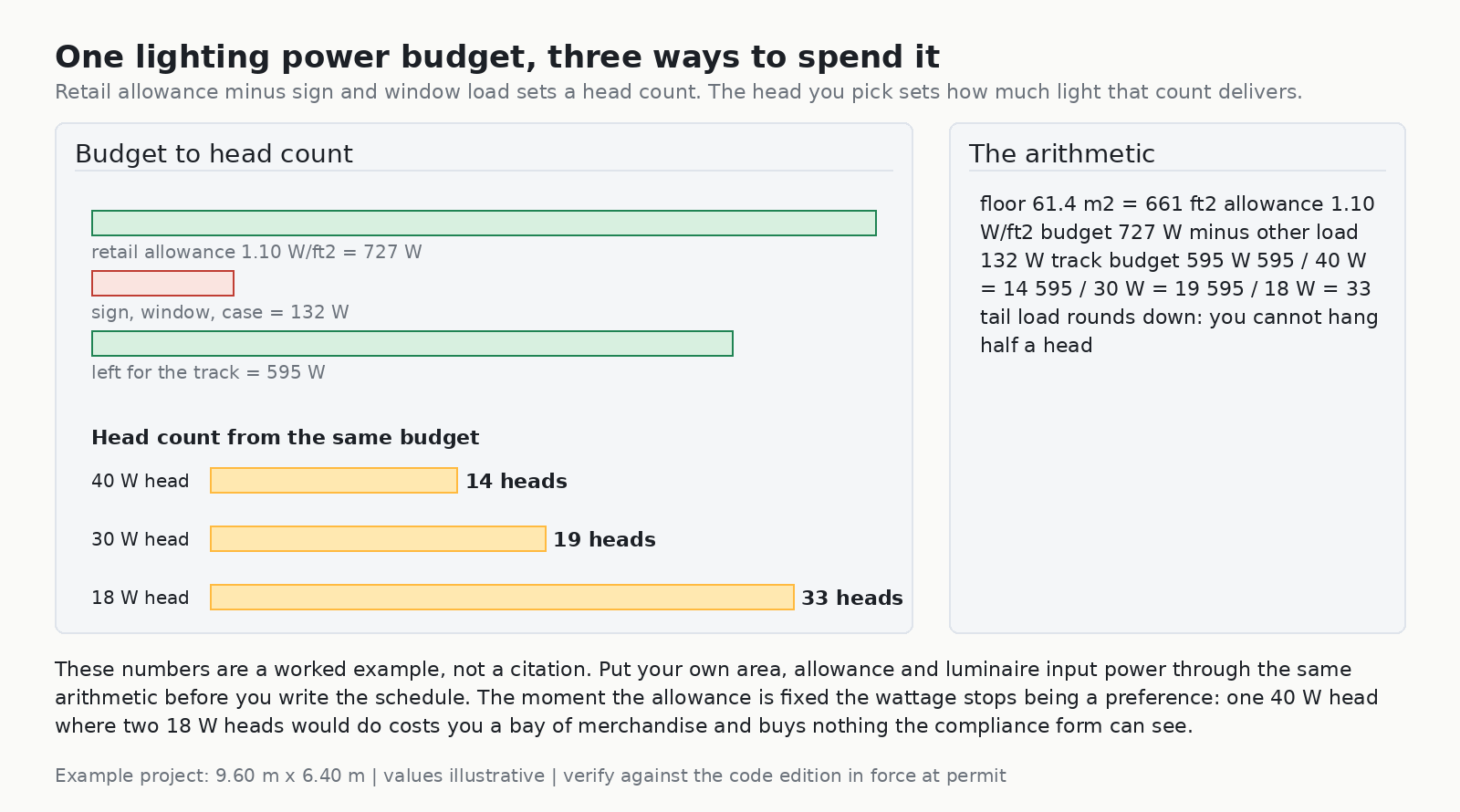
In the worked example on the drawing that is 14 heads at 40 W, 19 at 30 W, 33 at 18 W. Same allowance, same room, same merchandise. Three different designs. Three different quantities on the purchase order.
This is why the wattage conversation has to happen before the layout is frozen, and why a luminaire family with a range of wattages is worth more than one with a single wattage. On our side that range exists for exactly this reason: the AIMER 25 W / 30 W / 35 W track head and the CADIO 20 W / 25 W / 30 W track head cover a spread of about 2:1 in connected power, and the OVEGA Projector 10 W to 25 W gives you a 10 W option for the bays where you only need a pool of light on a small object. The compliance form does not care which one you pick. The shop does.
Input power, not LED power
The number that has to go on the certificate of compliance is the input power of the luminaire, driver losses included. A head sold on “20 W LED” with a 90 % efficient driver is drawing roughly 22 W at the panel once you account for the driver. Over 40 heads that is 80 W of unbudgeted load, which is more than one extra head’s worth, and it usually appears as a small panic in the week before inspection. Ask for the input wattage and the driver, in writing, before you commit the head count.
The same discipline applies to a continuous run: a linear system’s watts per metre includes everything after the driver, and the per-metre figure is what belongs on the schedule. Our note on linear track lighting for retail treats that arithmetic in detail, including why a linear run usually lands lower in W/m than a string of discrete heads covering the same shelf line.
Control requirements are where track layouts get redrawn
With track lighting, the controls question is not a nuisance at the end of the design. Track is the easiest lighting system in the building to re-zone, which sounds like a gift until you realise the zones are the item the code inspects, and the electrician can only realise the zones you drew on the plan as separate branch circuits.
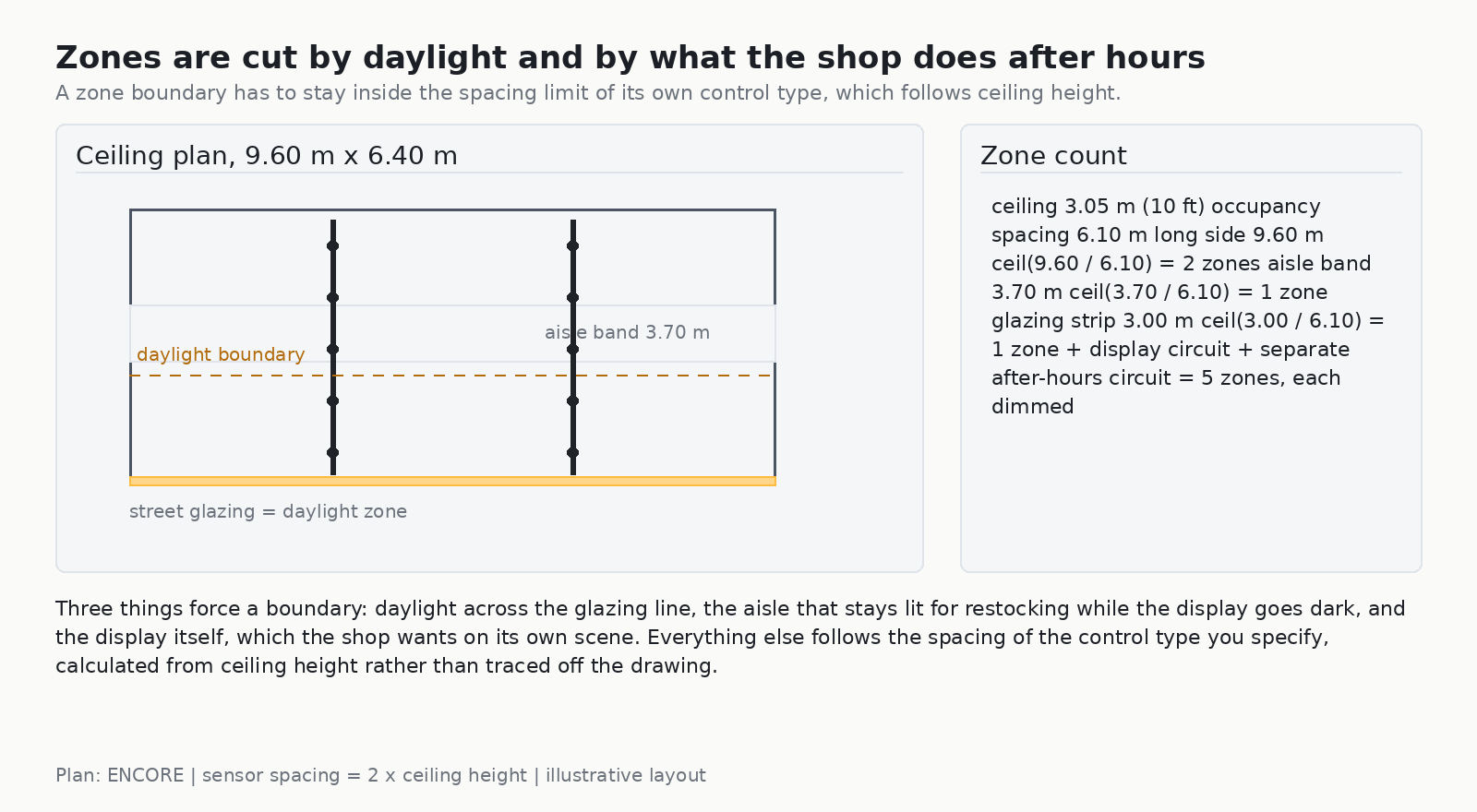
Three things force a zone boundary in a shop:
- Daylight. The band of ceiling next to the street glazing has to be able to respond separately from the rest of the floor, and it should be a zone the store can watch rather than one it discovers.
- After-hours use. The aisle stays lit for restocking and cleaning while the display goes dark. If those two sit on the same circuit, the shop either wastes power all night or restocks by phone torch.
- The display circuit itself. Feature lighting at the till and the window is generally its own circuit precisely so that it can be scenes rather than lighting.
Everything else follows the sensor spacing of the control type you specify. Ceiling-mounted occupancy sensing has a coverage radius that scales with mounting height, so the zone count is largely a function of ceiling height and the geometry of the ceiling, not of how the lighting looks in the render. If you have not yet chosen between vacancy sensing, partial-off and dimming control, the relevant question is what the space does per hour, which is what a shop floor and a stockroom answer very differently.
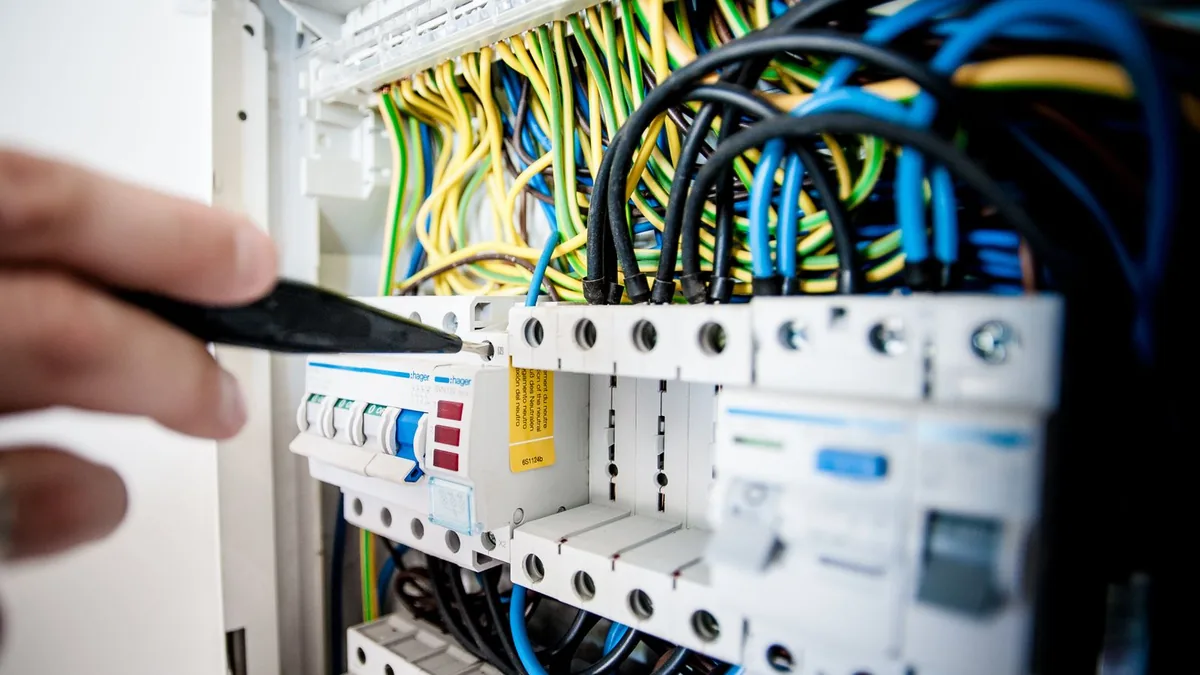
The practical habit to build: draw the lighting control zones on the ceiling plan in the same pass as the track runs, hand the electrical engineer a circuit per zone, and keep the zone count small enough that the panel schedule can absorb it. Our piece on commercial track lighting specifications walks through the layout side; the control side has to be specified at the same meeting.
The source rules that disqualify imported track heads
This is the part that most often stops a container rather than a design, and it is worth being blunt about it. The Energy Code imposes requirements on the light source, not only on the building. Two of those requirements do the damage to imported track fixtures:
Certification of the lamp or luminaire. A screw-base lamp has to be certified to the state’s appliance efficiency database before it can be sold in California, and a luminaire that ships with an uncertified lamp is a luminaire that cannot be specified. This is why a “magnetic track head with a GU10 socket and whatever lamp the factory had on the shelf” is not a product a California project should rely on unless the lamp question is answered and documented in the submittal.
Colour and quality requirements for the LED source. The Energy Code references a colour-rendering and colour-consistency standard for lamps and luminaires. In practice, that means a specification needs a CRI figure and a colour-tolerance figure, not just a colour temperature. An SDCM of 3 or better across a full run is what keeps 20 heads looking like 20 heads on the same ceiling, and it is also what keeps a colour-shift complaint out of the punch list.
Both of these belong in the RFQ, not in the shop drawing review. If you are sourcing from an OEM, our guide to cETLus certification for US and Canada importers explains why a certification mark on the driver is not the same as a certification mark on the assembly, and ETL versus cETL covers the difference between the two marks in a schedule.
A comparison table you can paste into the submittal conversation
| What the code looks at | What you control as the buyer | The mistake that costs money | What to ask your supplier |
|---|---|---|---|
| Connected lighting power against the allowance | Head count, and the input wattage of each head | Budgeting on “LED watts” and discovering the driver losses during commissioning | Input wattage per luminaire, driver included, with a tolerance |
| Control zones, sensors and shutoff | The circuit schedule, and how many zones the layout needs | Drawing a beautiful layout on 3 circuits because the ceiling looked cleaner | Whether the fixture can be fed 1-10 V, DALI or phase cut without extra parts |
| Source certification | Which lamp and which luminaire family you specify | An integrated head with an uncertified retrofit lamp inside a project in California | The lamp certification reference, and the CRI and SDCM figures in writing |
| Documents and acceptance | Who signs what, and when the fixtures arrive | Sample approval in week 2, certificate of compliance requested in week 14 | Test reports, SDCM data and driver data sheets available before order |
| Nothing at all: illuminance, glare, aim | Optic, target face, and aiming travel | Assuming compliance means the space will look right | Beam angle options and whether the head holds its aim |
Note the last row, because it is the one nobody puts on a form. Compliance and quality are separate deliverables. A room can pass every check on that first four rows and still light a shelf badly.
Where energy code compliance and optics collide
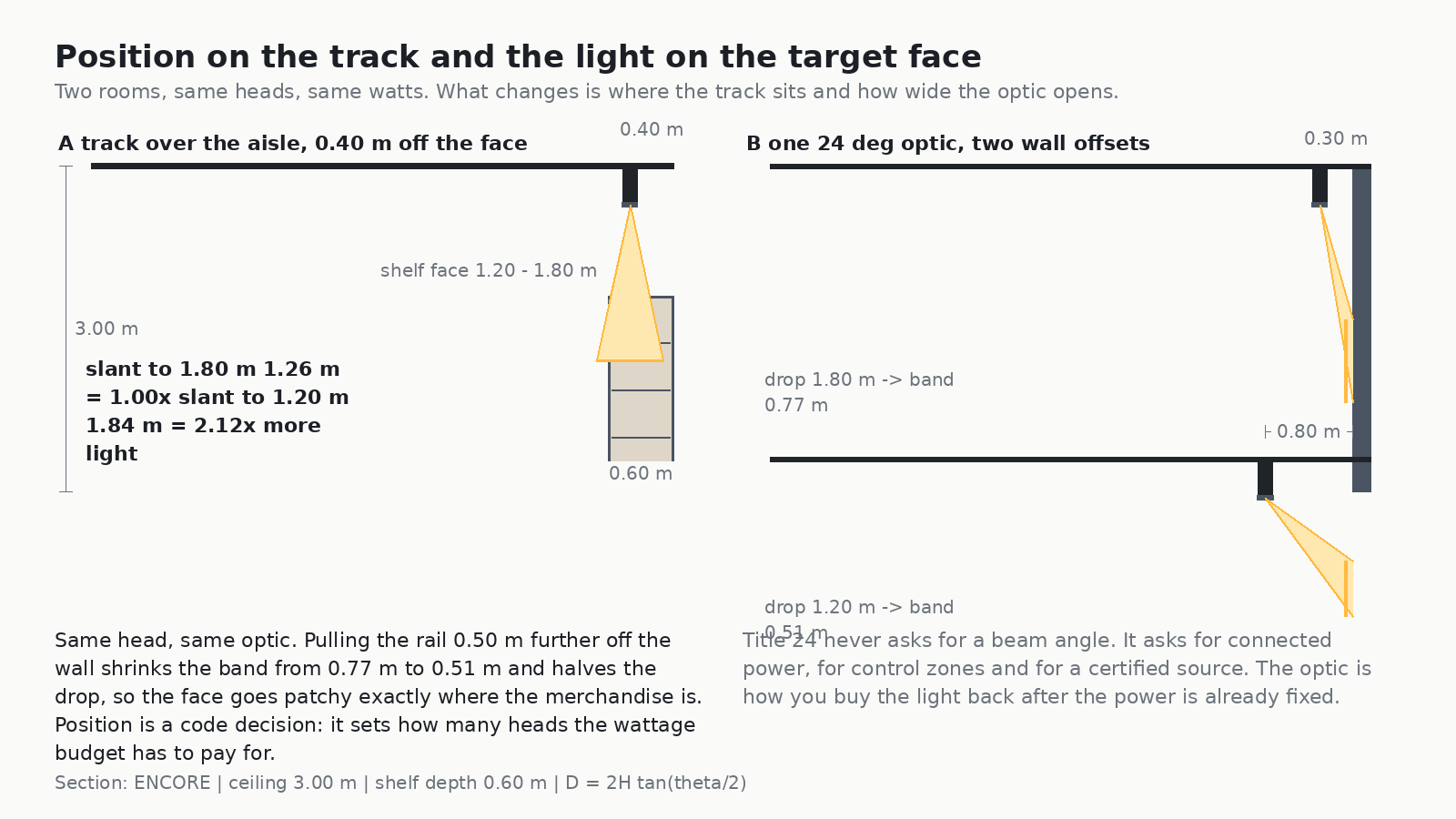
Once the wattage is fixed, the only lever left is the optic, and the optic is governed by geometry rather than by rules. On a track 0.40 m out from a shelf face, with a 3.00 m ceiling and shelf faces at 1.20 m and 1.80 m, the slant distances work out at 1.84 m and 1.26 m, and the illuminance ratio between them is 2.12 to 1. The low face gets more than twice the light of the high face from the same head.
If you then fit a beam wide enough to cover the whole face, you cover it unevenly, and the answer for the darker band is almost always more heads, which collides with the watts budget you just finished balancing. The alternative is a zoomable head that can be set narrower on the far face, or a two-position layout: one row of track for the high face and one for the low. Both cost money. The distinction worth remembering is that the first spends power and the second spends track.
The same geometry governs aiming. Two degrees of play in a track head’s tilt joint moves the spot about 105 mm on a target 3.00 m away. That is nothing at a brief glance and everything on a jewellery case, where the aim was set with the merchandise in place and the case lock fitted afterwards. A head that holds its angle with a detent rather than with friction is the difference between a commissioning visit and a second one.
For the optic-level detail on this, including how narrow a beam the far face actually needs, our retail display lighting specifications guide is the long version.
What is not in Title 24, and why it still decides whether the job succeeds
Three things a buyer expects to find in a lighting code are not there:
Illuminance targets. The Energy Code limits power. It does not tell you how bright the shelf should be. Those numbers live in the IES recommended practice series, in the owner’s brand standards, and in your merchandising plan. A compliant installation at the wrong light level is a compliant failure.
Glare and uniformity. Nothing in the energy rules looks at a shopper’s eye. Uniformity along a shelf face, and keeping the light source out of the shopper’s field of view, are design decisions that a code reviewer will never raise and a customer will never forgive.
How the system behaves after two years. Colour drift with case temperature, driver failure rate, and whether the fixture still points where it was aimed are all absent from the form and present in every store visit.
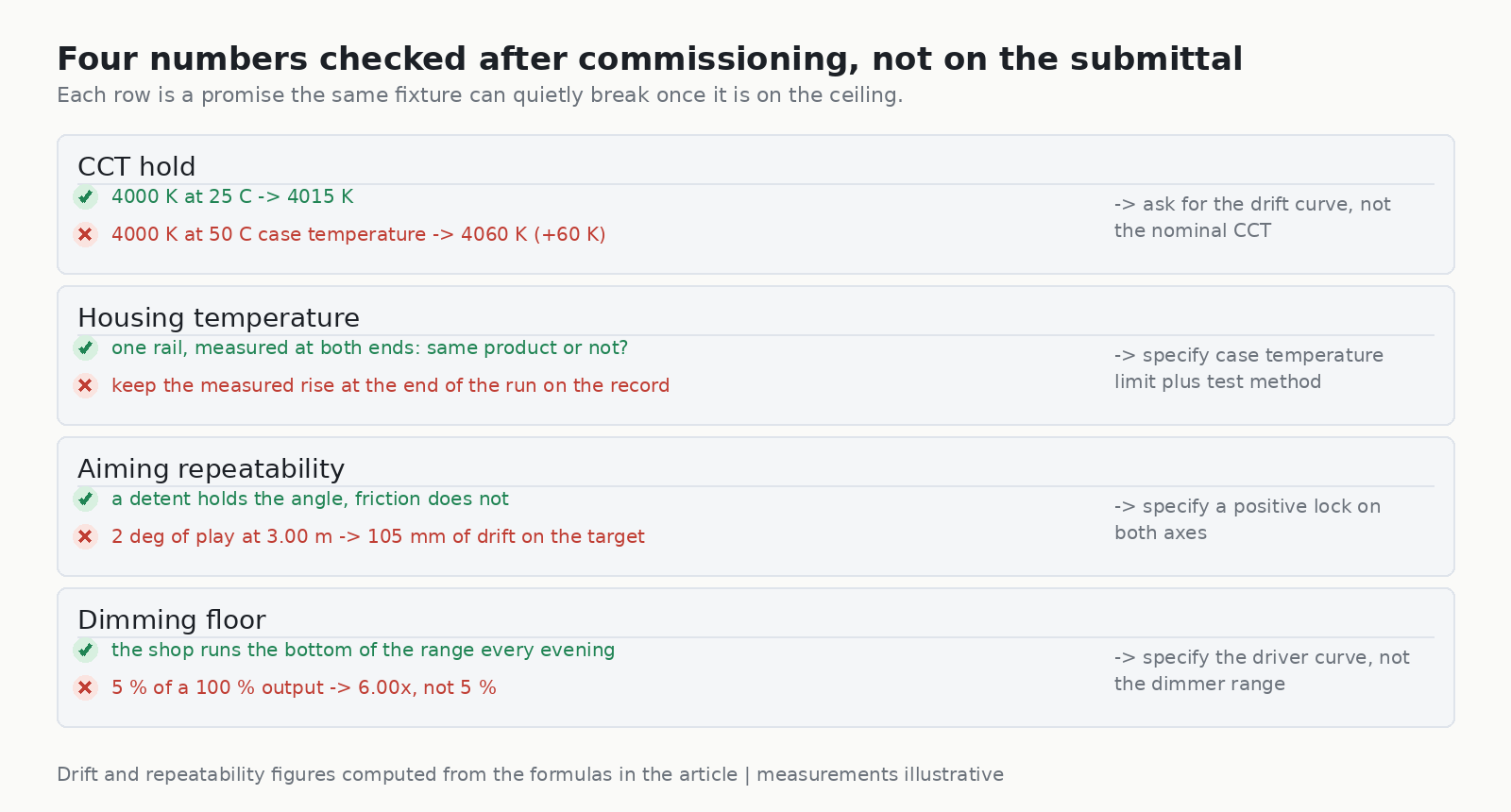
Four numbers, in that spirit, worth writing into the specification even though no code asks for them: the CCT drift allowed at the warmest part of a long run, the case temperature limit and the method used to measure it, the aiming play of the tilt and pan joints in degrees, and the actual low-end of the dimming curve. None of them takes more than a sentence. All of them are cheaper to specify than to retrofit.
If the project is a hotel or a restaurant rather than a shop, the control logic gets more demanding because those spaces are occupied unevenly across the day, which is what our hotel lobby lighting and restaurant track lighting design pieces are about. The power arithmetic is the same in all of them.
A short checklist for the week before submittal
- Take the floor area in the units the allowance is published in, and compute the budget in watts. Write the number down.
- List every load on that floor that is not track: sign, window, case, cove, signage power supplies.
- Divide what is left by the input wattage of the head you actually want. Round down.
- Check that the head count still covers the shelf line at the beam angles available. If it does not, change the optic before you change the count.
- Draw the control zones on the ceiling plan, one circuit each, and keep the sensor coverage inside its own spacing.
- Get the source certification and the colour figures in writing, with the lamp identified, not just the luminaire family.
- Confirm that whoever is signing the acceptance documents has seen the fixtures, not only the drawings.
If a step here produces an uncomfortable number, the honest answer is usually that the allowance is tighter than the merchandising plan assumed, and the fix is cheaper at step 3 than at step 7.
FAQ
Does Title 24 restrict which track heads I can buy?
It restricts the light source and imposes certification requirements rather than naming luminaires. A track head whose lamp cannot be certified, or whose colour-rendering and colour-consistency data cannot be documented, becomes very hard to justify in a California submittal. The practical effect on a buyer is the same: ask for the lamp reference and the CRI and SDCM figures in writing before you commit.
Is the compliance limit based on the LED wattage or the input wattage?
On the input wattage of the luminaire, which includes the driver. A head marketed at a lower LED wattage with a mediocre driver can land above its nominal figure at the panel, and over dozens of heads that difference is visible in the total. Always schedule the input wattage, and add a tolerance for the production units.
Do my track runs need to be on separate circuits?
The code sets control requirements rather than prescribing circuits, but a circuit per control zone is the only way to make the zones real. The three zones that nearly always deserve their own circuit in a shop are the daylight band near the glazing, the aisle that stays lit after hours, and the display or window feature lighting.
Do magnetic or low-voltage track systems comply more easily?
There is no compliance advantage in the track type itself: the same requirements apply to a 48 V magnetic system and a line-voltage system. What differs is the paperwork. A low-voltage system moves the driver off the ceiling, which can help with heat and with maintenance access, and it makes the lamp question disappear when the LED module is integrated. Our comparison of 24 V versus line-voltage track heads covers the specification differences.
Can I use decorative or vintage-style lamps in a California store?
Only if the lamp in question can be certified and documented. The screw-base rules exist precisely because retrofit lamps were being used to sidestep the standards. If the design needs a visible filament lamp for atmosphere, the lamp choice has to be resolved in the specification stage with a supplier who can name the certified lamp, not discovered at installation.
What happens if the inspection finds the lighting over the allowance?
It stops the sign-off, and the remedy is physical: fewer heads, lower-wattage heads, or a different compliance path with the modelling that supports it. This is why the head count arithmetic belongs in design, when changing it costs a drawing revision rather than a second site visit.
The short version
Title 24 and the California energy codes do not tell you how to light a shop. They tell you how many watts you may connect, how the lighting must be controlled, what has to be certified, and what has to be documented. Those four constraints land on the track system as an arithmetic problem, and the arithmetic has a habit of deciding the head count before anyone has drawn a beam angle. Get the input wattage, the circuit schedule and the certification documents right early, and the optic conversation afterwards is a design conversation instead of a rescue.
If you are putting together an RFQ for a California project and want a head count run against your own area and allowance before the numbers are frozen, send us the floor plan and the space types. Our team can come back with an input-wattage table, a control-zone sketch and the certification documents for the relevant families. Start with the track light range, or go straight to the enquiry form.
Compliance note: this article describes how energy code requirements interact with track lighting hardware. It is not legal advice and does not certify any installation. Verify the requirements of the code edition in force at the time of permit with your authority having jurisdiction, and treat every wattage and area figure on this page as a worked example to be replaced with your own project data.