
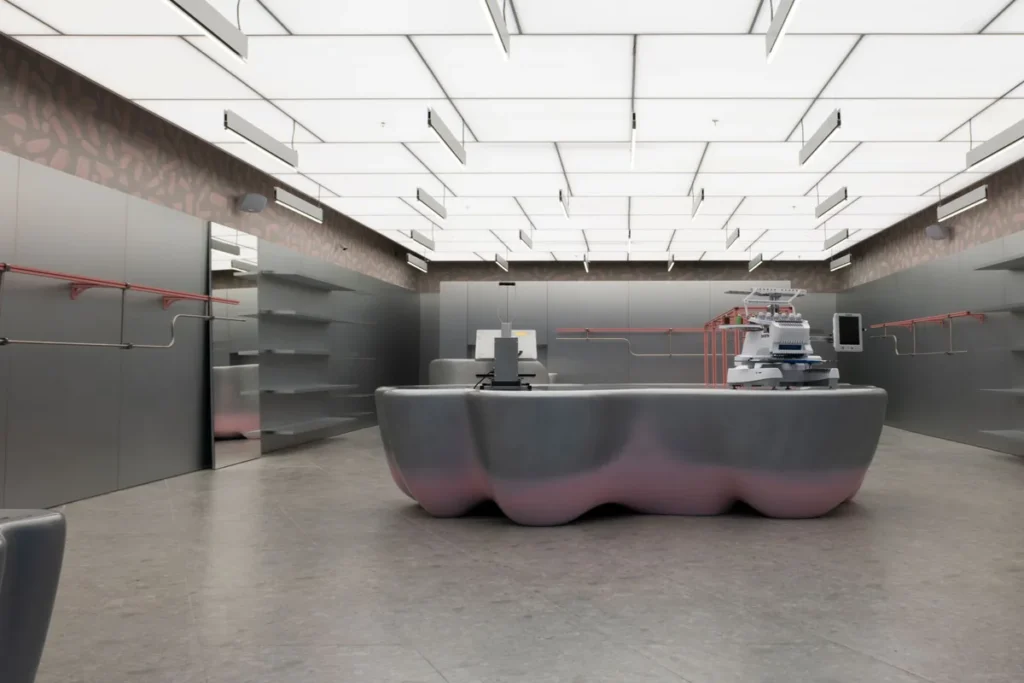
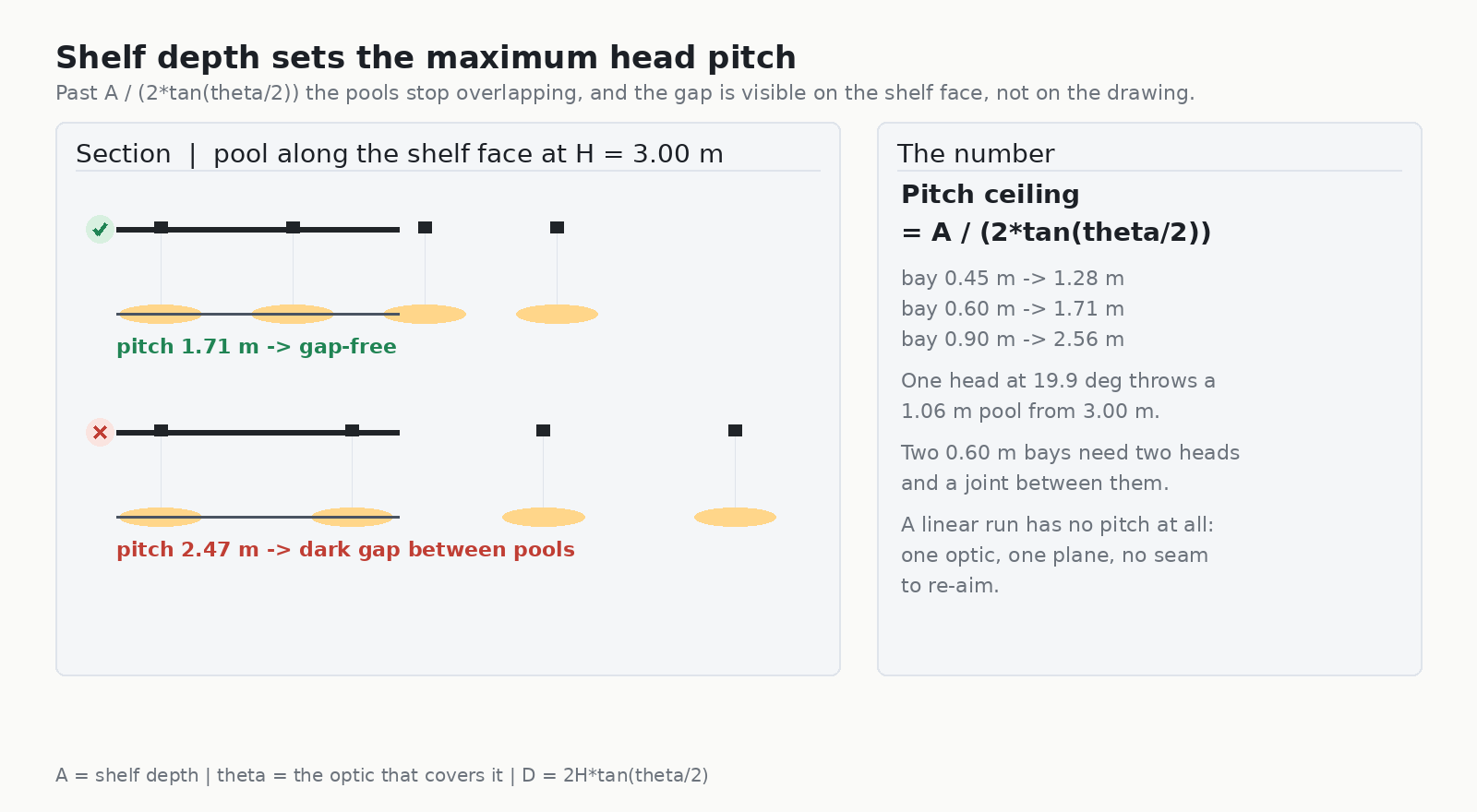
Linear track lighting for retail is the layout where one continuous rail carries dimmable linear modules down the length of the sales floor, instead of a string of individual heads each throwing its own circle of light. It solves the problem every head layout runs into at scale: the pools only overlap if the pitch stays under A / (2·tan(θ/2)), where A is the shelf depth. Once the bay is wider than the optic can cover, the goods get a rhythm of bright spots and dark gaps, and the merchandiser spends the season moving products into the light instead of the other way round. On a 3.00 m ceiling, a 20° optic gives a 1.06 m pool — enough for two 0.60 m bays, not enough for three. A continuous run has no pitch to get wrong.

Why a retail linear track replaces a run of heads
A track head is a good tool for a single object: a mannequin, a hero pedestal, one handbag on a plinth. It is a poor tool for a surface that repeats 20 times down a wall. Two things break at scale — the geometry of the pools and the arithmetic of the schedule.
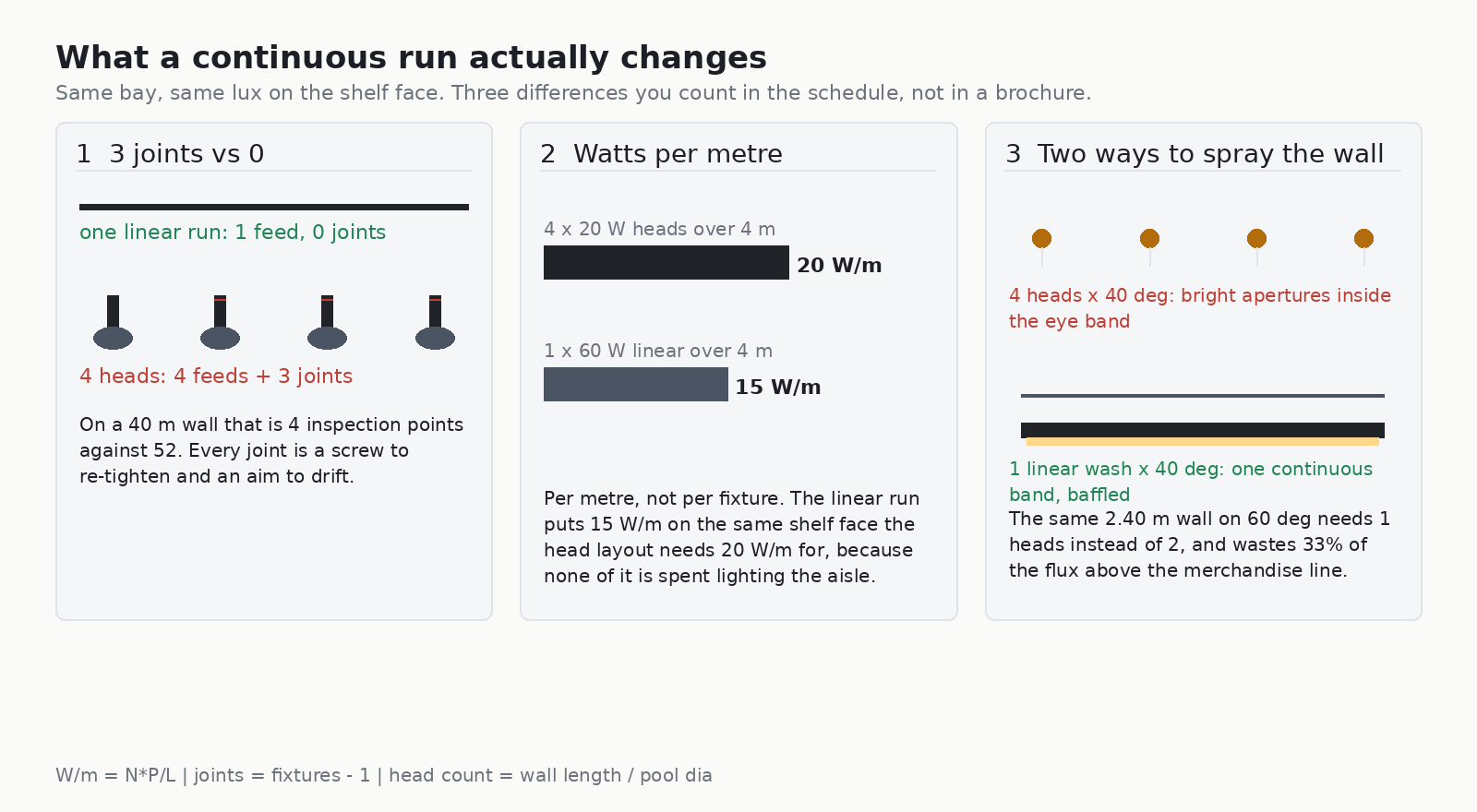
The geometry is unforgiving. Every head produces a circle, and circles cover a rectangle only where they overlap. Go past the overlap threshold and the shelf reads as a series of bright discs with dark leather between them; go under it and you pay for light that lands on the floor. The schedule breaks in the same direction: four heads along a 4.00 m shelf is 4 feeds, 3 joints, 4 adapter boxes and 4 aiming decisions, and every one of them drifts a little each time a merchandiser changes the display.
How much shelf line one linear run actually covers
Start from the plane you are lighting, not from the fitting. Three numbers do all the work.
Shelf depth sets the optic
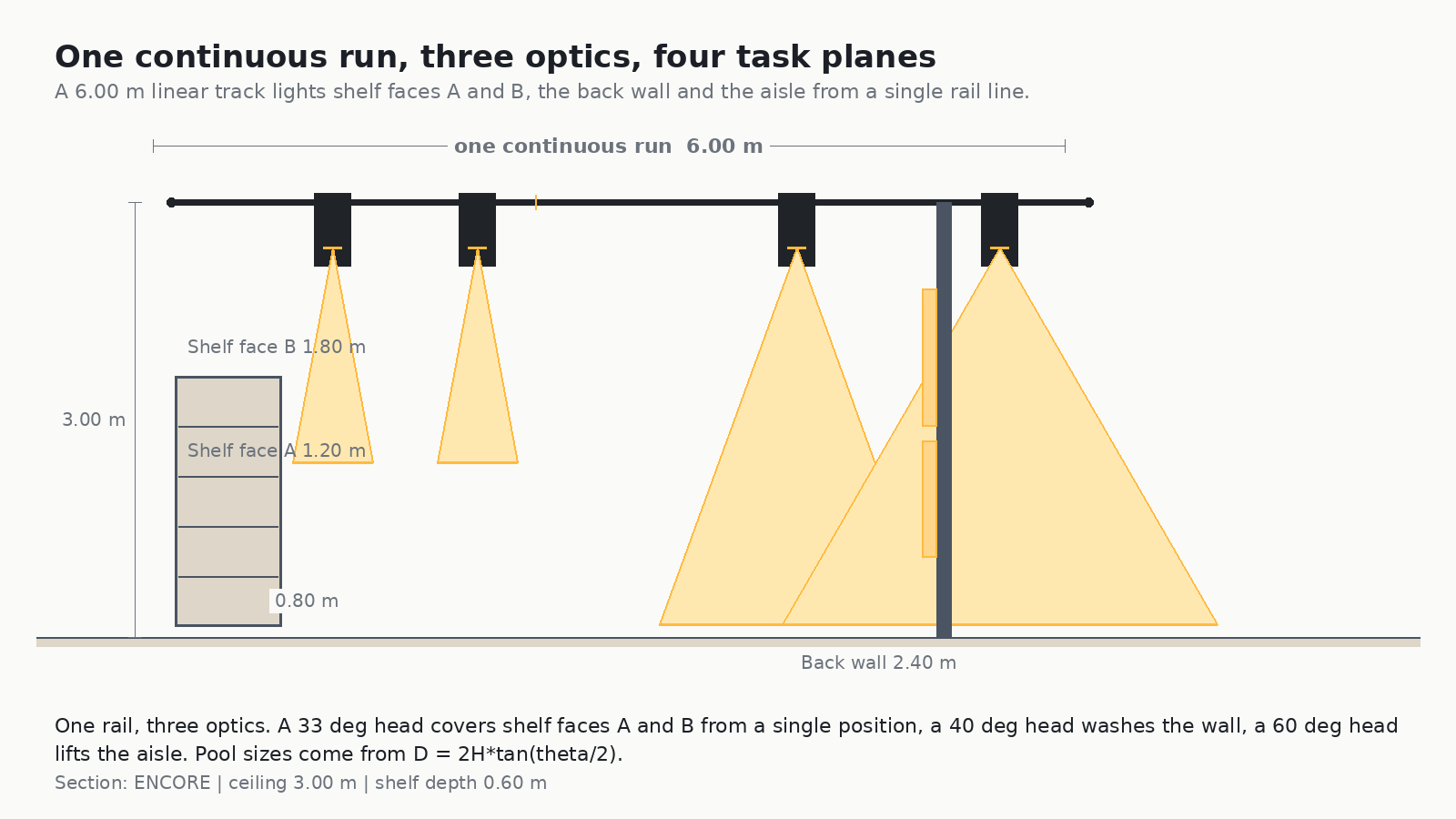
Take a gondola with 0.60 m bays facing an aisle and a rail line 0.80 m out from the shelf face, 3.00 m above the floor. The head is 1.80 m above a face at 1.20 m and 1.20 m above a face at 1.80 m, so the two slant throws are √(0.80² + 1.80²) = 1.97 m and √(0.80² + 1.20²) = 1.44 m. Both faces are served by one head on one rail because the rail sits off the shelf line, not above it.
That is the whole argument for setting the rail out from the shelf line: the oblique throw costs illuminance — it falls with the square of the slant distance and again with the cosine of incidence — but it buys the off-axis reach that lets one head cover two planes. Squared, the two throws differ by 1.87×, so the face at 1.20 m receives about twice what the face at 1.80 m receives. That deficit is intentional: the upper face sits nearer the shopper’s eye, and a face lit as hard as the one below it reads flat and blows out the highlights on folded stock.
The optic has to fit the bay
The pool that must sit on the shelf face is one bay deep plus the tolerance of the aisle edge: call it 0.70 m. Solving θ = 2·arctan(A / 2d) for a 1.97 m throw gives a per-head requirement of about 20°, which is exactly where the shelf module lands. Anything narrower leaves a gap between bays; anything wider spills onto the floor.
| Shelf face height | Slant throw | Optic to cover 0.70 m | Pool at that throw | Illuminance index |
|---|---|---|---|---|
| 0.90 m | 2.23 m | 17.9° | 0.70 m | 1.00 |
| 1.20 m | 1.44 m | 27.3° | 0.70 m | 2.39 |
| 1.50 m | 1.53 m | 25.8° | 0.70 m | 2.13 |
| 1.80 m | 1.97 m | 20.2° | 0.70 m | 1.29 |
| 2.10 m | 2.15 m | 18.5° | 0.70 m | 1.08 |
Read the index column as relative illuminance for the same head: a face at 1.20 m gets 2.4× what a face at 0.90 m gets. This is the number that decides where you can afford a wide optic and where you must not. It is also why the accent-to-ambient ratio you actually measure on site never matches the one in the spec: it was never constant with height.
Continuous runs remove the pitch question
A linear module does not produce a circle. Its aperture is a slit, so its coverage is a band whose length equals the module and whose depth equals the throw times the diffuser angle. The only remaining decision is where the band sits, and the diffuser or grill choice sets it: a 60° grill throws the band about 2.1 m deep from 3.00 m, a 100° diffuser about 7.1 m. Set the band to cover the shelf face plus half the aisle and the coverage is even end to end, bay after bay.
Retail linear track versus track heads: what changes in the schedule
Joints, feeds and failure points
A 4.00 m shelf with 4 heads carries 4 feeds and 3 joints. The same 4.00 m with one linear module carries 1 feed and 0 joints. Along a 40 m perimeter wall that is 52 potential failure points against 6. Every joint is a place where the contact drifts, the polarity gets reversed on a re-fit, or the aim moves when a cleaner bumps the rail. The maintenance figure on a linear run is usually reported from the first year of operation, not from the datasheet.
Watts per metre instead of watts per fitting
A head layout answering 20 W per fitting over 4.00 m is 20 W/m. A linear run delivering the same shelf-face illuminance typically lands at 12–15 W/m, because none of its flux is spent lighting the aisle behind the shopper. Ask for the figure in W/m plus the delivered lux at the plane, and you can compare two quotes in one line. Ask for watts per fitting and you will be comparing the wrong quantity, politely.
Two ways to light a wall
You can spray it obliquely from heads on a rail 1.20 m out, or wash it perpendicularly from a linear run 2.40 m out. Same head, same 40° optic: the oblique position has a slant distance of 1.70 m instead of 2.40 m, and because illuminance falls with the square of the distance and with the cosine of incidence, the oblique wall receives 2.83× the light. It sounds like a free win until you look at the pool: the same 40° optic covers 1.75 m at 2.40 m and only 1.24 m at 1.70 m, so the oblique rail needs more heads to keep the wall even, and every one of them is a bright aperture inside the shopper’s field of view.
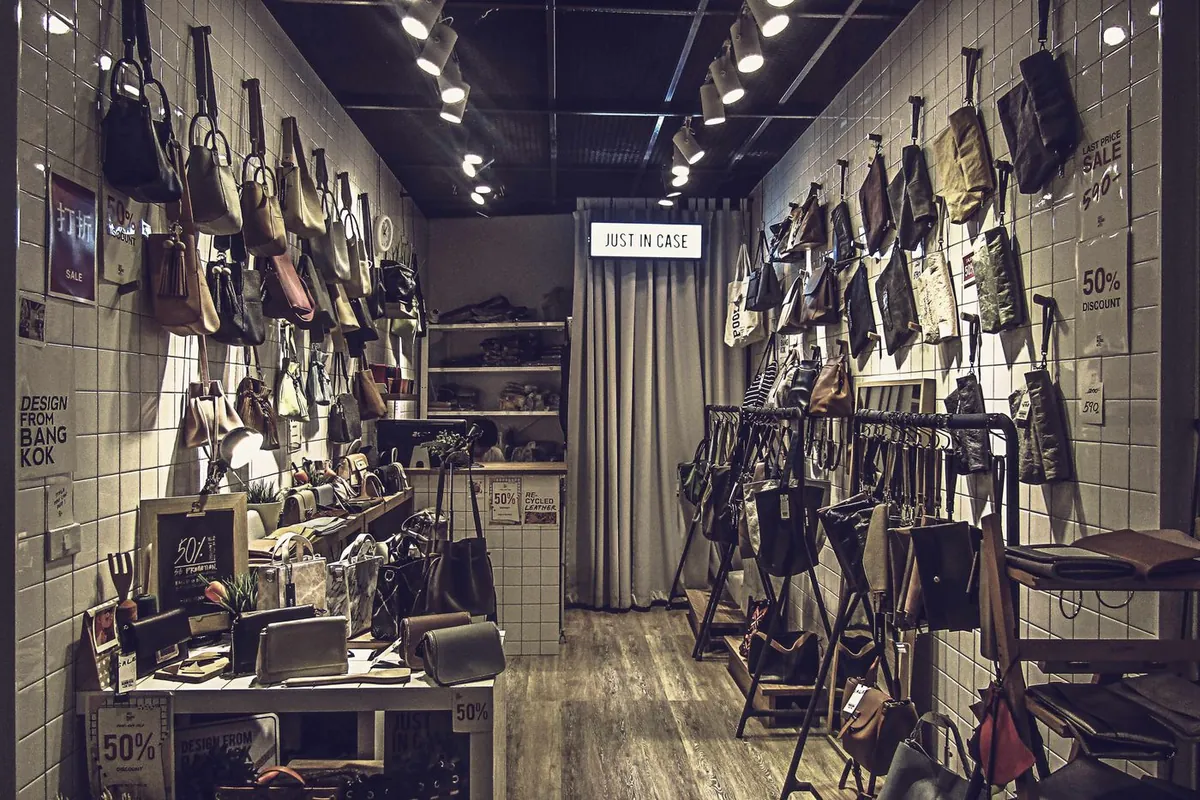
Where a linear track is the wrong answer
It would be dishonest to sell the continuous run as universal. Three cases where heads still win:
Single hero objects and window plinths
A window with two mannequins and one handbag does not need even coverage; it needs a 10–15° pool with a hard edge and a dark surround. A linear band flattens exactly the contrast that makes a window work. Use one narrow head per object and accept the pitch irregularity — there is nothing repeating.
Convention centres and pop-ups
If the whole fit-out has to come down in three days and travel in a van, a portable track with heads packs smaller than 1.2 m aluminium extrusions. Exhibition booths and rental showrooms belong here; see our portable track systems guide.
Ceilings that will not take a run line
Exposed services, low soffits and coffered plaster all break the line. A continuous run at 2.40 m through a coffered ceiling looks like a mistake, and it usually is. Either step the run down to a pendant height or go back to heads mounted in the coffers.
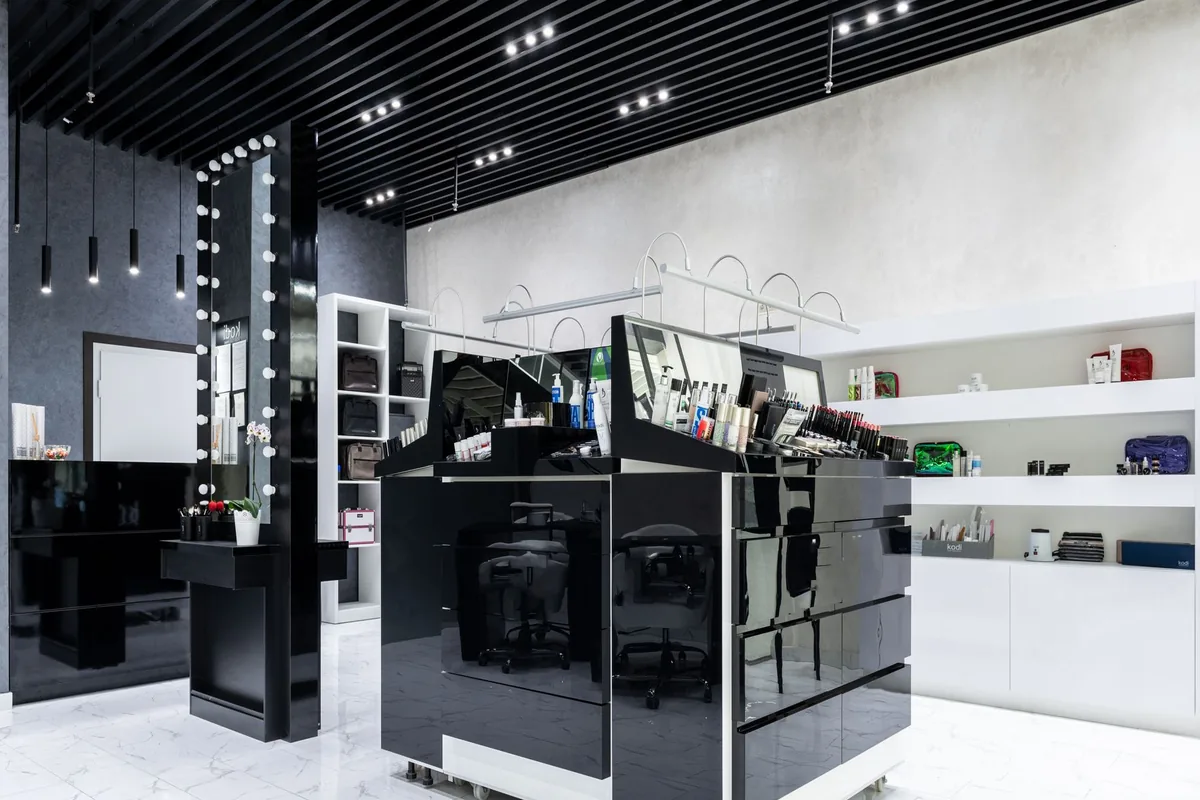
A 3.00 m ceiling, drawn end to end
Here is the working drawing for a 28 m × 12 m apparel floor at a 3.00 m structural ceiling, with a white metal deck above and no suspended grid.
Runs and spacing
Four runs along the long axis at 3.00 m centres, each 26 m long, at 2.90 m finished height on a 100 mm pendant drop. Each run is a 2.4 in linear module with a 60° grill, mounted over the shelf line 0.80 m out from the gondola face, so the coverage band lands across the shelf and onto the aisle but never behind the rail.
Zoning and control
Split each run into 3 m segments on three circuits: window and entrance on circuit A with a 1.5% floor on the dimmer, shelf faces on circuit B at 100% during hours, aisle on circuit C at 60% as ambient. Wire the window circuit to a separate astronomical timer — a shopper walking past at 21:00 sees the window, not the floor.
Delivered figures
| Zone | Vertical lux on the goods | Ratio to aisle | What it buys |
|---|---|---|---|
| Window / entrance | 1,500–2,000 | 12:1 | The 1.5-second read from the street |
| Shelf face B (1.80 m) | 700–900 | 6:1 | Colour and texture at eye height |
| Shelf face A (1.20 m) | 500–700 | 4:1 | Price tags and fold detail |
| Aisle floor | 150–250 | 1:1 | Navigation, no glare into the eye |
| Fitting room surround | 300–400 | 2:1 | Face-flattering, 100 K warmer than the floor |
Check the whole spec against the fitting room mirror, not the plan. A fitting area lit from behind the shopper returns a face in shadow, and a 200 lux shortfall there reads as a 500 lux shortfall in the mirror.
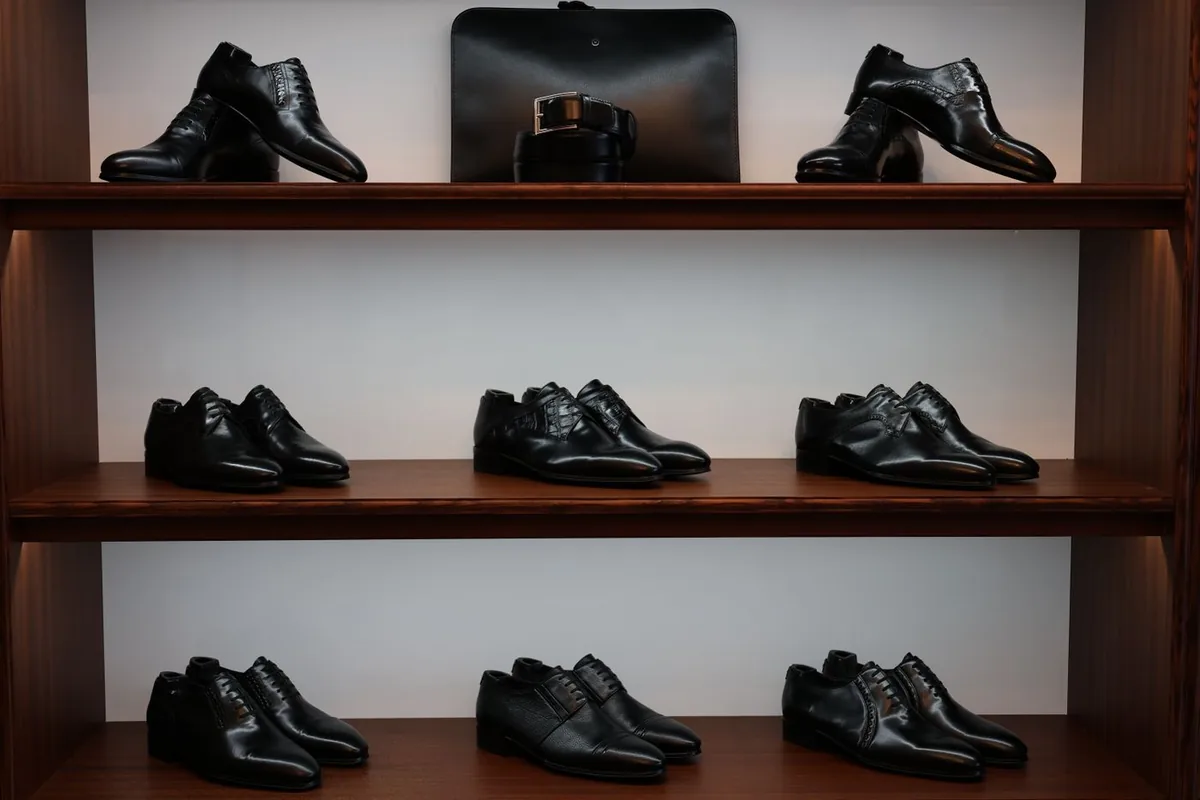
Where the aiming usually goes wrong
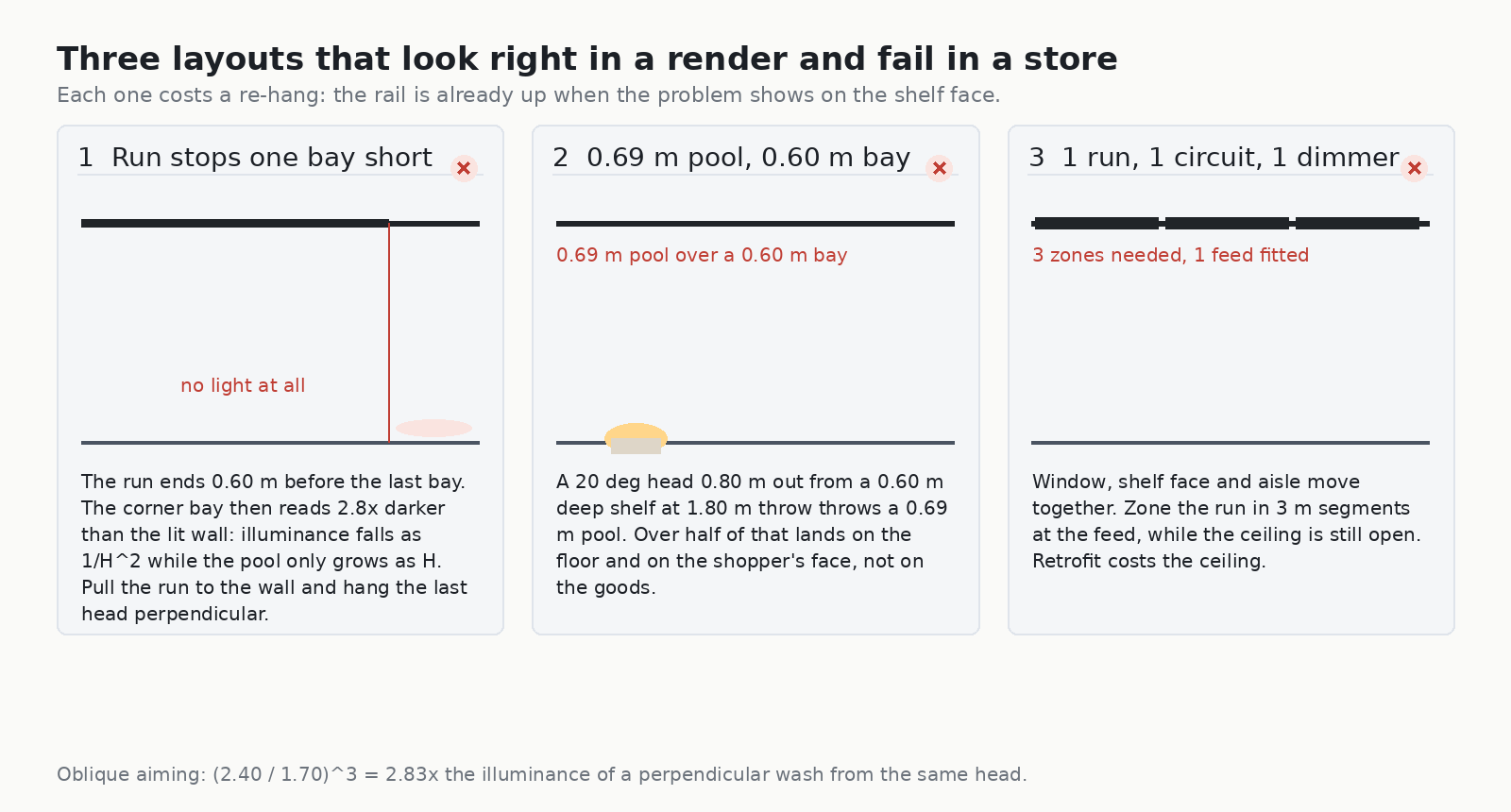
The run that stops one bay short is the most common. It happens when the rail is ordered in 2.4 m modules for a 26 m wall and the last 0.60 m gets a blanking plate. The corner bay is the one the shopper sees first, and it is the one with the least light; the oblique penalty here is 2.8×.
The second is mounting the rail too far out. Four metres of aisle look generous on plan and put the head 1.20 m from a 0.60 m shelf, at which point the same optic throws a 0.69 m pool — three quarters of it on the floor — and the shopper gets the glare that the floor gets the light.
The third arrives after handover, when someone discovers that the whole line dims as one. Zone at the design stage; it costs a three-core cable and a second driver, and it is impossible to retrofit without opening the deck.
Choosing the hardware
Four things decide whether a linear run works in a store:
Optics, not wattage. Ask for the delivered angle at the plane: a 60° grill puts a 2.1 m band from 3.00 m, a 100° diffuser 7.1 m. Both are legitimate; only one covers a shelf face without spilling behind the rail.
Joining and continuity. The run must be mechanically continuous — L, T and X connectors, and a feed that can be placed anywhere on the run rather than only at the end. A run fed only from one end loses a voltage window and nobody will tell you until the far end is 3% dimmer.
Dimming depth. A 1% floor matters in a store with a 12:1 accent-to-ambient ratio; a dimmer that stops at 10% cannot produce the window scene. Specify Triac, 1–10 V or DALI at the fixture, and check that the driver is inside the extrusion rather than in a ceiling void you cannot reach.
Colour consistency. SDCM ≤ 3 across every module on the run. A run is one continuous surface, so a 3-step bin shift on module 7 shows as a visible patch — something a head layout hides, because each head is already isolated by shadow.
For the rail side, the track light range covers the system components and adapters; the linear side is where the optics decisions live:
- SLEM 2.4in linear light system — 2/4/6 ft modules with 100° diffuser or 60° grill, 20/40/60 W, L/X/T connectors for continuous runs.
- ATRO 26mm linear light system — slimmer 960/1200/1800 mm modules, grill optics from 20° to 60° plus 20°×20°, for tighter ceilings.
- OVEGA wall washer 10–20 W — 25°×75° asymmetric optic for the back wall where a linear band cannot reach.
- CADIO track light 20–30 W — interchangeable 15°/24°/38°/60° reflectors and a separate driver compartment, for the hero and window positions a run cannot serve.
For the pattern this replaces, and the layout numbers behind it, see the retail display lighting spec guide (beam-to-pool maths, lux targets per zone) and clothing store track layouts (rail and wall layouts for apparel). If the run has to be continuous across a structural joint, the system choice matters: see 24 V versus line-voltage track systems. Lux targets by space type, including retail, are tabulated in commercial lighting lux levels by space.
FAQ
How many linear metres of track lighting does a retail store need?
One run per shelf or wall line, not per square metre. A 28 m × 12 m floor with four gondola runs facing aisles takes four 26 m runs, roughly 104 m of profile. As a first pass, allow 1 m of linear track per 3 m² of sales floor and adjust by how much vertical merchandise wall you actually have.
Can I mix a continuous linear run with track heads?
Yes, and most good stores do. Put the run over the repeating shelf line, and use heads — 10–15° for windows and mannequins, 24° for island tables — where the merchandise is a single object. Feed the run and the heads from different circuits so the window can stay up after hours without lighting the floor.
Is 60° or 100° better for a shelf face?
60° grill for shelf faces and aisles in the same room, because it puts a 2.1 m band from 3.00 m and keeps the light off the rail line behind it. 100° diffuser for a low ceiling where the run sits close to the wall and you want a wide, soft gradient rather than a defined band. If the ceiling is above 4.00 m, neither — the band gets too deep and you lose control of the wall.
What colour temperature for a retail linear track?
3000 K for apparel, cosmetics and anything where skin or fabric colour is the product; 3500 K for denim, sportswear and modern neutrals; 4000 K only as a deliberate fast-fashion decision, because it greys ivory and camel. Keep every module on one run within the same 3-step MacAdam ellipse, and keep the fitting room within 100 K of the floor.
How do I dim a retail linear run?
Dim per circuit, not per run. A 12:1 accent-to-ambient ratio needs a driver that reaches 1% without flicker; if the spec says 10%, the evening scene will be a compromise. Ask for the dimming protocol at the fixture — Triac for retrofit, 1–10 V for simple zoning, DALI where the store has a building management system.
Does a continuous run have to be one length?
No. Modules join mechanically with L, T and X connectors, and the electrical feed can sit anywhere on the run. Two practical limits: keep each circuit under the driver’s rated load, and keep the number of joints low enough that a 40 m wall does not become a maintenance list — which is the whole reason to use the run in the first place.
The short version
Linear track lighting for retail is what you specify when the merchandise repeats. One rail, one optic, one band of light down the shelf face, no pitch to calculate and no joints to re-aim. Keep heads for the objects that deserve a circle — the window mannequin, the hero plinth, the display table — and give the rest of the wall a line. If you are laying out a fit-out and want the run lengths, optics and lux figures checked against your ceiling, send us the plan and we will come back with a schedule rather than a catalogue page.