
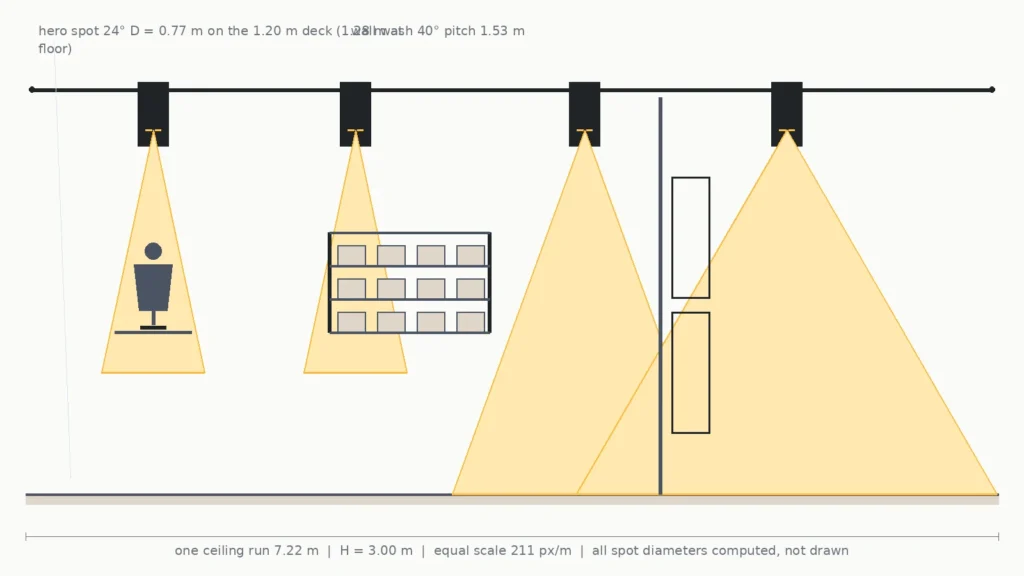
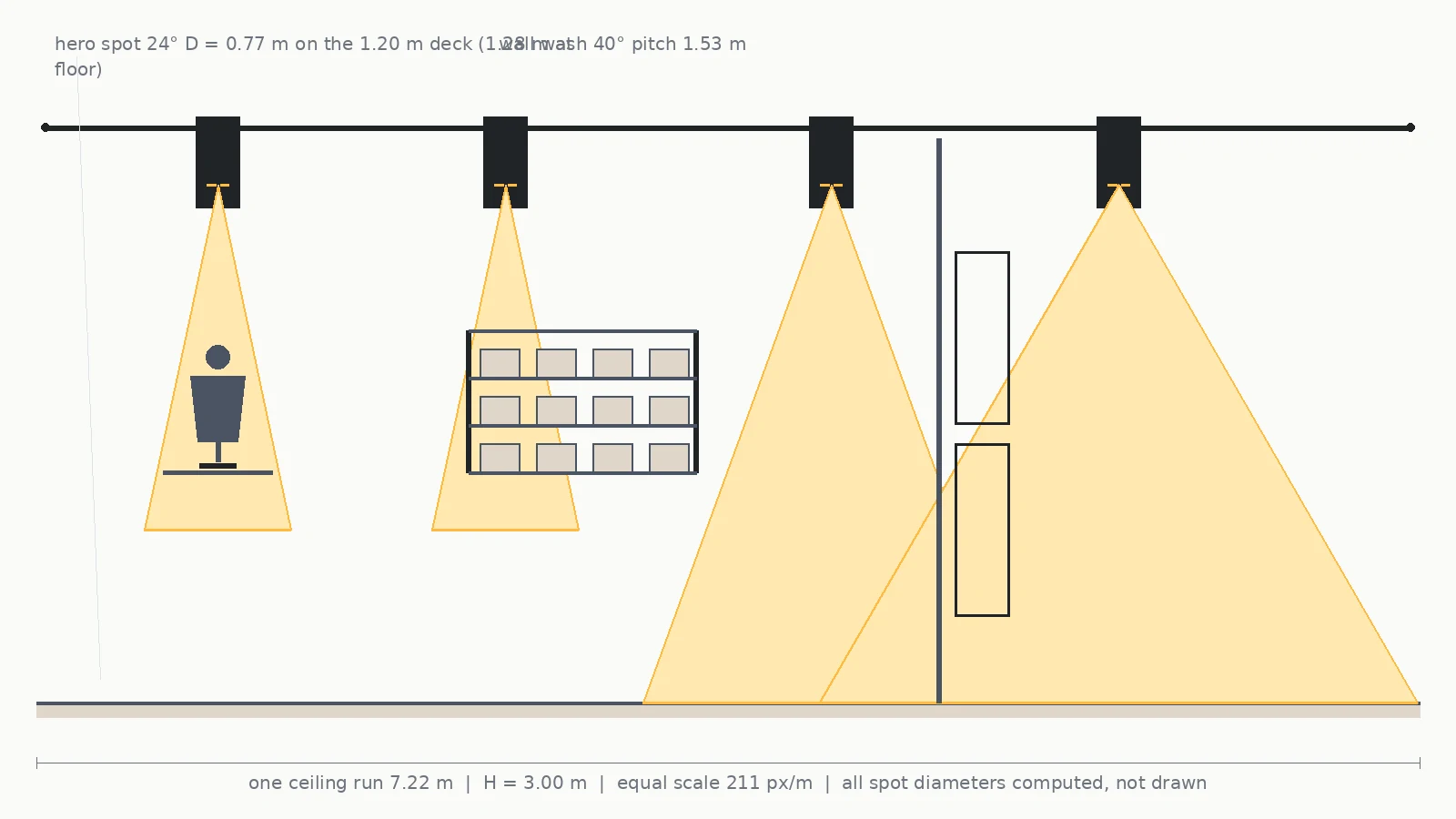
Retail display lighting is the only salesperson in your store that works every second without a script. This guide goes past the usual “use accent lighting” advice and gives you the numbers behind a retail display lighting plan: how many lux a hero item needs, what beam angle isolates it, how far apart the heads must sit so a wall reads as one wash instead of a row of scallops, and how to keep a 3 m head out of a shopper’s sightline. Everything below is computed from the same formulas we use on live jobs, so you can reproduce each figure with a tape measure and a light meter.
If you are fitting out a boutique, a footwear wall, a cosmetics counter or a department store end cap, the physics is identical. What changes is the target lux, the colour temperature and the beam angle. Get those three right, and a $40 head outperforms a $400 one aimed badly.

Why Retail Display Lighting Is a Geometry Problem, Not a Wattage Problem
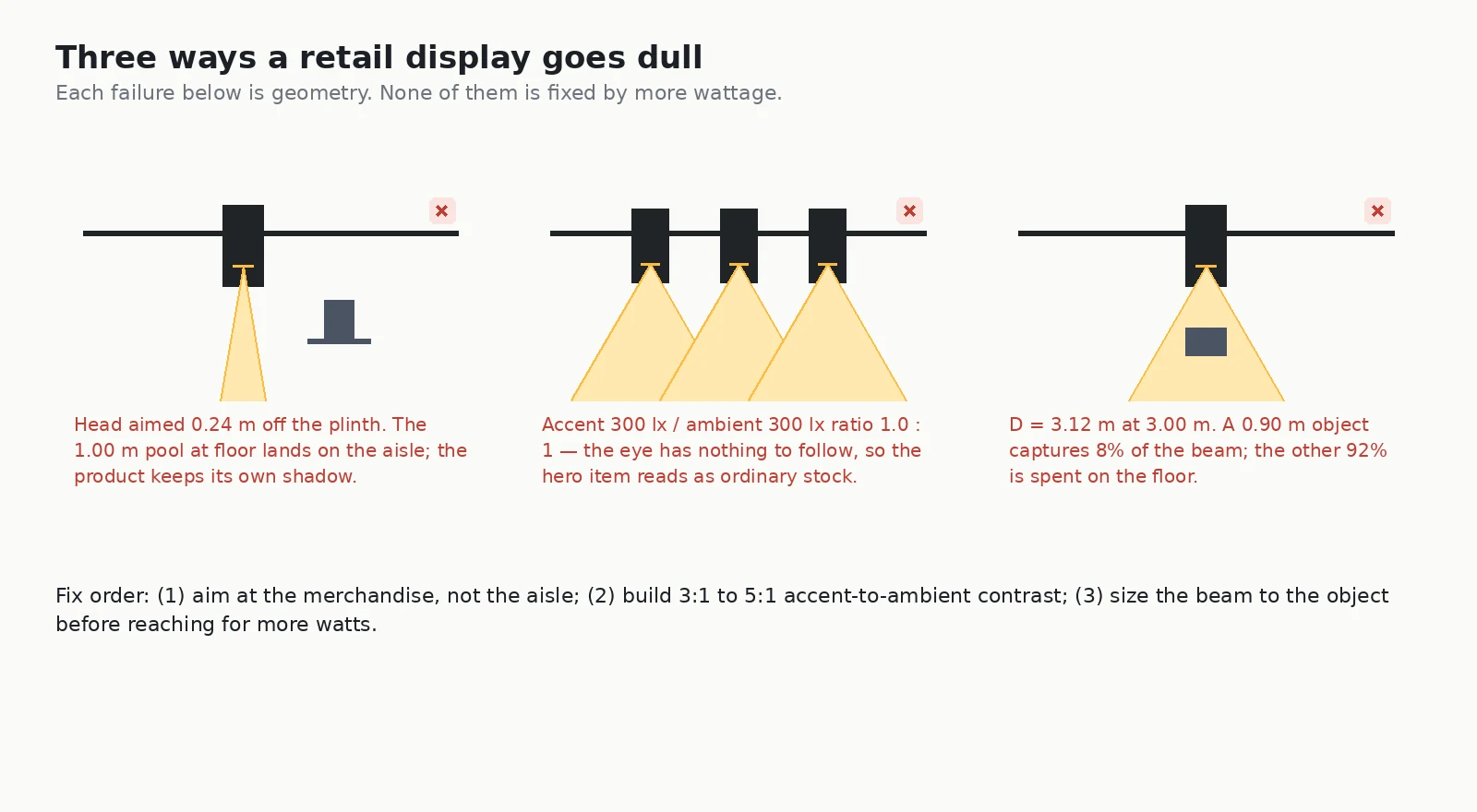
Most dull retail lighting is not under-powered. It is mis-aimed. A 30 W track head pointed 240 mm off a plinth throws its entire pool onto the aisle and leaves the product in its own shadow — the fixture is doing exactly what it was told, and the shopper walks past.
Three geometric levers decide whether a display reads as premium:
- Pool size — the diameter of light that actually lands on the merchandise, set by beam angle and throw distance.
- Contrast ratio — how much brighter the hero item is than its surroundings. Without contrast there is no hierarchy.
- Cut-off angle — whether a shopper standing 3 m away sees the product or the lamp.
Wattage only decides how bright the pool is. It cannot move the pool, sharpen the contrast, or hide the source. That is why a fixture swap alone rarely fixes a flat display.
Beam Angle: Sizing the Pool to the Product
Everything in retail display lighting starts with one equation. You will use it more than any other:
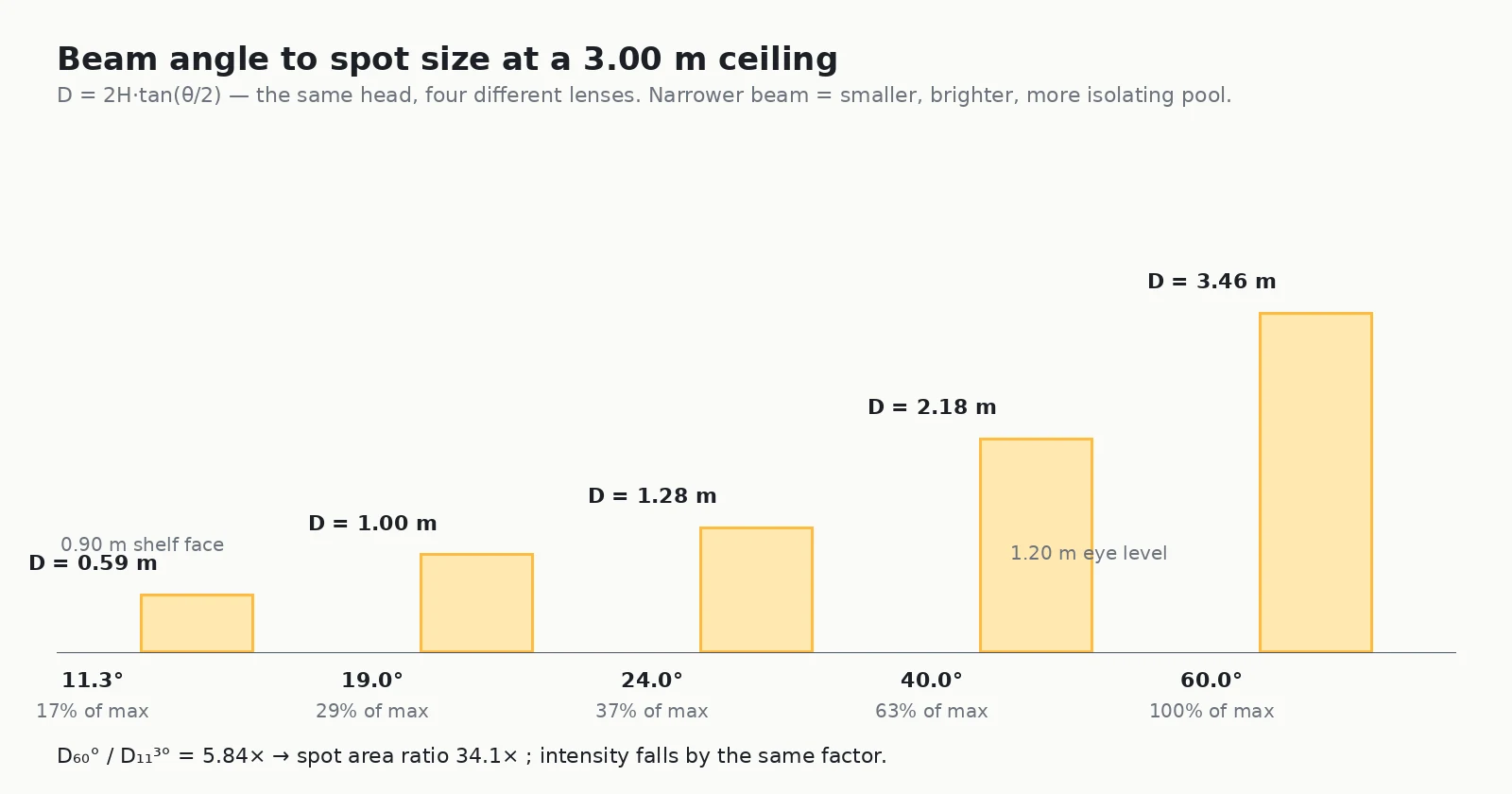
D = 2H · tan(θ/2)
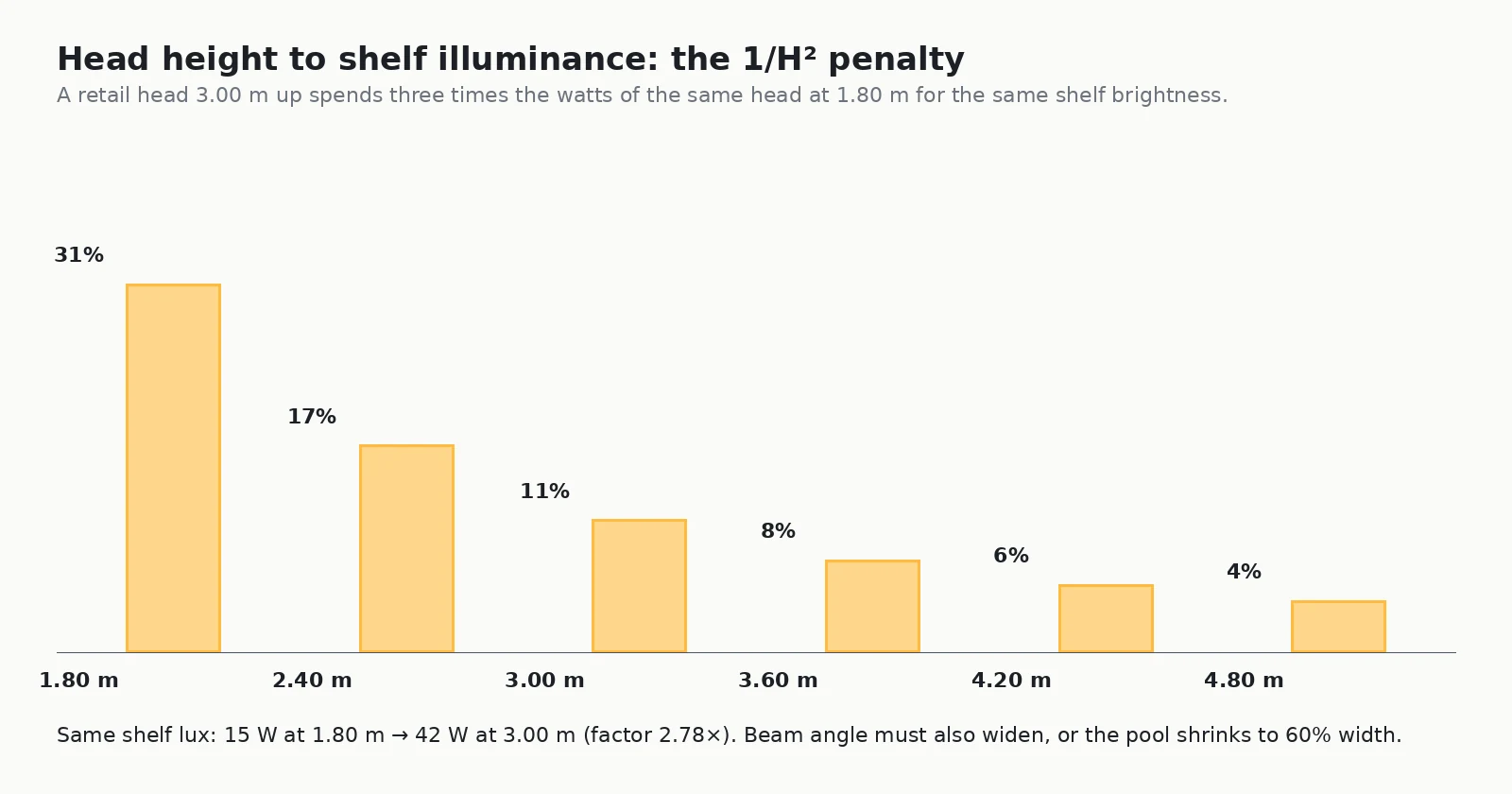
Where D is the circular pool diameter, H is the perpendicular distance from the lens to the surface you are lighting, and θ is the beam angle. Two things about this formula surprise people. First, pool size grows linearly with distance but not linearly with angle — the tangent does that. Second, intensity falls with the square of the distance, so a head raised from 1.80 m to 3.00 m loses 64% of its illuminance on the shelf.
Here is the same fixture fitted with five different lenses at a 3.00 m ceiling:
Matching Beam Angle to Merchandise Size
Work backwards from the object. If your hero item is 0.40 m tall and sits on a 0.90 m plinth under a 3.00 m ceiling, the throw is 2.10 m. To fill that object with light you need a pool of roughly 0.45–0.55 m, which means:
θ = 2 · arctan(0.50 / (2 × 2.10)) = 13.6°
That is a narrow spot. Retail floors are full of 60° flood heads doing the work of a spot — which is why the light lands on the floor instead of the product. A 60° lens at 2.10 m makes a 2.42 m pool, so a 0.40 m object receives roughly 2.7% of the beam. The other 97% is decoration.
What Each Lens Is Actually For
- 8°–15° — jewellery, watches, small electronics, single-shoe hero shots on a plinth. Tight enough to isolate, bright enough to sparkle without extra watts.
- 18°–24° — mannequins, handbags, hero garments, end-cap pyramids. The workhorse retail display angle.
- 30°–40° — clothing rails, table presentations, wall washes that must stay even along a long run.
- 50°–60° — ambient fill and general circulation only. Never for a hero item.
If you want a single fixture to cover several of these, a zoomable head is worth the premium. Being able to change beam angle on the track, without ordering new lenses, is what turns a one-off display into a fixture you keep when the merchandising plan changes. Our IMAX-Zoomable 15W-30W covers 15°–30° mechanically, and the VEGA-Projector 20W goes further by framing the pool into rectangles and squares for shelf faces that are not round.
Distance and Height: The 1/H² Penalty in Real Stores
Retail ceilings run from 2.4 m in boutiques to 4.5 m and beyond in department stores and atria. Every ceiling height multiplies your fixture count if you hold shelf illuminance constant, because illuminance falls with the square of the throwing distance:
E₁ / E₂ = (H₂ / H₁)²
Move a head from 1.80 m to 3.00 m and you need 2.78× the flux for the same shelf brightness. Move it to 4.20 m and you need 5.44×. This is the single most common reason a high-ceiling fit-out comes in over budget after the fact.
There are only three honest answers to a high ceiling:
- Accept the watts. Use 30–45 W heads and budget the electrical load. Track circuits typically support 1,200–2,400 W, so the limit is cost, not wiring.
- Lower the light, not the wattage. Pendant-mounted or suspended track brings the lens to 2.4–2.8 m, immediately recovering 30–60% of the lost illuminance. This is also what makes the lighting feel deliberate rather than installed.
- Shrink the pool. A narrower beam concentrates the same lumens into a smaller area, raising illuminance without extra watts. The trade-off is that the pool is smaller, so you need more heads or better aim.
What you cannot do is hold the beam angle, the wattage and the mounting height all constant and expect the shelf to stay lit. It will not.
Accent-to-Ambient: The Ratio That Makes a Product Look Important
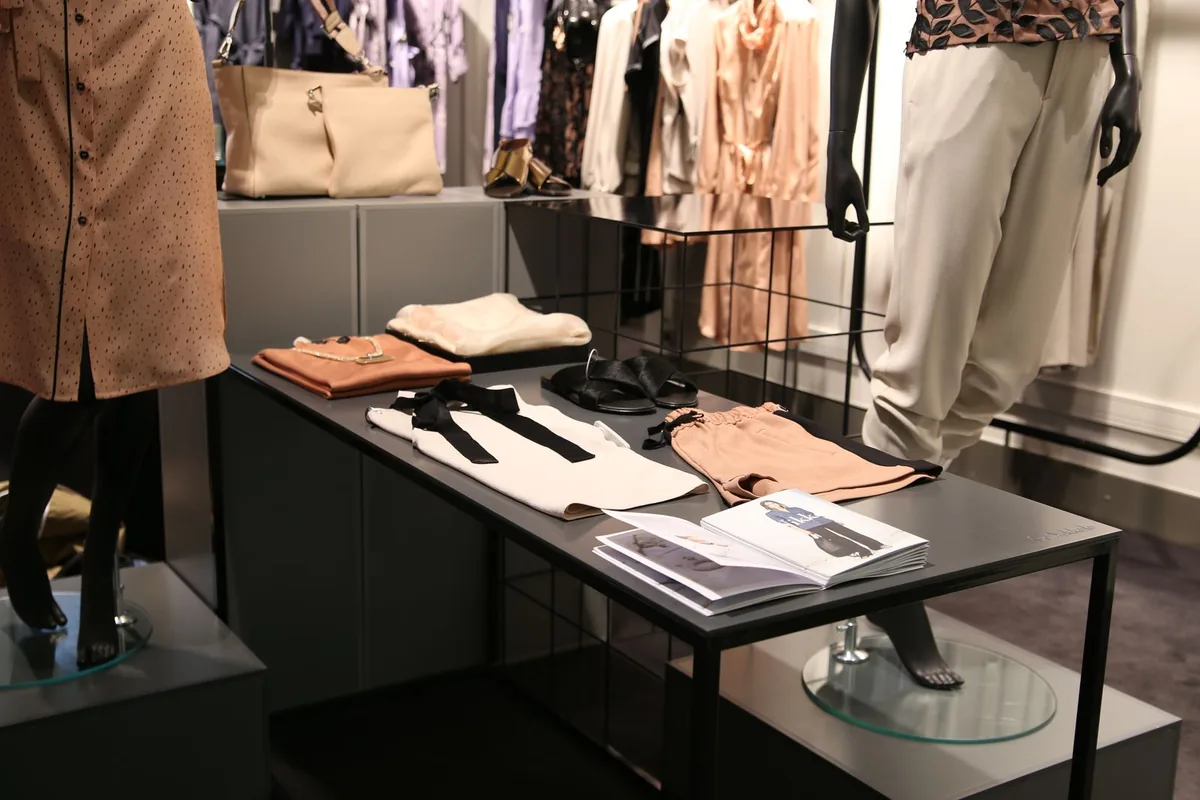
The eye does not measure brightness, it measures difference. A display lit to 1,000 lux across a 1,000 lux sales floor reads as flat and ordinary, while the same 1,000 lux across a 200 lux floor reads as premium and urgent. The accent-to-ambient ratio is the number that controls this.
For retail display lighting, the working range is 3:1 to 5:1. Below 3:1 the hierarchy dissolves. Above about 8:1 the pools become islands, the shopper’s eye adapts to the bright spot, and the surrounding merchandise goes black — which is fine for a jewellery case and wrong for a shoe wall.
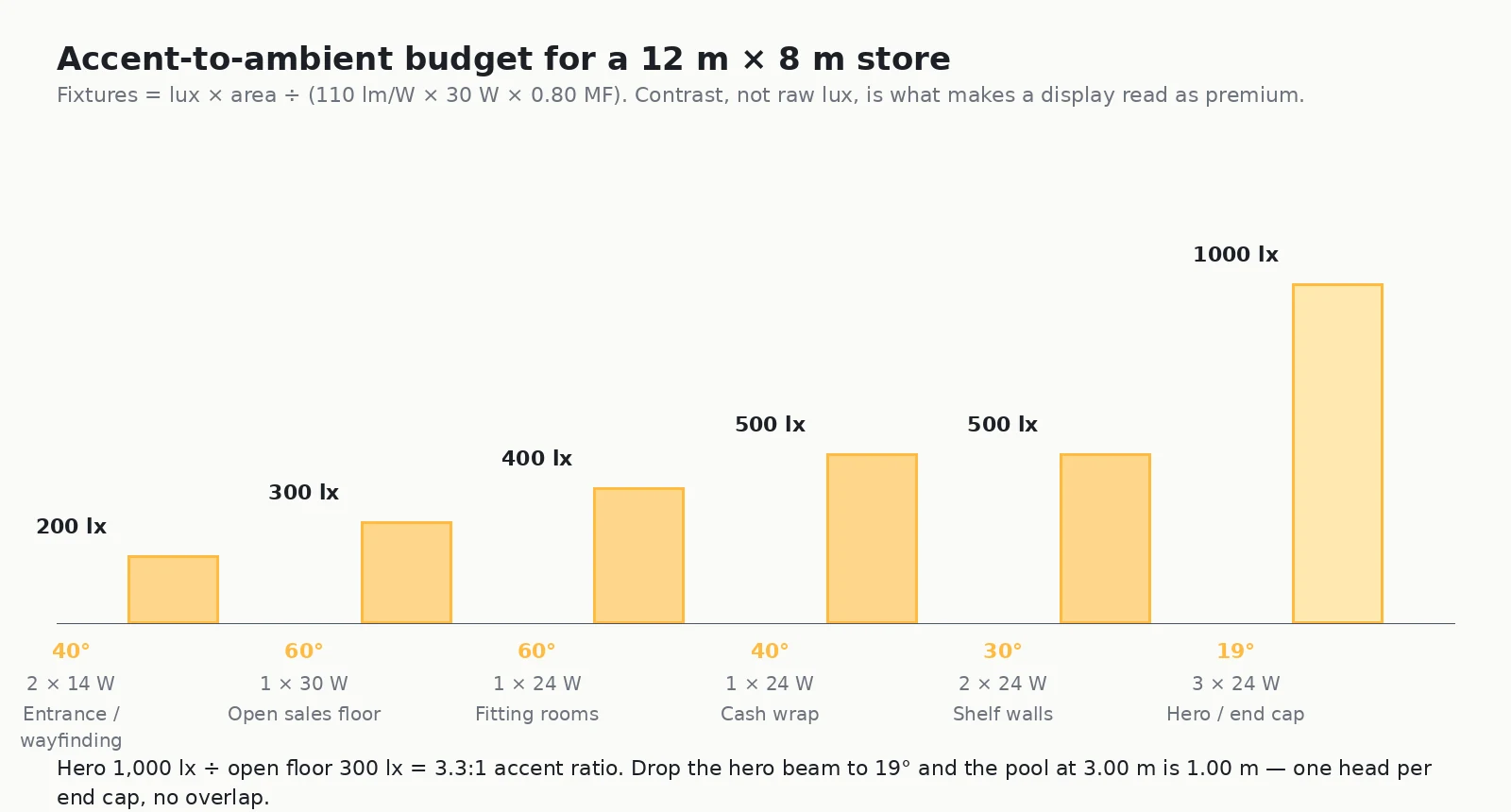
Target Lux by Store Zone
| Zone | Target lux | Beam angle | Notes |
|---|---|---|---|
| Entrance / threshold | 200–300 | 40°–60° | Adaptation zone; keep it calm, never brighter than the displays |
| Circulation and open floor | 200–300 | 50°–60° | Enough to read labels and faces, not enough to compete |
| Clothing rails and tables | 400–600 | 30°–40° | Even, low-contrast wash so every size in the rail reads |
| Shelf walls and gondolas | 500–700 | 24°–30° per shelf face | Light each shelf level, not the whole wall |
| Fitting rooms | 400–500 | Vertical, 30°–40° | Light the customer’s face, not the ceiling |
| Cash wrap / POS | 500–750 | 30°–40° | Task lighting for staff; high CRI for returns |
| Hero item / end cap | 900–1,200 | 15°–24° | 3:1 to 5:1 over the surrounding floor |
| Window / mannequin | 1,500–2,500 (day) | 18°–30° | Must fight daylight; dim to ~30% after dark |
Note the window figure. A shop window competes with direct daylight at 10,000–50,000 lux, so a 900 lux interior display that looks brilliant inside evaporates behind glass. This is why window positions almost always need a dedicated, separately switched circuit.
Colour Quality: CRI, R9 and Why Your Navy Jacket Looks Black
Lux gets the shopper’s attention; spectrum decides whether they believe the product is worth the price. Two numbers matter and they are not the same number:
CRI (Ra) averages the rendition of eight pastel test colours. A lamp can score Ra 90 while rendering saturated red and deep blue badly, because those are not in the average. That is where R9 comes in. R9 is the saturated-red score, listed separately, and it is the one that decides whether:
- brick and rust tones read as a single colour family on a clothing rail,
- fresh produce looks ripe rather than pickled,
- skin tones on a mannequin or a shopper’s face stay natural in the fitting-room mirror,
- wine, steak and bakery items look appetising in food retail.
For retail display lighting, specify CRI 90+ with R9 ≥ 50 as a floor, and CRI 95+ / R9 ≥ 80 for fashion, cosmetics and food. Anything claiming CRI 90 with no R9 figure should be tested before you commit a whole store to it.
SDCM: The Number Behind Colour Consistency
SDCM (standard deviation of colour matching) describes how much the colour varies between individual heads. At SDCM ≤3, two fixtures side by side on one track are visually indistinguishable. At SDCM 5–7, adjacent pools drift noticeably green or pink, and a long wall of light looks dirty. For retail, SDCM ≤3 is the minimum; SDCM ≤2 is what you want anywhere two heads share a display.
Colour Temperature by Product Category
- 2700 K — fine jewellery, luxury leather, warm wood finishes, hotel-adjacent boutiques.
- 3000 K — the safest default for fashion, apparel and general retail. Flatters skin and fabric without going yellow.
- 3500 K — footwear, homeware, modern interiors that already use a cool palette.
- 4000 K — cosmetics counters, electronics, pharmacy and fresh grocery where clarity beats atmosphere.
Mixing colour temperatures on one sales floor is a common and expensive mistake. A 3000 K wall next to a 4000 K wall reads as a dirty patch, not as contrast. If you need both, separate them by a full fixture run or a structural break.
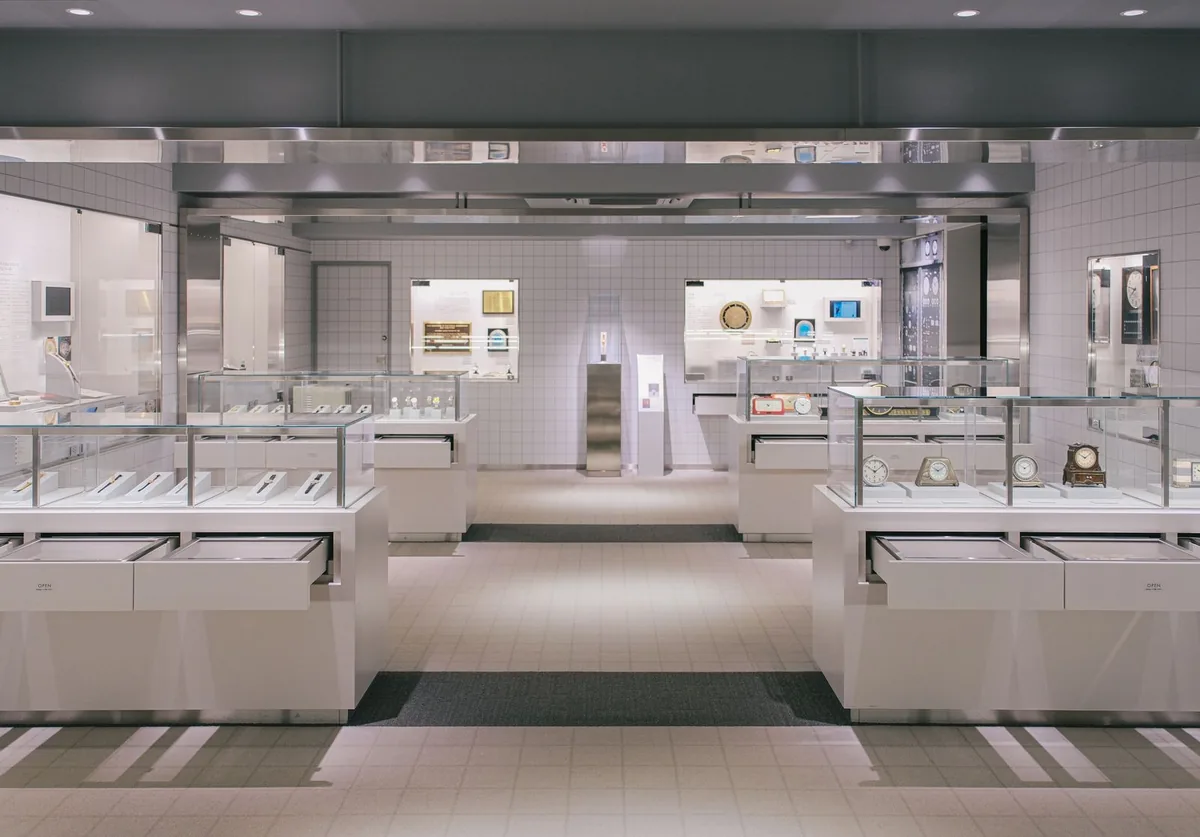
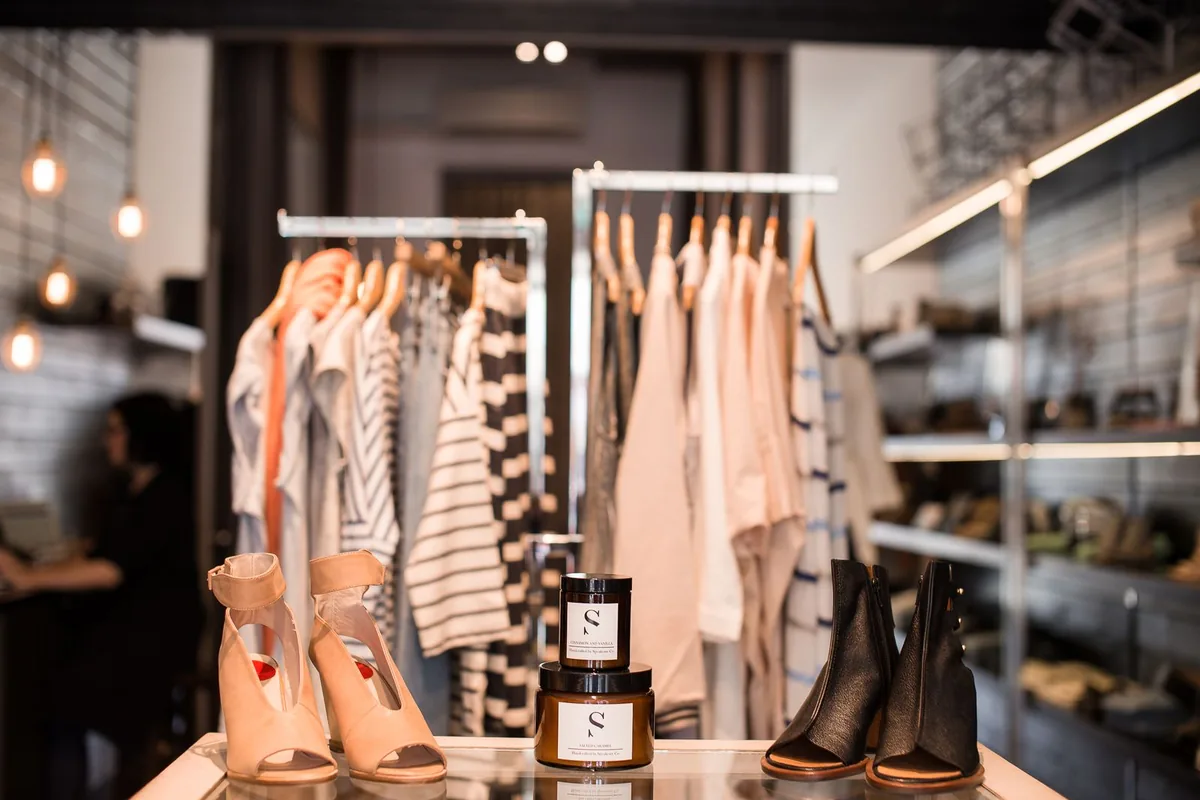
Layering: Ambient, Task and Accent Working Together
Retail display lighting needs three layers, and they have three different jobs. Skipping the ambient layer is the mistake that produces harsh, glary stores full of bright pools surrounded by dark aisles.
Ambient provides circulation light at 200–300 lux: linear runs, recessed washes, or wide floods on the general track. It should be invisible in the sense that nobody notices it.
Task lights the places where a decision or a transaction happens — fitting-room mirrors, cash wrap, service counters, stockroom doorways. Vertical illuminance at face height matters more than horizontal illuminance at floor level.
Accent is the layer that sells. Narrow spots on heroes, wall washes behind shelf faces, framing projectors on framed graphics. This is where the contrast ratio lives, and it is the only layer that should be visibly bright.
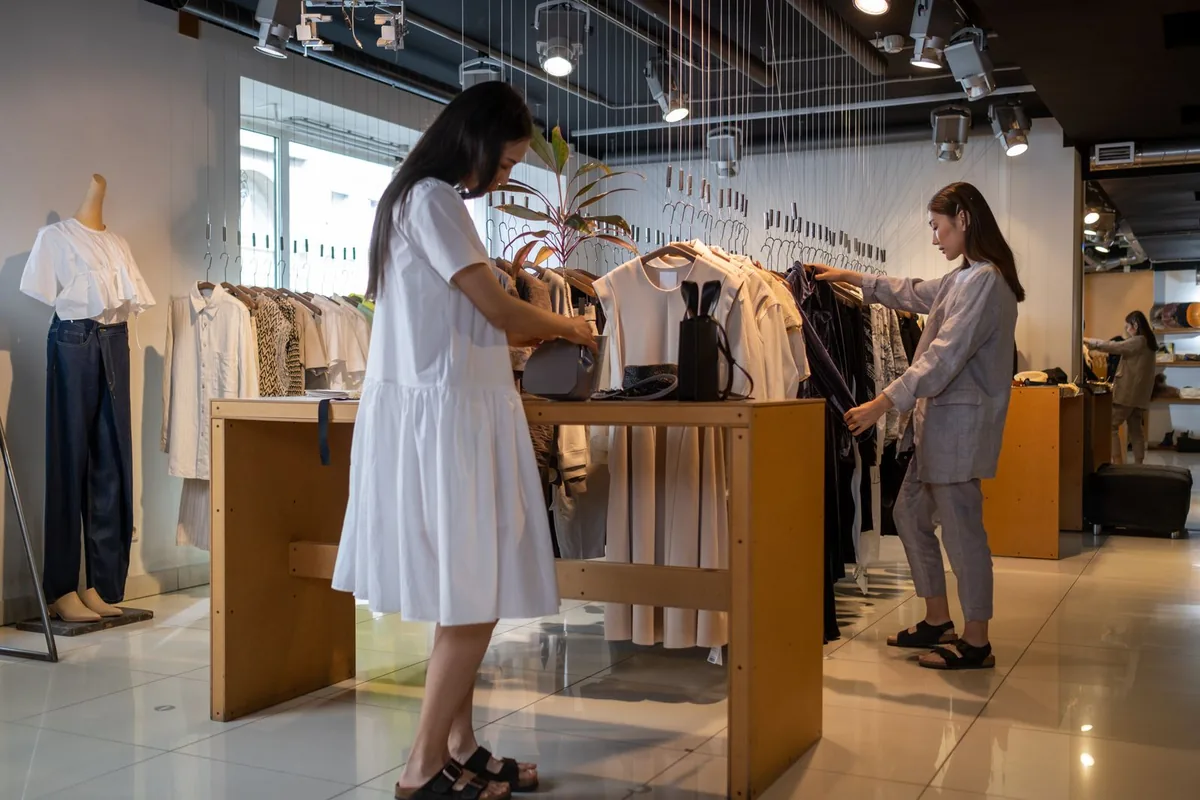
Wall Washes and Shelf Walls: Pitch, Overlap and the Scallop Problem
A display wall lit by evenly spaced heads produces a row of bright bands with dark gaps — scallops. The fix is not more wattage, it is more overlap. The pitch between two heads is:
pitch = D × (1 − overlap)
For a 6.00 m display wall with 40° lenses on a 3.00 m ceiling, the pool at the wall is 2.18 m. At 30% overlap the pitch is 1.53 m, which yields 5 heads across the run and still bands. At 40% overlap the pitch drops to 1.31 m, giving 6 heads — one extra fixture that converts banding into a continuous field.
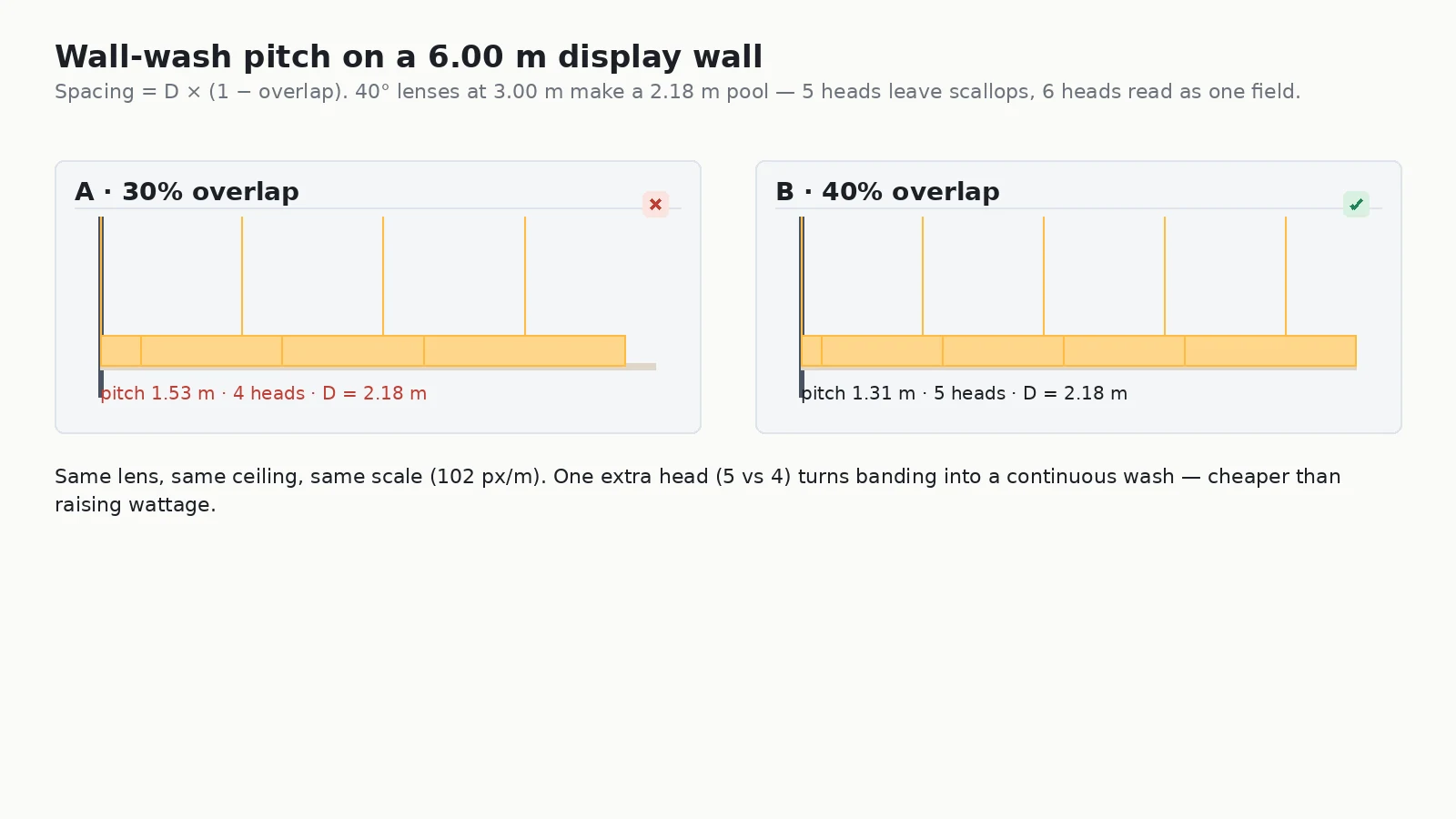
Two rules keep wall washes clean. First, mount the track at least 0.60–0.90 m off the wall; closer than that and the pool becomes a hot spot at the top of the wall with a dark base. Second, keep shelf-face heads on a separate aim from wall-wash heads. A single head cannot do both well: the shelf needs a narrow pool per level, the wall needs broad overlap.
Glare Control: Cut-Off Angle, UGR and Sightlines
In a store, glare is not just uncomfortable, it is expensive. A shopper who catches a bare lamp in the eye looks away — from the product you just lit. The controlling number is the cut-off angle, and unlike UGR it is something you can measure with a ruler:
cut-off = arctan(recess depth ÷ half aperture)
A flat lens in a 60 mm aperture has no recess, so the source is visible from almost anywhere. Recess it 18 mm and the cut-off rises to 31°. Recess it 35 mm and you get 49°, which keeps the lamp out of a standing shopper’s sightline from typical viewing positions.
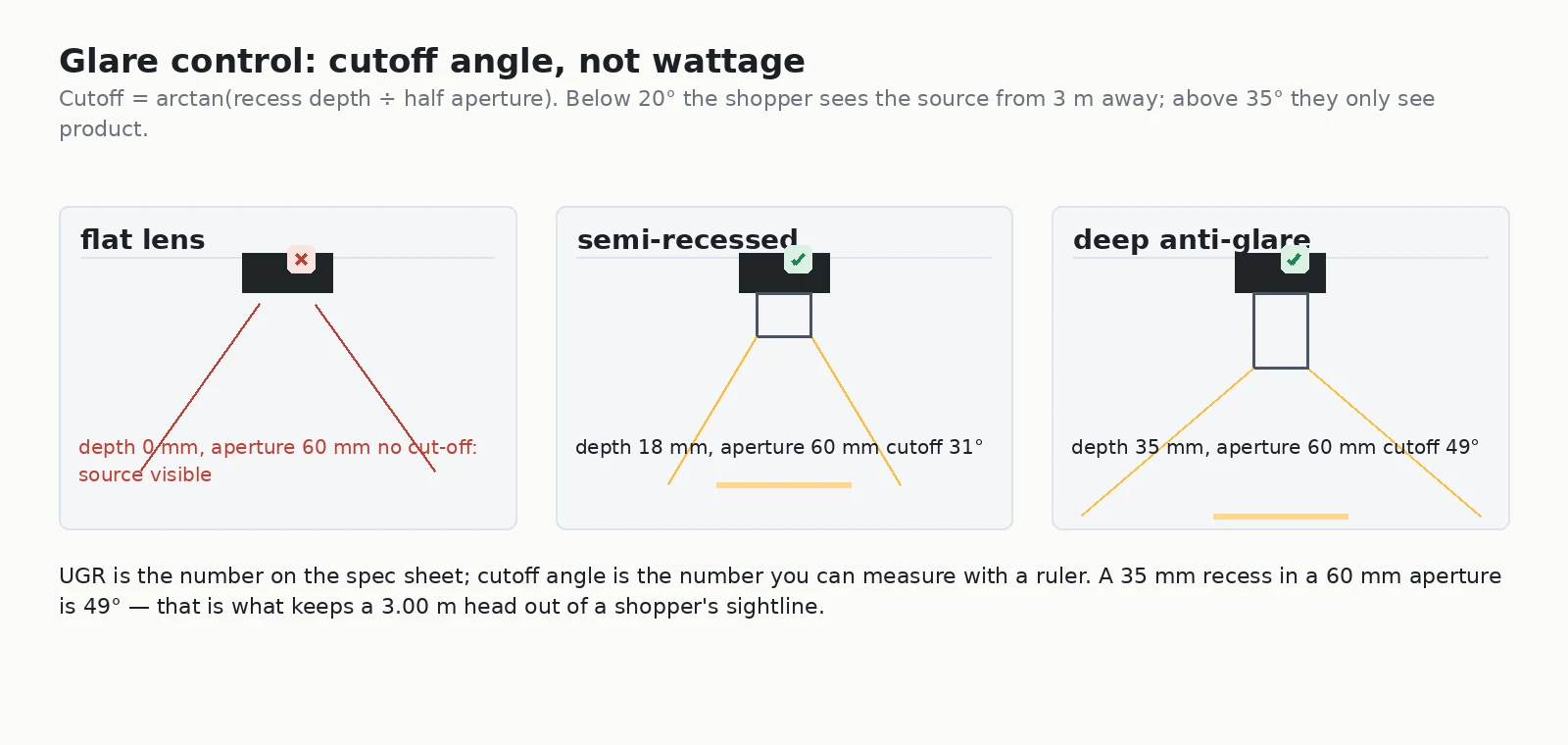
If you are specifying to a standard rather than a sightline, the UGR figures worth holding are:
| Space | UGR target | Practical means |
|---|---|---|
| Open sales floor | ≤ 22 | Wide beams, low luminance, deep enclosures |
| Shelf walls and aisles | ≤ 19 | Recessed heads, honeycomb or soft-lens accessories |
| Fitting rooms and mirrors | ≤ 16 | Diffused vertical light at face height, no ceiling source in view |
| Jewellery and watches | ≤ 10 | Deep anti-glare, narrow beams, high contrast on a controlled floor |
There is a real tension here that no specification acknowledges: the tighter the beam, the brighter the source looks. A 10° head with the same wattage as a 40° head is roughly 16× the source luminance. This is why narrow-beam hero lighting almost always needs a recessed or deeply baffled body, while wide ambient floods can get away with a simple flat lens. Our VEGA-Premium 30W pairs a 125 lm/W engine with CRI 95 and COB SDCM ≤2 — which is the combination you want when several narrow heads share a jewellery case and must match exactly.
Adjustability: Where the Money Actually Goes
Merchandising changes weekly. The value of a track head is not what it does on installation day, it is what it does when the seasonal collection arrives and every hero position moves 2 m down the wall. Adjustability is measured in four numbers, all of which belong on a spec sheet:
- Rotation range — 360° horizontal is standard; less is a false economy.
- Tilt range — 90° vertical is standard. Motorised heads reach ±140°.
- Beam adjustability — fixed lens, interchangeable lens, or mechanical zoom.
- Aim retention — whether the head holds its position months later, or droops at the hinge.
That last one is where cheap heads fail. A friction hinge that loosens after 6 months of re-aiming turns an aimed pool back into a flood, and the store team stops adjusting the lighting because adjusting it does not hold. The VEGA-Standard 30W uses an in-track driver with 360°+ rotation and 90° tilt; the MOVIA Motorized Track Light 30W replaces the friction hinge with three DC stepper motors giving 0°–360° pan, ±140° tilt, 18°–60° zoom and 2700 K–6000 K tuning — so a whole scene can be re-aimed from a phone instead of a ladder.
Optics for Three Different Merchandising Jobs
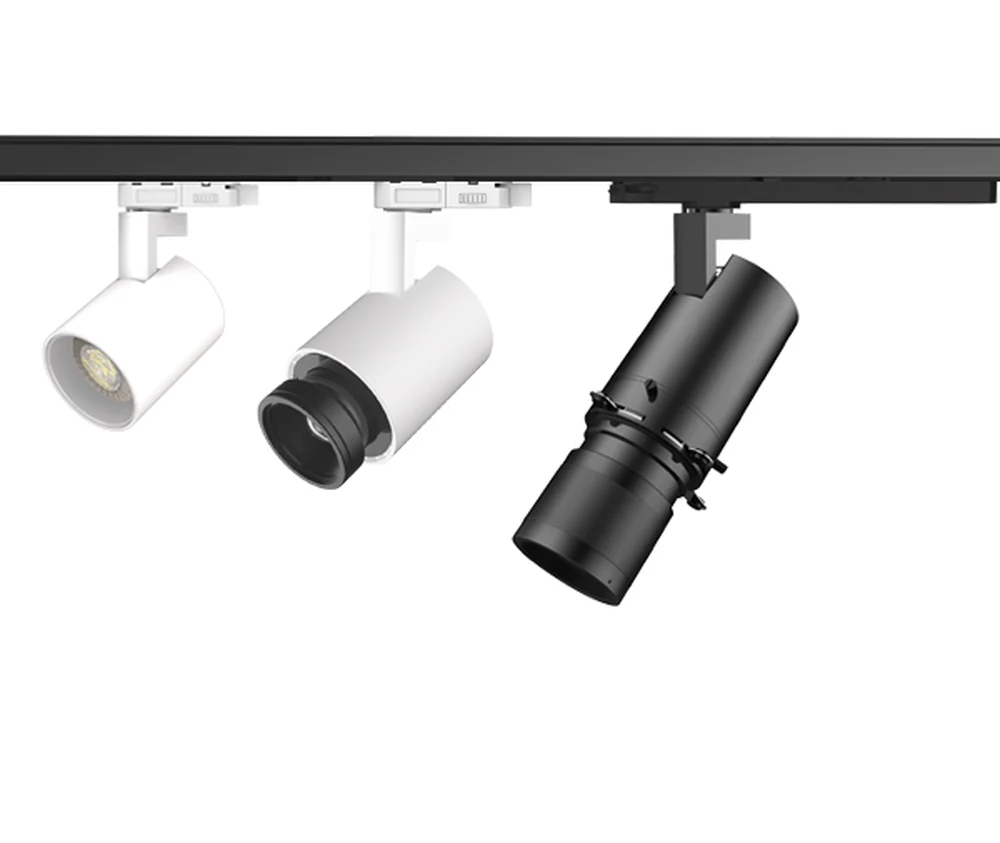
Track heads are often described as one product. In practice a store needs three different optics, and they are not interchangeable:
- Standard round pool — the general-purpose aim, best on mannequins and tables where the object is roughly circular.
- Zoomable — one optical train, a range of beam angles, changed in place. Best where the merchandising plan is still fluid.
- Projector / framing — a shaped pool with a clean edge, used for shelf faces, framed graphics, and hero items on a rectangular plinth. Our IMAX-Projector 10-20W cuts a round beam down to squares and rectangles with four shutter blades, holds UGR<6, and swivels 360° horizontally and 90° vertically without dead angle — deliberately designed for displays where stray light on the neighbouring product is not acceptable.
Aim Retention and the Hinge Question
Ask any lighting supplier what happens to a head that is re-aimed twice a week for two years. A geared hinge keeps the head exactly where the last person left it. A friction hinge drifts. Our own heads use a geared hinge rather than friction, so a head can be parked at any point in its travel and stay there without being loosened first — a detail that only shows up in the third year of a fit-out, which is exactly when nobody is watching the specification any more.
Retail Display Lighting by Product Category
Different categories need different specifications. These are working targets rather than a standard, but they hold up on real jobs.
| Category | Accent lux | Beam | CCT / CRI | Specific note |
|---|---|---|---|---|
| Fashion apparel | 700–1,000 | 18°–24° | 3000 K, CRI 90+, R9 ≥ 50 | Vertical illuminance on the garment face beats floor lux |
| Footwear | 600–900 | 24°–30° per shelf | 3000–3500 K, CRI 90+ | Light each shelf level; the midsole is the selling detail |
| Jewellery / watches | 1,000–2,000 | 8°–15° | 2700–3000 K, CRI 95+, R9 ≥ 80 | UGR ≤ 10; avoid hard shadows on stone settings |
| Cosmetics | 500–800 | 24°–40° | 3500–4000 K, CRI 95+ | Neutral render for foundation matching; no warm drift |
| Electronics | 500–800 | 24°–30° | 4000 K, CRI 90+ | Control screen reflections; aim off-axis to the display |
| Food and grocery | 500–1,000 | 24°–40° | 3000–4000 K, CRI 90+, R9 ≥ 50 | Bakery warm, produce cool; keep IR and UV off fresh goods |
| Homeware and furniture | 400–700 | 30°–40° | 3000 K, CRI 90+ | Texture and grain need grazing angles, not overhead light |
| Luxury / boutique | 800–1,200 | 15°–24° | 2700–3000 K, CRI 95+ | High contrast against a deliberately low ambient level |
Six Mistakes We See on Retail Fit-Outs
Every one of these is a geometry or specification error, and every one shows up in the sales data before anyone notices it in the lighting.
1. Spotlight on the Aisle, Shadow on the Product
The head is aimed a few degrees off the plinth and the pool lands on the floor 2 m in front of the merchandise. The store then reports the display as “too dark” and orders more fixtures, which makes the aisle brighter and the product no better lit. Check aim first, at eye level, during a normal trading day.
2. Flat Lighting Across the Whole Floor
When accent and ambient sit at the same lux, nothing reads as important. A shopper’s gaze has nothing to land on, so they scan the whole store at once and leave. Build in a 3:1 minimum contrast ratio and audit it with a meter rather than by eye — the eye adapts far too well to judge this.
3. Wide Beam on a Small Object
A 60° flood on a 0.90 m plinth delivers about 8% of its output to the product and 92% to the floor. The fixture is not under-powered; it is over-spread. Narrow the beam before raising the wattage — the result is brighter, cheaper and better looking.
4. Peak CCT Without R9
Buying “CRI 90” without checking R9 is how a store ends up with navy garments that look black and red leather that looks brown. Ask for the R9 figure in writing and, where it matters, for the spectral power distribution. If a supplier cannot produce either, the CRI figure is marketing.
5. One Beam Angle Across the Whole Ceiling
A single lens type across a store forces every display into the same pool size. The hero item is then either under-lit at the edges or the rail next to it is over-lit with spill. Two or three lens types on one track cost almost nothing extra and are the difference between layered and flat.
6. No Dimming Strategy for Daylight
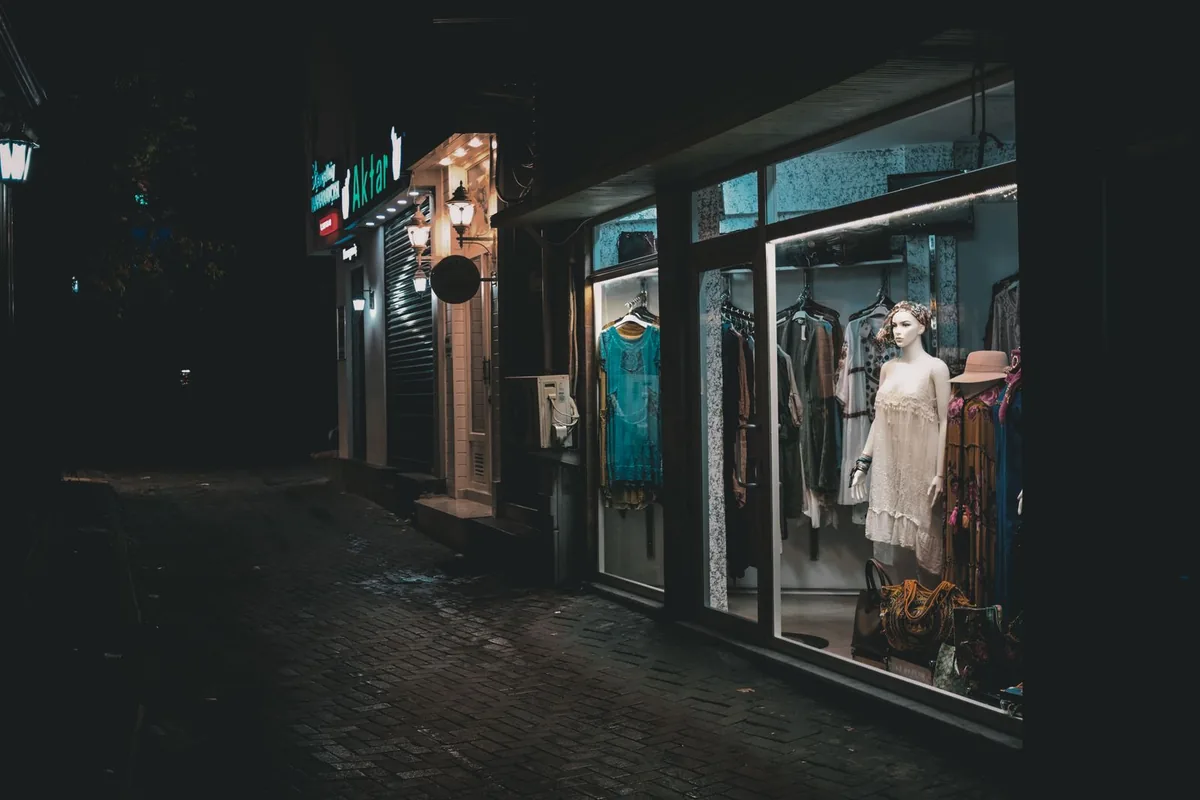
A shop window lit for a 1,500 lux daytime target looks blown out at 21:00, when ambient drops below 50 lux. Without dimming, the window is either invisible in the afternoon or uncomfortable at night. Specify dimmable drivers and, ideally, scene control with a daylight-dependent curve.
Specifying the Track System Itself
Retail display lighting is only as good as the rail carrying it, and the rail is usually the part nobody specifies. Three decisions matter:
- Voltage. Line-voltage track carries the driver in each head; low-voltage (24 V) systems carry it remotely. Low voltage is tidier and easier to dim per head, but a 100 W circuit at 24 V draws over 4 A, so long runs need heavier copper or repeated feeds.
- Circuit count. A two-circuit track lets you switch accent and ambient independently on the same rail. This is what makes dimming strategies and restocking schedules practical.
- Accessory ecosystem. Honeycomb louvers, soft lenses and oval filters are the cheapest way to fix a glare or spill problem after installation. Specify heads that accept them.
See our full range of LED track lighting, or start from track light fixtures if you are building a specification from scratch.
Frequently Asked Questions
How many lux do I need for retail display lighting?
Ambient/circulation 200–300 lux, clothing rails 400–600 lux, shelf walls 500–700 lux, and hero items or end caps 900–1,200 lux. Window displays need 1,500–2,500 lux to compete with daylight. The ratio between the hero level and the surrounding floor matters more than the absolute number — aim for 3:1 to 5:1.
What beam angle should I use on a track head?
Size it from the object, not the ceiling. Compute the throw (ceiling height minus the height of the surface you are lighting), then solve θ = 2 · arctan(pool diameter ÷ (2 × throw)). For a 0.40 m object at a 2.10 m throw, that is about 14°. Use 15°–24° for hero items, 24°–30° for shelf faces, 30°–40° for rails and wall washes, and 50°–60° for ambient only.
What CRI do I need for a clothing store?
CRI 90+ as a minimum, but insist on an R9 figure of at least 50 because CRI (Ra) averages only eight pastel test colours and can hide poor saturated red. For fashion, cosmetics and food, specify CRI 95+ with R9 ≥ 80, and SDCM ≤ 3 so adjacent heads match. Without SDCM control a wall of light drifts green or pink between fixtures.
Is 3000 K or 4000 K better for retail?
3000 K suits fashion, leather, wood and jewellery because it flatters skin and warm materials. 4000 K suits cosmetics, electronics, pharmacy and fresh grocery where neutral, clear rendering matters more than atmosphere. The rule that matters more: never mix colour temperatures on one continuous sightline, because the step between them reads as a dirty patch.
How far apart should track heads be for an even wall wash?
Multiply the pool diameter at the wall by 0.60–0.70, which is 30–40% overlap. For 40° lenses on a 3.00 m ceiling the pool at the wall is 2.18 m, so the pitch is 1.31–1.53 m. Mount the track 0.60–0.90 m off the wall, and prefer the tighter pitch — one extra fixture removes the scalloping that makes a wall look unfinished.
Can I use the same track head for ambient and accent?
Only with a zoomable or motorised head. A fixed lens cannot be both a 15° hero spot and a 60° ambient wash, which is why stores that try it end up with either flat lighting or excessive contrast. Zoomable heads (15°–30°) and motorised heads (18°–60°) solve this in place, without swapping lenses or ordering new fixtures.
How do I stop glare from track lighting in a store?
Use the cut-off angle: arctan(recess depth ÷ half aperture). A 35 mm recess in a 60 mm aperture gives 49°, which keeps the source out of a standing shopper’s sightline. Raise and steeply angle the heads, keep UGR ≤ 19 on shelves and ≤ 10 for jewellery, and remember that halving the beam angle roughly quadruples source luminance — so narrow hero spots need recessed or honeycomb-baffled bodies.
Let the Lighting Do the Selling
Retail display lighting rewards arithmetic. A pool sized to the product, a contrast ratio the eye can follow, a cut-off angle that keeps the lamp out of sight, and a spectrum with the R9 to prove it — those four decisions move more merchandise than any increase in wattage, and they cost less to get right the first time.
If you are specifying track lighting for a store, a chain of stores, or an OEM programme, send us your ceiling height, the merchandise categories and the plan. We will come back with beam angles, lux targets, fixture counts and a photometric sheet you can check. Request a retail lighting specification or browse the full track light range.
Related reading from our lighting library: Retail Display Lighting: How Track Heads Sell Product, Showroom Track Lighting: Color, Coverage & Conceal, Commercial Lighting Lux Requirements by Space, and Office Track Lighting Specs.
Further reading: DesignLights Consortium for qualified products lists and lighting specification resources, the U.S. Department of Energy Solid-State Lighting programme for photometric testing and colour quality guidance, and NIST Photometry for how illuminance and colour metrics are actually measured.