
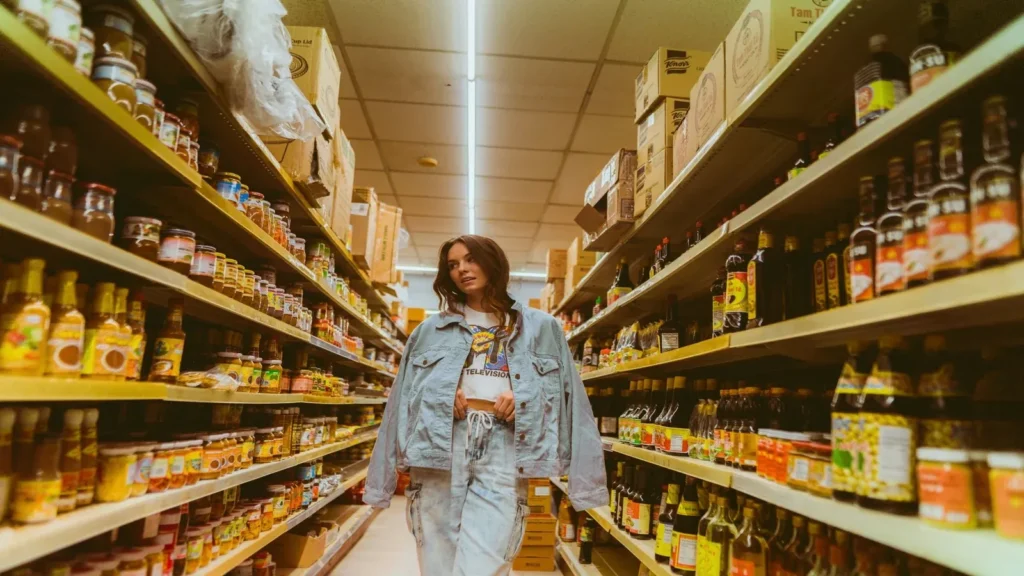
Every supermarket runs on a contradiction: the produce has to look greener than it did on the farm, the beef has to look redder than it did at the butcher, and the invoices have to keep looking harmless. Track lighting is how grocery operators win that argument. It lets you put a different optic, a different beam and a different colour temperature over each zone — 300–500 lux over the dry aisles, 500–750 lux on the fresh counters, 500–750 lux over the tills, and a 3:1 to 5:1 accent-to-ambient ratio on whatever is being promoted this week — from one rail that stays re-aimable when the planogram changes.
This guide is the arithmetic behind that layout: how to work out the pool diameter from the ceiling height and the optic, how to space the heads so they read as one continuous band instead of a row of bright dots, what lux levels to specify zone by zone, and how colour temperature changes what a shopper thinks about a cucumber and a ribeye. It assumes you already know what lux is — if not, the metric itself is covered in lux vs lumens.
The short version. A 36° optic at 3.60 m gives a 2.34 m pool on the floor and 0.97 m on a 2.00 m shelf face. For a continuous band along an aisle, use that pool width minus 10–30 percent as your head spacing. Specify Ra ≥ 90 with R9 ≥ 50 stated separately, and do not let two colour temperatures share a sightline.

Why a Supermarket Is a Layered Lighting Problem, Not a Brightness Problem
The first instinct on a grocery refit is to raise the overall illuminance until nothing looks dim. That is expensive and it does not work, because a shopper never reads a lux number. They read edges: the wet shine on a pepper, the marbling inside a ribeye, the crisp fold of a salad bag, the price card that has to stay legible under the cart.
Three layers produce those edges, and each one has a different job:
- Ambient — wide-beam heads or linear runs that put 300–500 lux across the aisle floor and the shelf face. This layer is about safety, wayfinding and the feeling that the store is clean.
- Task and vertical — tighter optics aimed at shelf faces, counters and tills, usually at 500–750 lux. This layer is about reading labels, judging ripeness and packing bags without squinting.
- Accent — narrow heads on end caps, feature tables and promotional islands, running 3:1 to 5:1 above the ambient level so the promoted product wins the first glance.
Track lighting is well suited to all three because the same rail carries different optics and the aim can be corrected after the shelving goes in — which is the moment every lighting drawing turns out to be slightly wrong. The retail-side version of this argument is set out in retail display lighting specs. For the general commercial picture across other sectors, see commercial lighting lux requirements, and our retail-specific library under Lighting Insights.
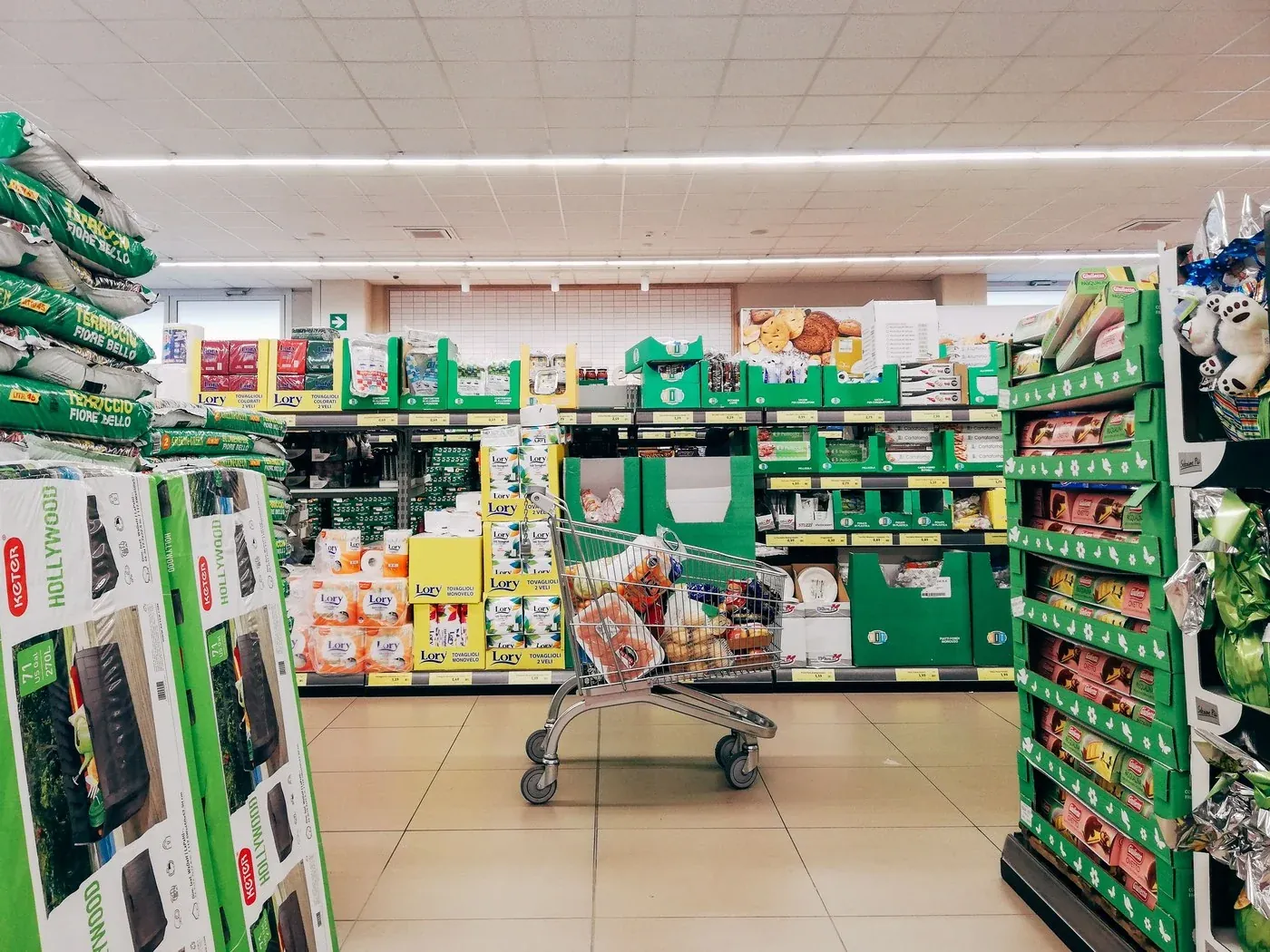
The Three Numbers That Set the Whole Layout
Before anything gets ordered, three figures decide how many heads you need and where they go.
| Figure | Formula | What it tells you |
|---|---|---|
| Pool diameter | D = 2H · tan(θ/2) | How wide the light is when it lands. H is the vertical distance from the fixture to the surface you care about — the floor, or a shelf face. |
| Head spacing | s = D · (1 − overlap) | How far apart the heads sit along the rail. 0–10 percent overlap gives separate pools; 25–35 percent gives a continuous band. |
| Illuminance | E ≈ Φ · UF · MF / A | The lux you actually get. Φ is delivered lumens, UF the utilisation factor (≈0.85 for a well-aimed aisle), MF the maintenance factor (0.80 = 20 percent allowance for dirt and LED ageing), A the area served. |
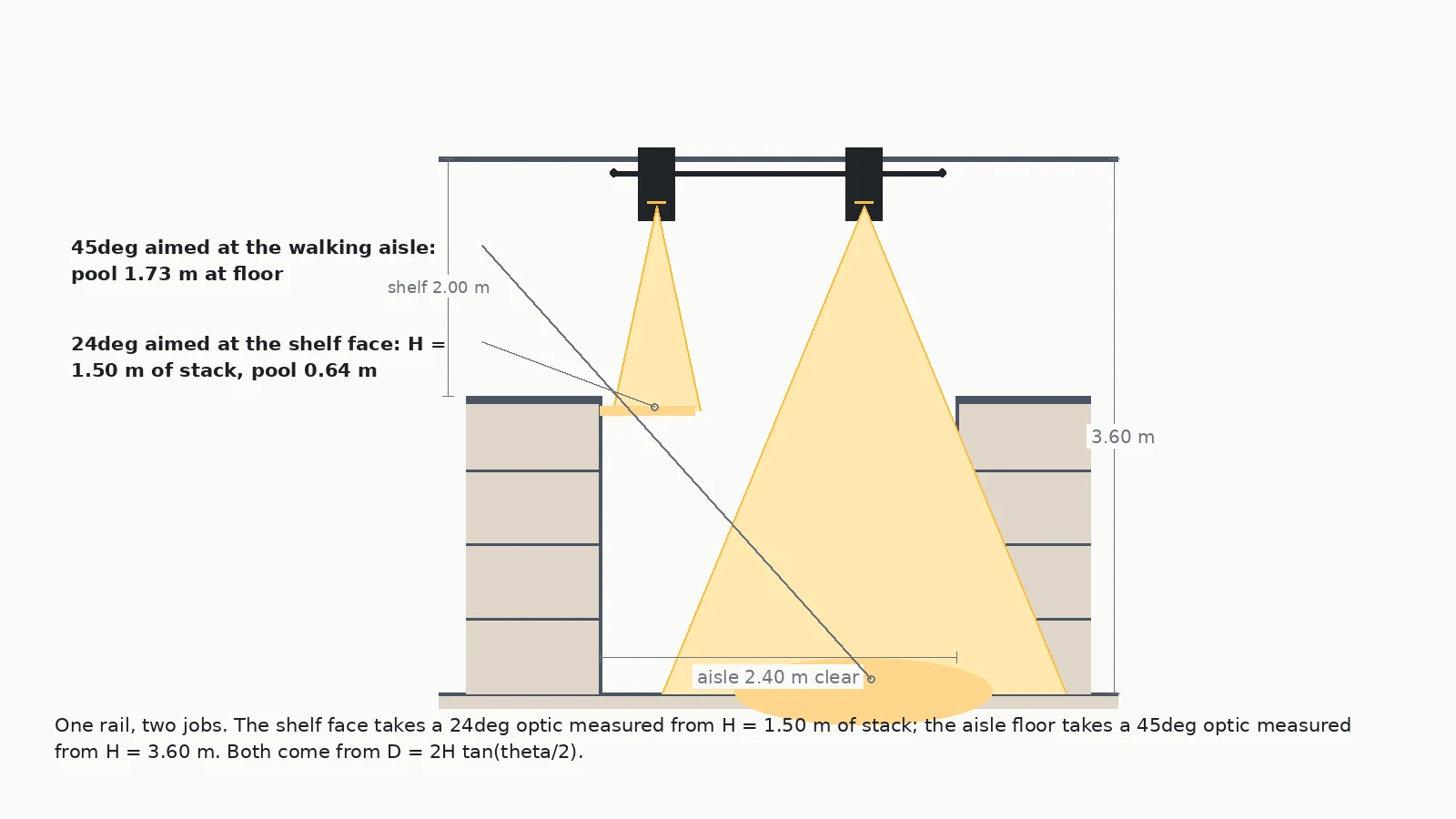
The consequence people miss is the second H. In a grocery aisle the fixture is not 3.60 m above the surface you are trying to light — if the task is the shelf face, it is 3.60 m minus the 2.00 m shelf height minus a 0.10 m working gap, so H = 1.50 m. That is why a 36° head produces a 2.34 m pool on the floor and only a 0.97 m pool on the shelf face. Same fixture, same optic, two completely different lighting outcomes, depending on which surface you aimed at.
Beam Angle and Mounting Height: What a Grocery Aisle Actually Needs
Beam angle is the only lever that changes the pool without changing the fixture — and in a grocery aisle the geometry is unforgiving, because the aisle is narrow and the shelves are tall.
| Optic | Pool at the shelf face (H = 1.50 m) | Pool on the aisle floor (H = 3.60 m) | Where it belongs |
|---|---|---|---|
| 15° | 0.39 m | 0.95 m | Narrow accent on a featured item, a deli tray, a single promo stack |
| 24° | 0.64 m | 1.53 m | The workhorse shelf-face optic; also the tight option for narrow aisles |
| 36° | 0.97 m | 2.34 m | Default for 2.4–2.7 m aisles: one head per bay pair, continuous band |
| 45° | 1.24 m | 2.98 m | Wide ambient in the open floor, checkout, bulk stacks — not above shelving |
Read that table against a 2.40 m clear aisle and the trap is obvious. A 45° head lays a 2.98 m pool — wider than the aisle itself — so the surplus light lands on the shelf uprights and the price edge instead of the merchandise. And because the shelves are only 1.50 m below the fixture, that same wide cone is also washing the top of the stack at a much higher illuminance than the bottom.
Two practical fixes, both of which the Encore range supports directly. The first is to use the zoom: a fixture such as the VEGA-Zoomable 20W–30W or the IMAX-Zoomable 15W–30W lets you set the optic on site once the shelving is up, rather than living with a drawing-stage guess. The second is to separate the optics vertically: a tight 24° head for the shelf face, and a wider head deliberately aimed at the walking floor, as shown in the section drawing above.
Aisle Layout: Spacing Heads From the Pool, Never From Habit
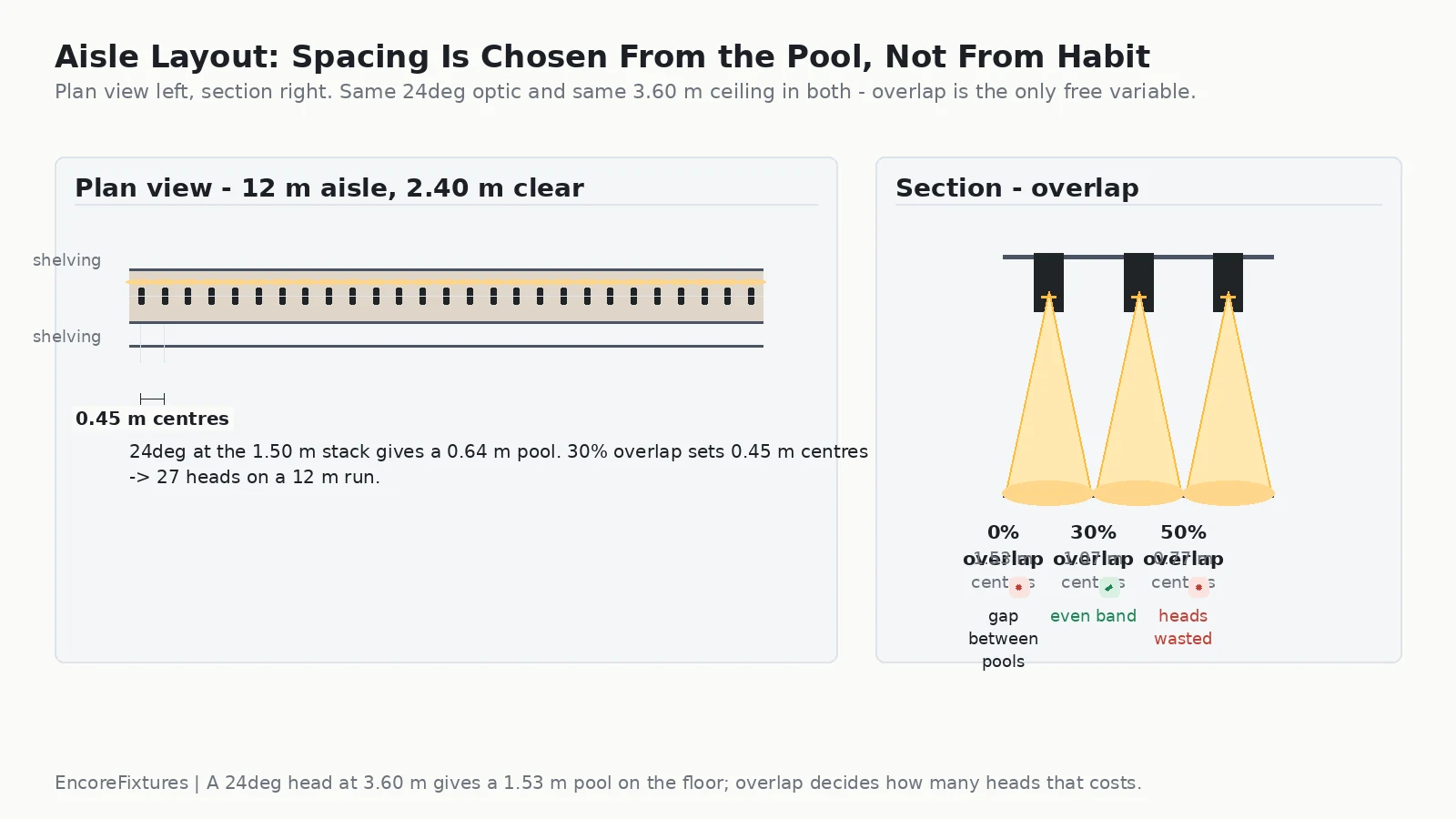
On a 12 m aisle with a 24° optic aimed at a 2.00 m shelf stack, the pool at the shelf face is 0.64 m. Set the centres at 30 percent overlap and the rail needs a head every 0.45 m — 27 heads for the run. Drop to 10 percent overlap and the count falls to 21, but gaps start appearing between pools at eye level, and a shelf row with visible dark bands reads as poorly stocked even when it is full.
A few rules that hold up on site:
| Overlap | Spacing rule | Visual result | Use it for |
|---|---|---|---|
| 0–10 % | s ≈ D | Distinct pools with visible gaps | Accent only — a promo island, a display table (a feature, not a task area) |
| 25–35 % | s = 0.65–0.75 D | Continuous band, no scalloping | Grocery aisles, counters, circulation — the default |
| 40–50 % | s = 0.50–0.60 D | Very even, slightly flat | Where label legibility matters more than punch — pharma, checkout lanes |
For a retail-floor version of the same arithmetic, including how accent-to-ambient ratios move sales, see track lighting for retail stores.
Then run the illuminance check. A 12 m aisle with a 2.40 m clear width has a floor area of 28.8 m². To hold 400 lx on the shelf-face work plane with a 0.85 utilisation factor and a 0.80 maintenance factor, the run needs about 16,900 delivered lumens aimed at the shelving — roughly 630 lm per head across 27 heads, comfortably inside a 10–15 W optic. That is the arithmetic that turns a photometric file into a bill of materials.
Recommended Lux by Zone: Fresh, Dry, Chilled, Checkout, Back of House
Grocery is not one lighting condition. It is six, and the boundaries are usually the shelving changes rather than the room. The table below is the range we specify at the task plane.
| Zone | Recommended lux | Task plane | Optic | Notes |
|---|---|---|---|---|
| Fresh produce & bulk | 500–750 lx | Product face, tilted displays | 36° | Highest CRI in the store; the misting and the wet greens are the whole sell |
| Butcher & deli counter | 500–750 lx | Counter surface + 0.75 m behind | 24–36° | Warm CCT; R9 is what makes red meat look red |
| Dry grocery aisles | 300–500 lx | Vertical shelf face | 24–36° | Uniformity matters more than peak level; label legibility drives the number |
| Chilled & frozen | 300–500 lx | Shelf face behind glass | 24–36° | Avoid aiming into the glass at normal incidence; a 20–30° approach kills specular veiling |
| Checkout & service | 500–750 lx | Belt / counter surface | 36° | Slightly cooler CCT; also the highest UGR sensitivity because customers look down for minutes |
| Back of house & stockroom | 150–300 lx | Floor + rack face | 45–60° | Rack aisles only; no task lighting, motion sensing usually pays for itself |
| Perimeter walkway | 150–200 lx | Floor | 36–45° | Wayfinding and safety; too bright here flattens the accent layer |
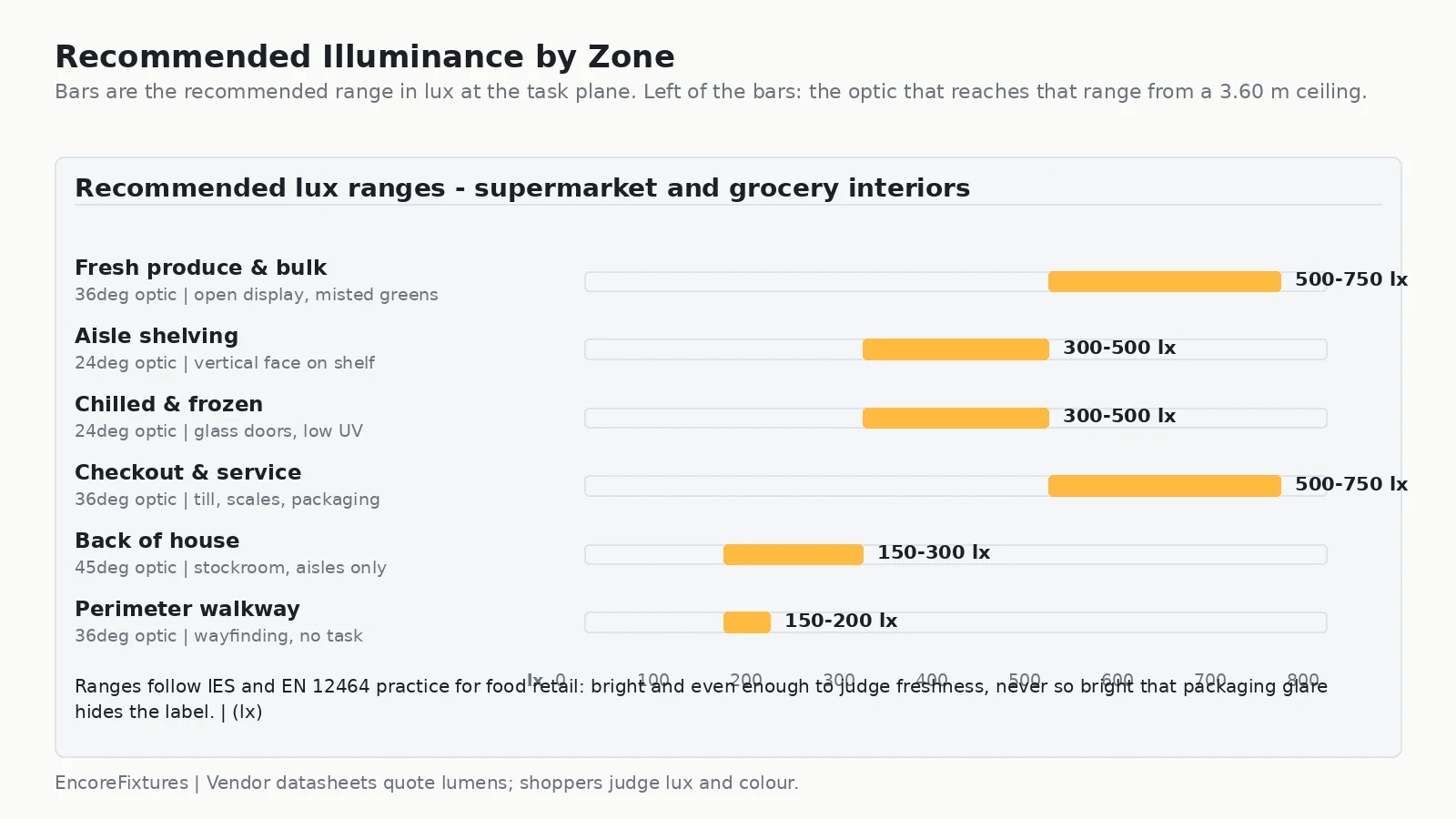
Two of those rows are worth repeating. Fresh produce and the butcher counter get the most light in the building, because they are the two zones where visual quality converts directly into margin. And the perimeter walkway should stay dimmer than the aisles — not to save energy, but because a bright perimeter has nothing to contrast against, and the accent layer stops reading as accent.
Colour Temperature: Which CCT for Which Zone, and Why
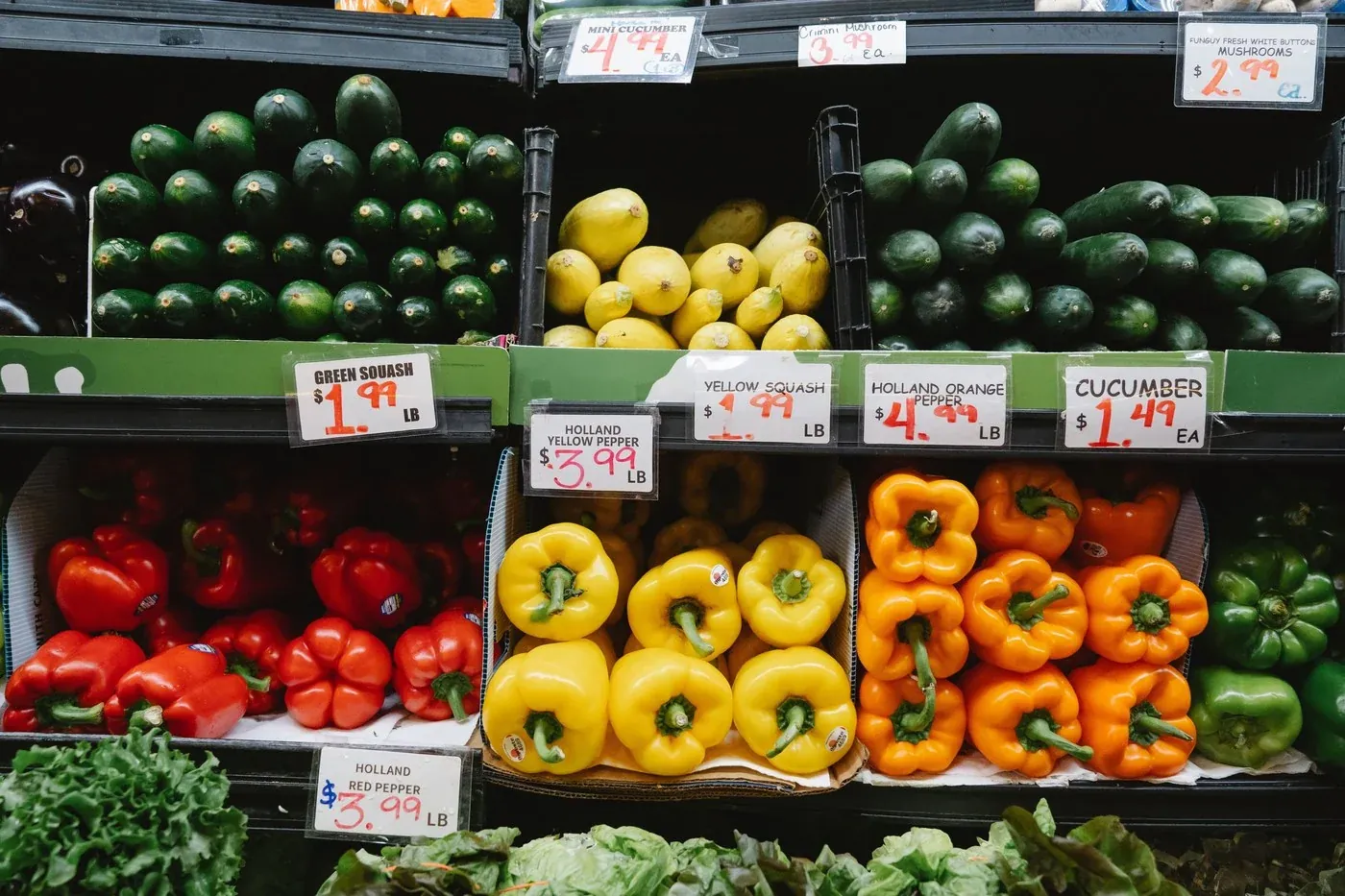
CCT is the most argued-about and least-understood control in grocery lighting, because it does two jobs at once: it sets the mood of the store, and it decides which pigment in the food looks good.
The mechanism is simple. Moving from 3000 K to 4000 K shifts spectral power toward the short wavelengths and away from the long ones. Measured at three representative channels, normalised at 555 nm where the eye peaks:
| Channel | Reads as | 3000 K | 4000 K | What changes on the shelf |
|---|---|---|---|---|
| 450 nm | Blue / green | 0.38 | 0.63 | Greens, lettuce, herbs and cucumbers gain saturation at 4000 K |
| 555 nm | The eye’s peak | 1.00 | 1.00 | Reference point — brightness perception is unchanged |
| 660 nm | Deep red | 1.66 | 1.18 | Beef, tomato, salmon and bakery crust lose their depth at 4000 K |
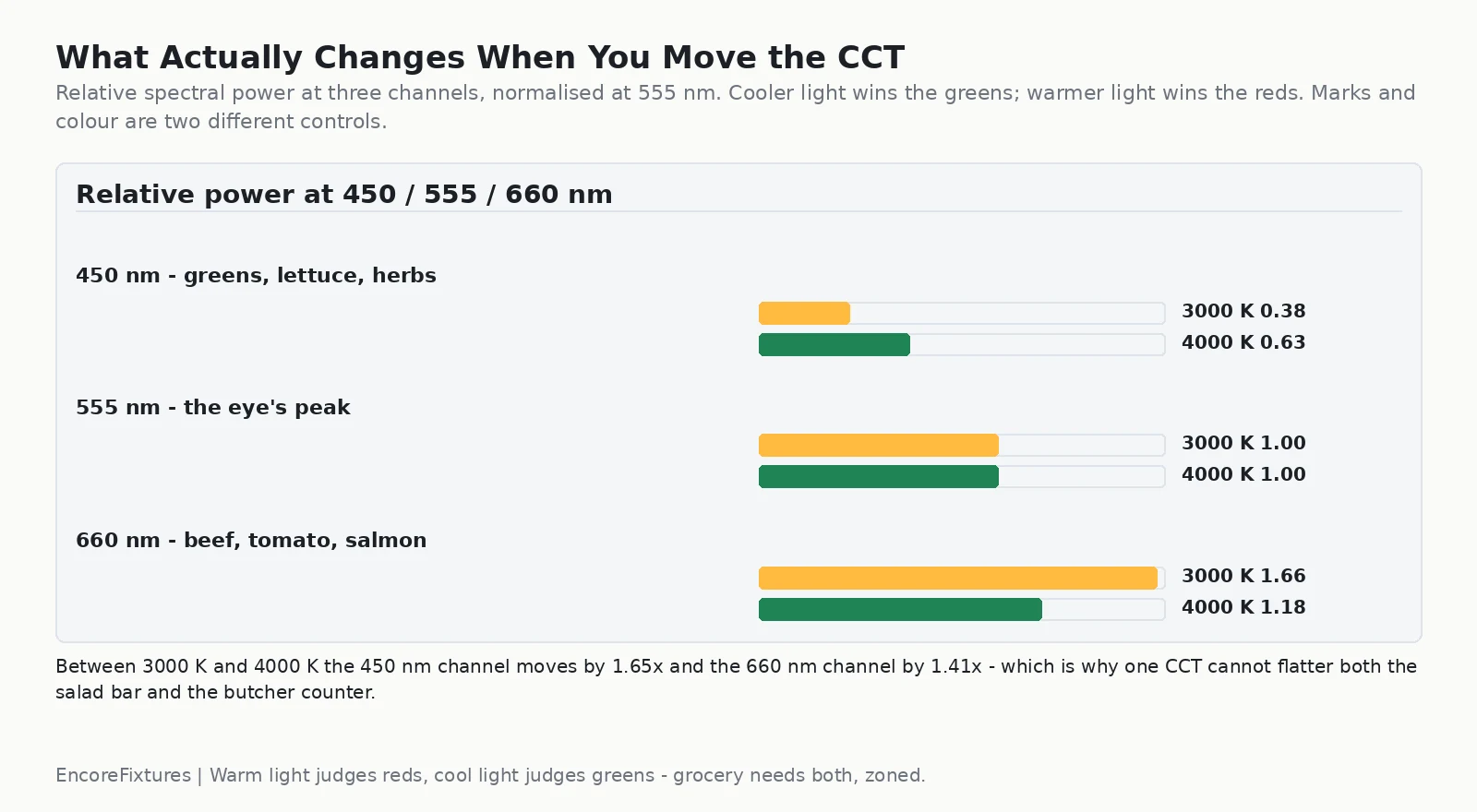
The mechanism above is a black-body approximation of a white LED; the formal treatment of colour appearance and colour rendering is published by the International Commission on Illumination (CIE). What it means in a grocery aisle is simple: the practical conclusion is a two-temperature store, not a one-temperature store.
, not a one-temperature store:| Zone | CCT | Reason |
|---|---|---|
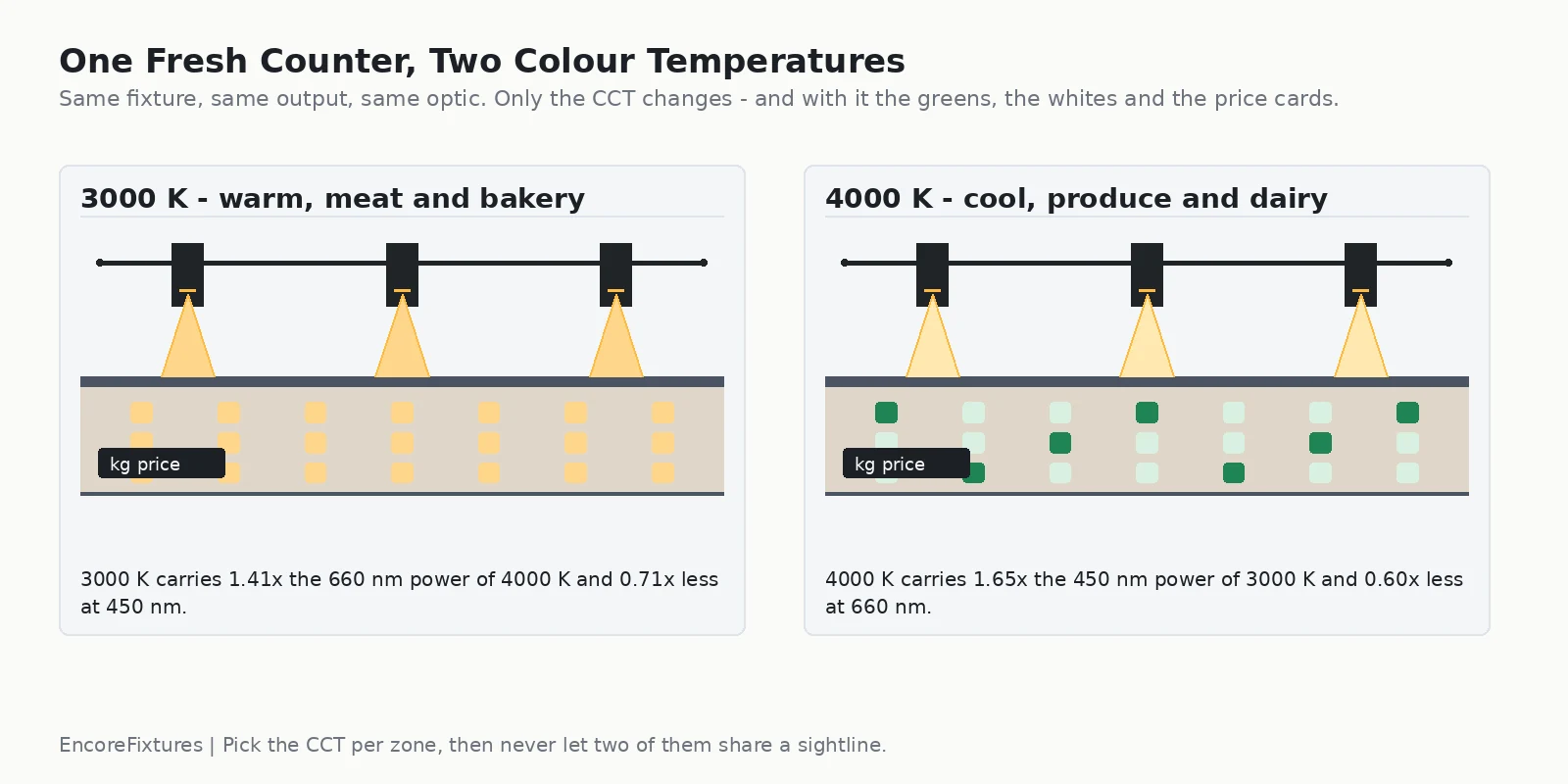
| Fresh produce, dairy, frozen, seafood | 4000 K (up to 5000 K on iced fish) | Short-wavelength power separates greens, whites and iced blues; signals cold and clean |
| Butcher, deli, bakery | 3000 K | Long-wavelength power keeps red meat, pastries and crust warm and appetising |
| Dry aisles, checkout, back of house | 4000 K | Neutral white, unambiguous packaging colour, cheap to run uniformly |
| Entrance and promo zone | Whatever the brand is, ±0 | One decision per store, applied consistently |
What you must never do is let two CCTs share a sightline. A 3000 K butcher counter with a 4000 K aisle behind it makes both zones look wrong, because the eye judges each relative to the other — the meat looks jaundiced, the aisle looks clinical. Keep the transitions behind a wall, a shelving gantry or a change of ceiling plane. For the full optics of CRI and R9, and how a Ra 90 lamp can still render red badly, see 2700K vs 3000K — the mechanism is identical, only the target pigment changes.
CRI, R9 and Standby Colour: The Specification a Datasheet Will Not Give You
Two numbers decide whether the colour temperature you chose actually lands on the food.
Ra (CRI) is an average of eight pastel test patches, R1 to R8. It excludes saturated red entirely. So a lamp can score Ra 90 while rendering beef, tomato and chorizo as flat brown, because the average never looked at red. This is why grocery specifications have to write R9 as a separate line — for produce and counters, R9 ≥ 50 is the practical floor and R9 ≥ 80 is what a butcher counter should ask for.
Standby colour matters as much as the lit colour. A fixture that swings blue at 20 percent output will make the store look like a car park at close, and the failure is invisible on a datasheet that only quotes full-output values. Ask for the CCT at 100 percent, 50 percent and 20 percent; the shift should be under about 100 K across the range.
The same reasoning runs through using track heads to sell product in general retail. Layering CRI and CCT correctly is what makes the produce wall below read as wet rather than dusty, and it is a fixture-level decision rather than a control-level one. Encore builds the produce and dairy optics as Ra 90, R9 ≥ 50 heads in the same housing family as the warm counter optics, so one specification covers both ends of the store without a colour step at the aisle change.
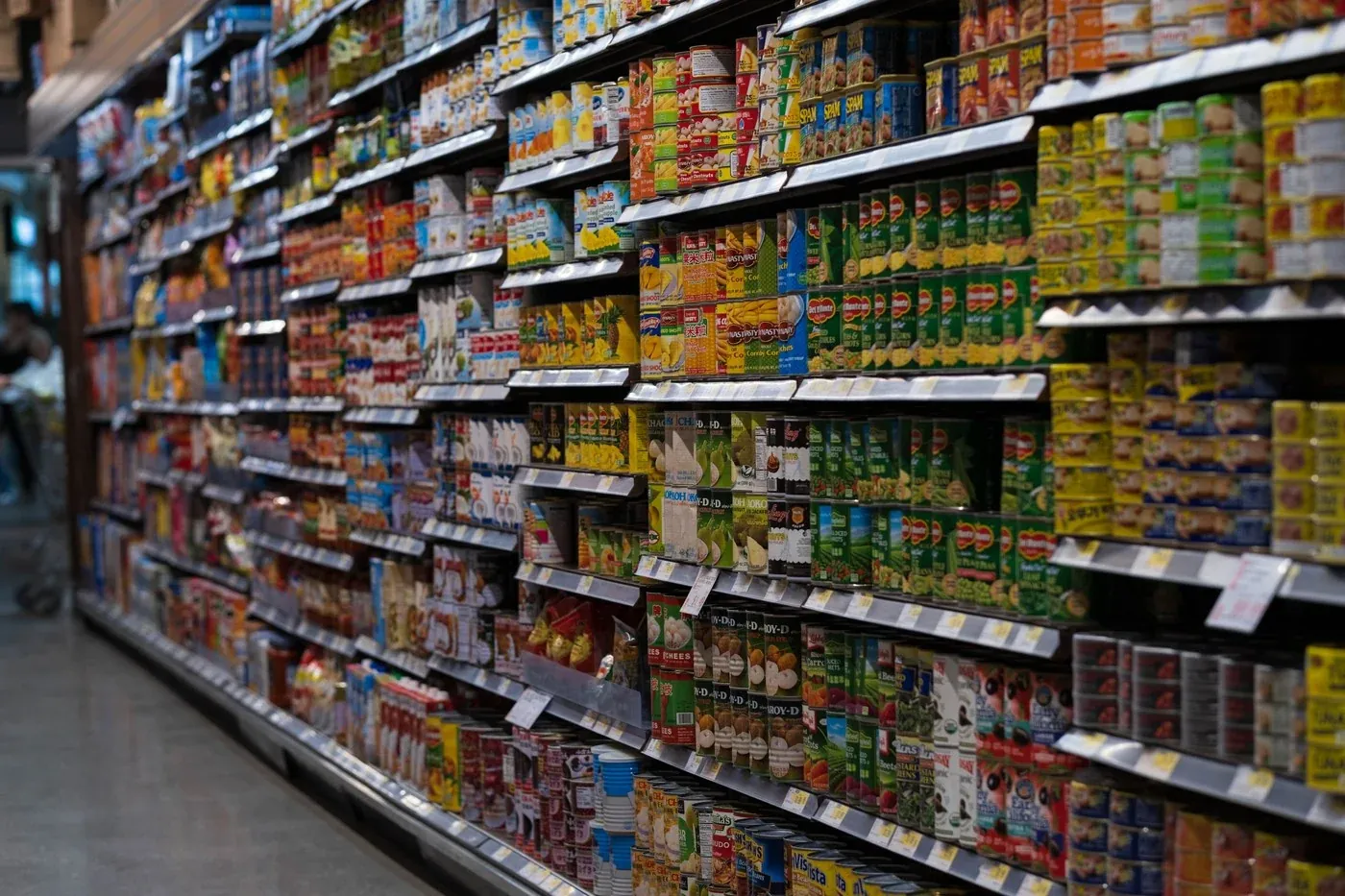
The Aisles: Dry Grocery, Chilled and Frozen
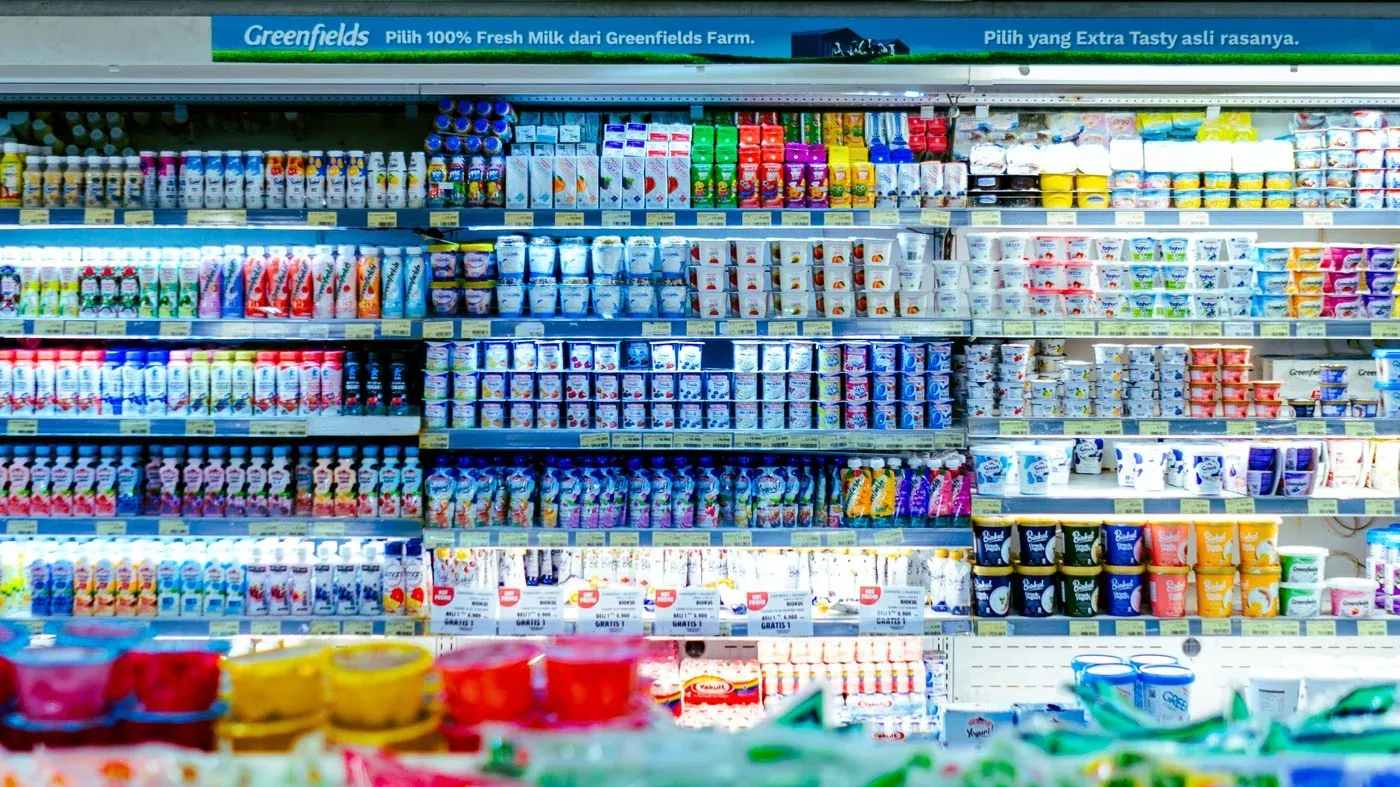
Dry aisles want uniformity and a neutral CCT. Four to six heads per 3 m bay, spaced on the pool, is typical. Because the shelf face is only 1.50 m below the fixture, a 24° optic gives a 0.64 m pool — enough to cover one bay’s worth of vertical face at a time, which is why dry aisles usually run a higher head count than the drawings first suggest.
Chilled and frozen is where optics matter more than lumens. Aiming at normal incidence turns the glass into a mirror; angling the head 20–30° off the plane of the door moves the reflection out of the customer’s line of sight. If the aisle is too narrow to do that with a ceiling-mounted head, a Projector-style head with a snoot or four-leaf barn doors gives you the cut-off control to keep light on the shelf and off the glass.
Freezer chests come with their own problem: a high lid means the product face is at 1.2–1.4 m, unusually far below the fixture and unusually horizontal. Wider optics work here, because the task is a broad lid rather than a narrow vertical band.
Fresh Produce, Butcher and Deli: Where the Lighting Earns Its Money
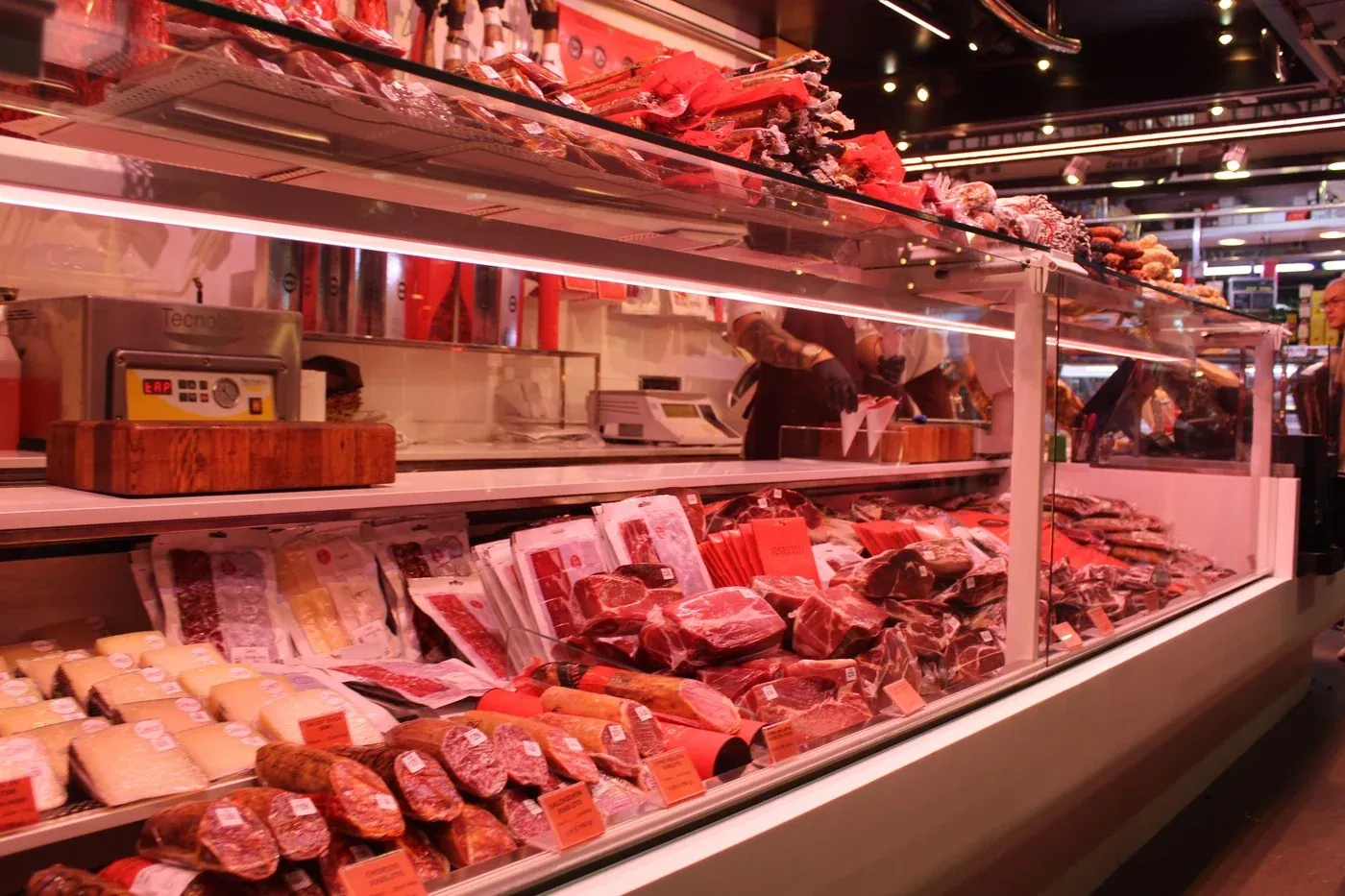
Fresh departments are where the lighting bill meets the revenue line, and three things go wrong repeatedly.
Glare on the misted produce
Misted greens and wet peppers are specular surfaces. A head that is bright enough to give a good general impression can put a white highlight on every wet surface in the run, and the department reads as harsh rather than fresh. The fix is not lower output — it is a diffused or recessed aperture plus a careful aim. An anti-glare downlight with a deep recessed aperture or a linear wash along the top of an angled display does the same job with far less sparkle.
Warm floor, cool counter, no transition
Produce and meat are almost always adjacent, and almost always specified separately. The result is a hard colour step at the department boundary. Either keep the two departments under one CCT and fix the reds with R9, or place the transition behind a structural element so no shopper sees both at once.
Accent with no ambient to be an accent against
Promotional islands get the narrow-beam treatment and the ambient gets cut to pay for it — and the result is a bright island in a grey room with no visual hierarchy. Hold the ambient at 300–500 lx on the surrounding circulation, and let the accent sit 3:1 to 5:1 above it. The contrast is the design.
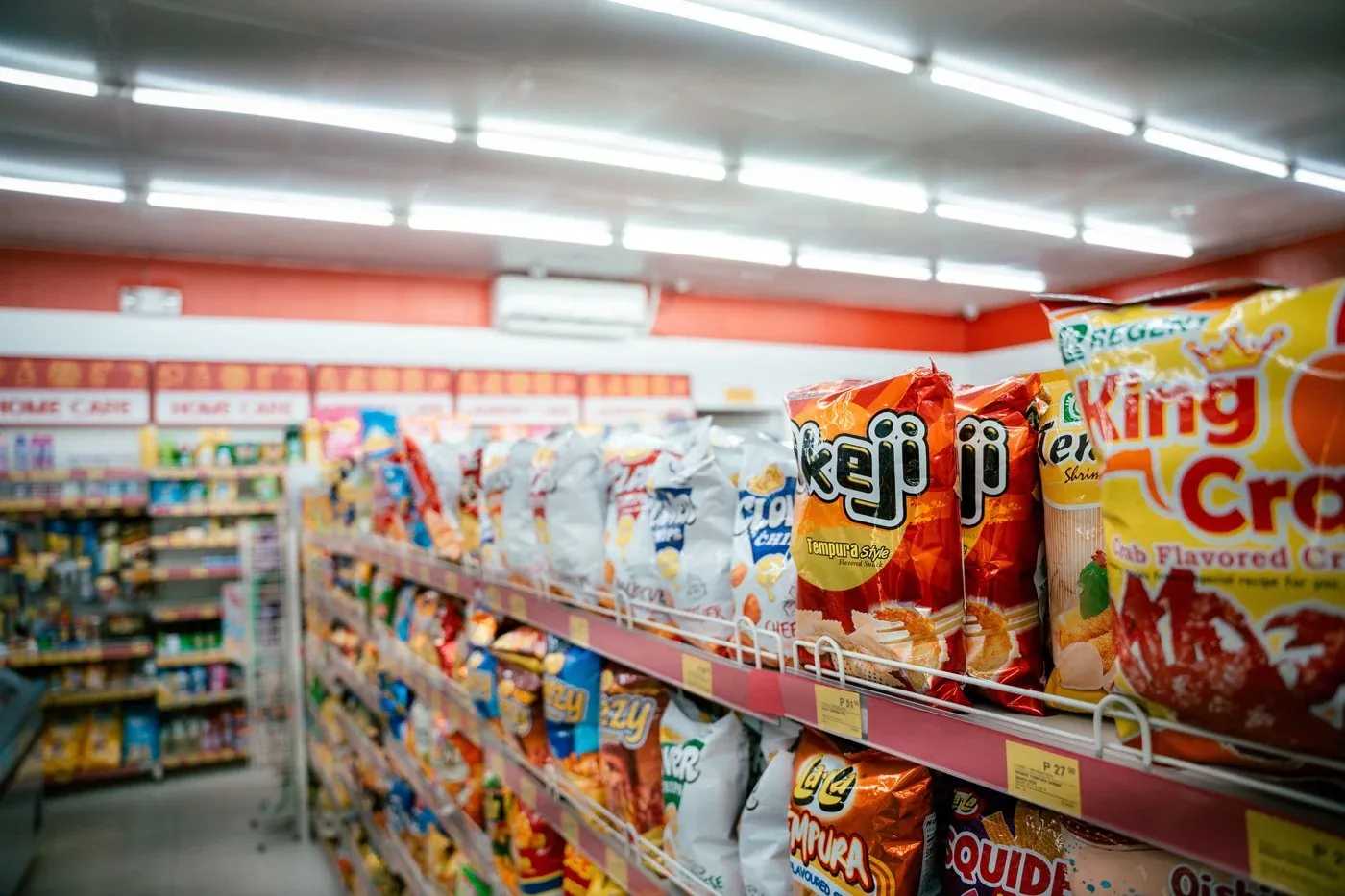
Checkout, Scales and the Bags: Light for Two Seconds of Concentrated Attention
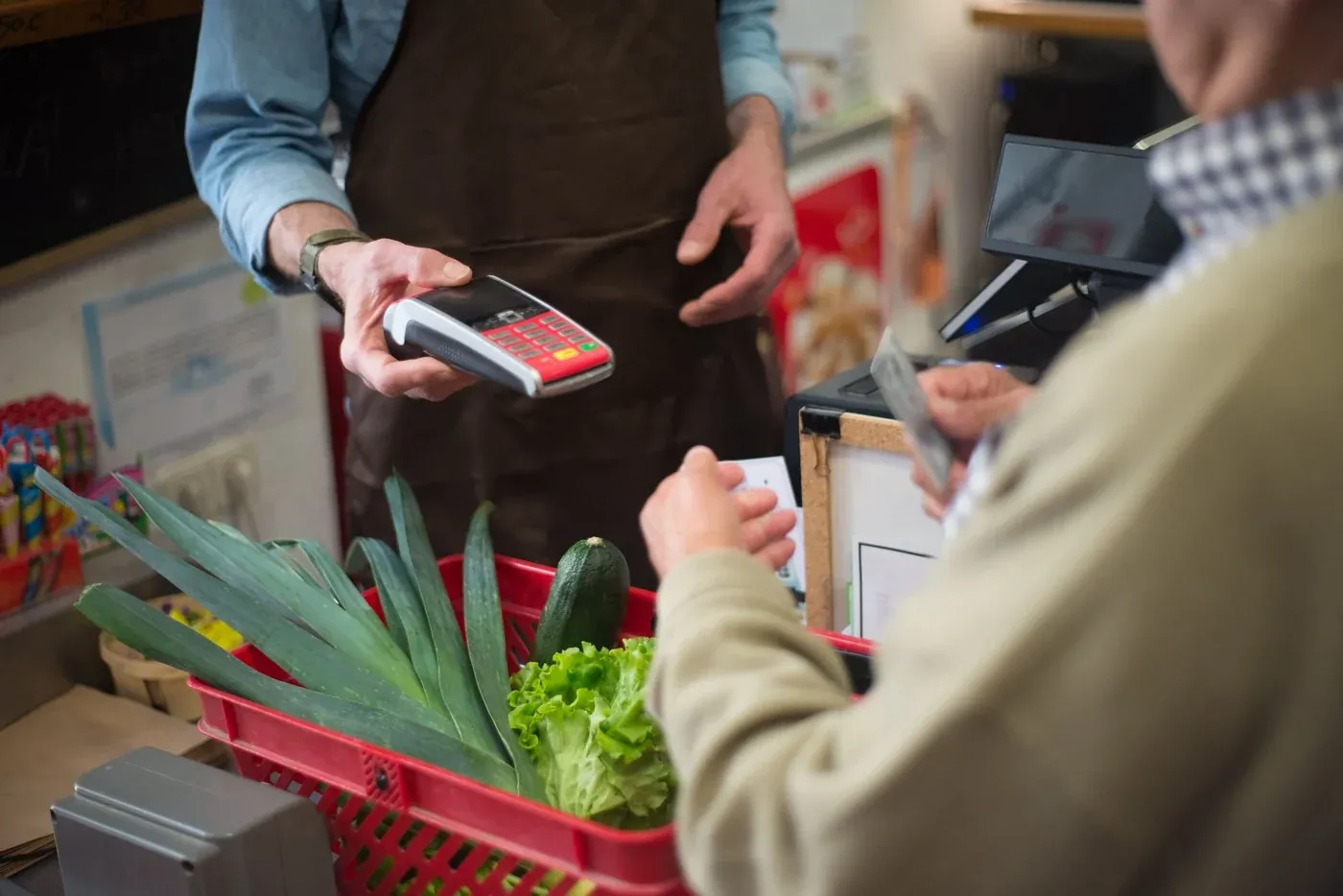
Checkout lighting has an unusual requirement: it is the one place where the shopper looks down and close for an extended period. That makes it the store’s highest glare-sensitivity zone even though it is not its brightest.
- 500–750 lx on the belt, the scale and the packaging surface — high enough to read a card, count cash and check a receipt.
- Slight over-aim, not straight down. A head aimed vertically over the till puts its source in the customer’s field of view during payment. Tilt it 15–25° forward so the source stays behind the shopper’s brow.
- Watch UGR. Every fixture should be at or below UGR 19 at the till; below UGR 16 if the store runs a service desk where staff work under the same head all shift.
- Give the weighing station its own head. Scale and screen illumination is a task, not ambience — the digital display is only readable if the light is on the display rather than behind it.

High Ceilings, High Racks and the Square Law
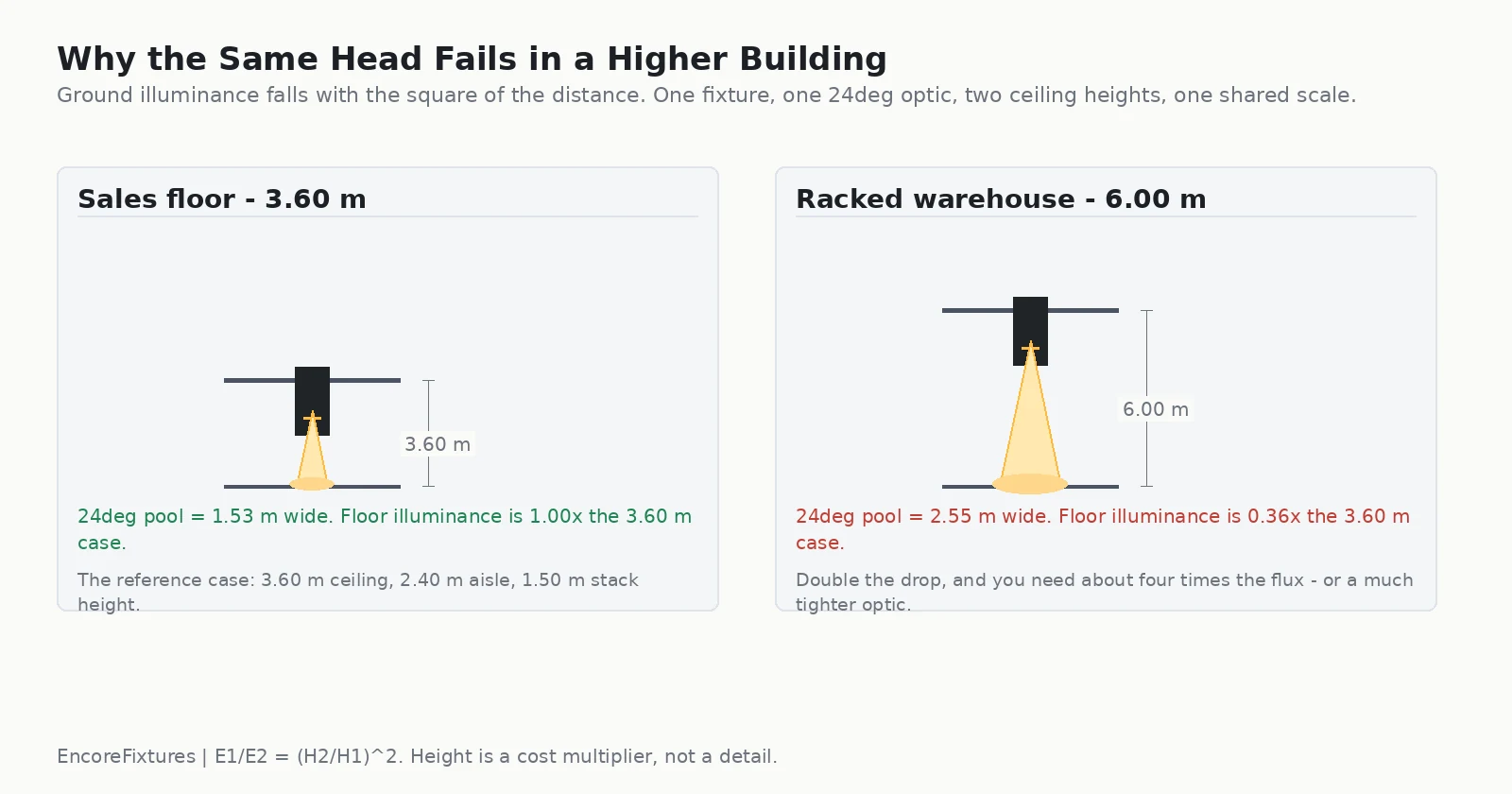
Every so often the brief jumps from a 3.60 m sales floor to a 6.00 m warehouse-style shed. The instinct is to keep the same fixture and add heads. The arithmetic says otherwise: illuminance falls with the square of the distance, so moving the same 24° head from 3.60 m to 6.00 m drops floor illuminance to 0.36× — a 64 percent loss — while the pool widens from 1.53 m to 2.55 m.
Getting that back means roughly four times the flux, or a much tighter optic, or both. On tall ceilings the sensible answers are high-output heads such as the GALAXY Cylinder 20W–45W, wide linear runs (SLEM linear system, ATRO 26 mm linear system) for the ambient layer so the head count stops mattering, or going to the ceiling height as a design constraint rather than fighting it with wattage. The same trap applies to aisles with very high shelving, and our guide to lighting 12-foot rooms works through the numbers.
Controls, Dimming and Daylight: Where Grocery Refits Usually Leak Energy
Grocery stores run long hours in buildings with a lot of daylight, which makes controls the highest-return part of the specification — and the part most often value-engineered out.
| Control | What it buys | Watch out for |
|---|---|---|
| Daylight dimming (closed loop) | 15–30 % saving on the perimeter aisles and the entrance zone | The colour of the daylight and the colour of the LED must match, or the dimmed zone goes visibly blue or yellow at midday |
| Scheduling by trading pattern | 10–20 % on back-of-house and stockroom | Do not dim the produce department during the quiet hours — perceived freshness is the whole proposition |
| Occupancy in store rooms | Up to 60 % in low-traffic rooms | PIR sensors that switch to zero in a chilling corridor are a health-and-safety problem; use them with a maintained 10 percent low level |
| Dimming down to 10 % | Clean and restocking scenes without over-lighting the store | Check the flicker at the bottom of the range, and the CCT shift — this is where cheap drivers show themselves |
For the standards behind the dimming and flicker claims, the U.S. Department of Energy Solid-State Lighting programme and the DesignLights Consortium qualified products list are both useful references for what a datasheet should be showing you. The two protocol notes below matter more than they look on a grocery floor.
Two protocol notes. For a new build or a full refit, DALI-2 gives you per-fixture addressability, which is what you need to dim a perimeter aisle independently of the centre; 0–10 V is cheaper and adequate for zone-level control. Either way, the retail lighting protocol matters more than it looks, and it is worth reading the product page notes on our digitally controlled heads before deciding.
Three Failures You Can Catch on the Drawing
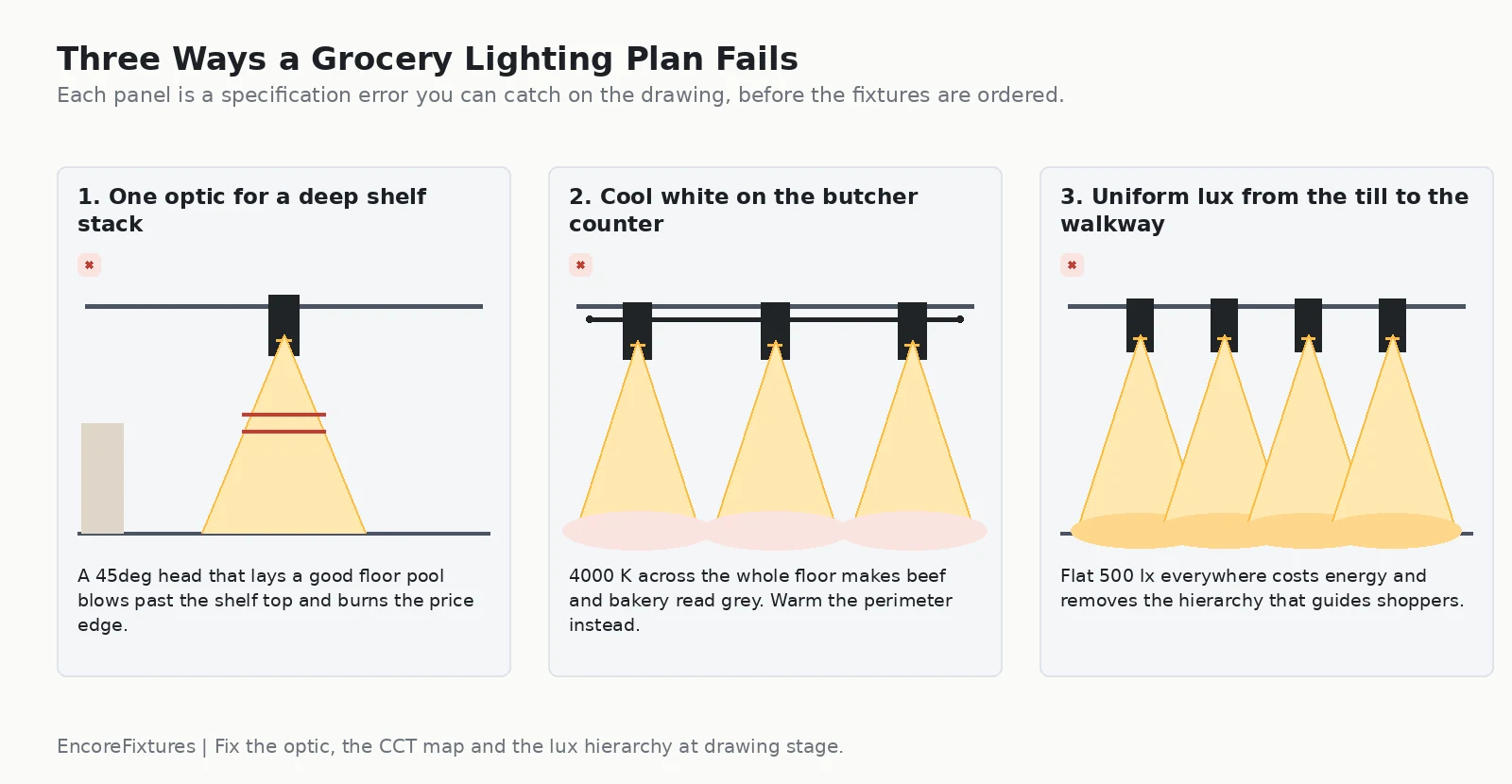
Every one of these was seen on a live project, and every one was cheaper to fix on paper than in the ceiling:
- One optic for a deep shelf stack. A 45° head that lays a perfectly good 2.98 m floor pool is aimed at shelving 2.00 m tall and 1.50 m below it. The result is a blown-out top shelf, an unlit bottom shelf, and a hot band along the price edge. Fix: separate the optics by how far the surface is from the fixture.
- Cool white on the butcher counter. 4000 K across the whole sales floor is easy to buy and easy to run. It also drains the reds out of beef, salmon and pastry, and the fresh departments lose the argument with the shopper’s eye. Fix: something like a 3000 K VEGA-Standard head with R9 ≥ 80 on the counters, 4000 K everywhere else.
- Uniform illuminance from the till to the walkway. A flat 500 lx everywhere hits every code, costs far more than it needs to, and destroys the contrast that makes a promotional display read as promotional. Fix: 500–750 lx at the task, 150–200 lx on the circulation, and an accent layer 3:1 to 5:1 above the ambient.
A Track Layout That Actually Gets Specified
Here is the whole method in the order it survives a value-engineering review:
- Zone the plan. Produce, butcher/deli, dry aisles, chilled, checkout, back of house, perimeter. Assign each one a lux range and a CCT from the tables above.
- Find the real
Hper zone. Floor-mounted fixture: ceiling height. Shelf-face task: ceiling minus shelf height minus a 0.10 m working gap. - Pick the optic from the pool. A 36° head at 3.60 m gives 2.34 m; if the aisle is 2.40 m, that fits, and it does not fit at 3° of tilt. Use
D = 2H·tan(θ/2)and check the pool against the aisle width, every time. - Set the spacing from the overlap, then divide the run length by the spacing to get the head count. Head count is an output, never an input.
- Check the lumen budget per zone at the task plane with
E = Φ·UF·MF/A, using MF 0.80 and UF 0.85 as a starting pair. If the numbers do not close, change the optic before you change the wattage. - Write CRI and R9 as two numbers, and add the standby colour shift at 20 percent output. Then specify the dimming protocol and the scene list.
A minimal grocery bill of materials usually ends up looking like this: VEGA-Standard 30W heads at 3000 K over the counters; IMAX-Zoomable or AIMER 25–35W heads set to 24–36° over the dry aisles; OVEGA-Zoomable for the produce wall where the optic will need to be corrected after the display is installed; WASH-02 or ATRO linear for the ambient bands; and MEGA or NOVA-Orb where the store wants the hardware to be part of the design language. All of them take the same track, the same driver options and the same colour families, which is what stops a refit turning into five incompatible inventories.
If the store also needs the hardware to disappear into a black ceiling, our black track lighting guide covers the finishes; if the plan includes magnetic rails for the promo zone, the magnetic track range shares the same optics.
Related Reading on Store Lighting
If this article is the geometry, these are the neighbours. Retail display lighting specs covers the accent layer and the 3:1 contrast rule in a general-merchandise context. Track lighting for retail stores walks through sales-floor layouts. Commercial lighting lux requirements has the cross-sector lux table, and lux vs lumens explains the metric itself. For the warm end of the spectrum and how R9 changes what meat looks like, 2700K vs 3000K is the closest companion to the butcher-counter section above.
Supermarket & Grocery Store Track Lighting: FAQs
How many lux does a supermarket need?
Dry grocery aisles should sit at 300–500 lux on the shelf face. Fresh produce, butcher and deli counters, and the checkout area need 500–750 lux at the task plane. Chilled and frozen cabinets run 300–500 lux, back of house and stockrooms 150–300 lux, and perimeter walkways 150–200 lux. The store is deliberately not uniform, because the contrast between zones is what directs attention.
What beam angle should I use for track lights over grocery aisles?
Work backwards from the pool. At a 3.60 m ceiling, a 24° optic gives a 1.53 m pool and a 36° optic a 2.34 m pool on the floor. For a shelf-face task the fixture is only about 1.50 m above the shelf stack, so the same 24° optic gives a 0.64 m pool and a 36° gives 0.97 m. In a 2.40 m clear aisle, 24–36° is the practical range; 45° is a floor optic only.
Should supermarket lighting be 3000K or 4000K?
Both, in different zones. Use 4000K on fresh produce, dairy, frozen and seafood, where short-wavelength power separates greens, whites and iced blues. Use 3000K on butcher, deli and bakery counters, where long-wavelength power keeps red meat and crust looking warm and appetising. Keep 4000K on the dry aisles, the checkout and back of house. Never let two colour temperatures share a sightline — put the transition behind a wall or a shelving gantry.
What CRI do I need for supermarket lighting?
Ra 90 minimum, plus R9 stated separately at 50 or above, and 80 or above on butcher and deli counters. Ra on its own averages eight pastel patches (R1 to R8) and excludes saturated red, which is the colour that dominates meat, tomato, salmon and packaging graphics. If a datasheet does not quote R9, treat the fixture as unspecified. Also ask for the CCT at 20 percent output, not just at full output.
How much light do fresh produce sections need?
500–750 lux on the product face, with the highest CRI in the store and a colour temperature of 4000K or cooler. Misted produce is a specular surface, so glare control matters as much as output: use diffused or deeply recessed apertures and aim carefully, or the wet surfaces will read as harsh highlights instead of freshness.
Can track lighting handle a whole supermarket, or do I need linear fixtures?
Most grocery projects use both, on the same ceiling. Track carries the vertical and accent layers — the shelf faces, the counters, the promo islands — because it stays re-aimable when the planogram changes, which in grocery is constantly. Linear or wide-beam runs carry the ambient layer over the open floor and the long aisles, where a fixed even band is cheaper per lux than a row of heads. Specify them in the same colour families so the two layers read as one design.
Why does my store look bright in the drawing but dim on site?
Usually one of three things. The lux was measured at the floor when the task is the shelf face 2 m higher. The beam angle was chosen from the fixture rather than the pool, so the light is spread wider than the aisle and half of it lands on shelving uprights. Or the maintenance factor was left at 1.00, which ignores the 20 percent you lose to dirt and LED ageing. Re-run the numbers at the real task plane with MF 0.80 before changing any hardware.
Do I need dimming in a supermarket?
Yes, and not only for energy. Grocery stores need at least three scenes: full trading, restocking and closed. Daylight dimming on perimeter aisles typically returns 15–30 percent, occupancy control in store rooms up to 60 percent. Specify flicker-free dimming down to 10 percent and confirm the colour shift across the range — that is where cheap drivers show up.
Specify in the Order That Survives the First Price Review
Read the plan as six lighting conditions rather than one room, fix a CCT and an R9 value for each, derive the pool from the real mounting height and the optic, and let the head count fall out of the spacing. Fixtures come last — by then the brief is specific enough to defend against the first cost-cut.
ENCORE manufactures track, linear, magnetic and downlight systems built for grocery interiors: Ra 90 with R9 stated separately, 3000 K and 4000 K in the same housing families, adjustable optics for shelf faces that change after installation, and drivers that dim to 10 percent without a colour shift. The track light range covers the vertical and accent layers, the linear light range the ambient bands, and the magnetic track range the re-configurable promo zones.
Send us the plan, the ceiling height, the shelving schedule and your trading hours, and we will return a zone-by-zone specification: lux target, optic, pool diameter, head spacing, CCT, CRI and R9, plus a lumen budget you can price. Talk to the Encore specification team — or start from our overview of commercial track lighting.