
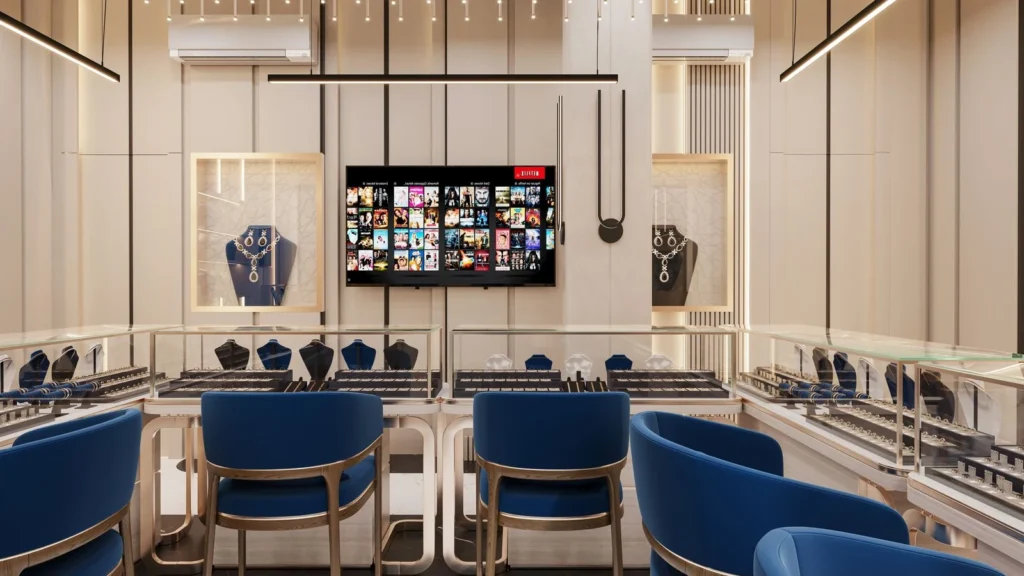
Walk into two jewellery stores on the same street and one case sparkles while the other looks like a pawnbroker’s window. The difference is almost never the number of lumens. It is whether the light that lands on the stone has the spectrum to make it look like a stone, and whether the beam is narrow enough to concentrate those lumens on the one piece you want the customer to notice. This guide works through jewelry store lighting the way we spec it on live jobs: CRI and R9 first, beam angle second, lux third — because that is the order in which the three actually decide how a case reads.
Everything below is computed from the same formulas we use in quotations, so you can reproduce each figure with a tape measure, a light meter and a spec sheet. If you are fitting out a single boutique or rolling out a chain, the arithmetic does not change.

Why Jewelry Store Lighting Is a Spectrum Problem Before It Is a Brightness Problem
A diamond does not glow. It returns borrowed light — and what it returns depends on which wavelengths you sent in. That is why two lamps with identical lumens and identical beam angles can make the same ring look like a showpiece or a piece of cut glass.
Three attributes decide the outcome, and only one of them is on the front of the box:
- CRI (Ra) — the average rendition of eight pastel test colours. Necessary, but a weak instrument on its own.
- R9 — the saturated-red score, reported separately. Ruby, coral, rose gold and skin all live here. A lamp can score Ra 90 with R9 below zero.
- SDCM — how much colour drifts between two heads on the same track. At SDCM 5–7 a row of cases goes green then pink, and the whole floor looks dirty.
Wattage decides only how bright the pool is. It cannot widen a spectrum, sharpen a red, or stop two adjacent heads from disagreeing about what gold looks like.
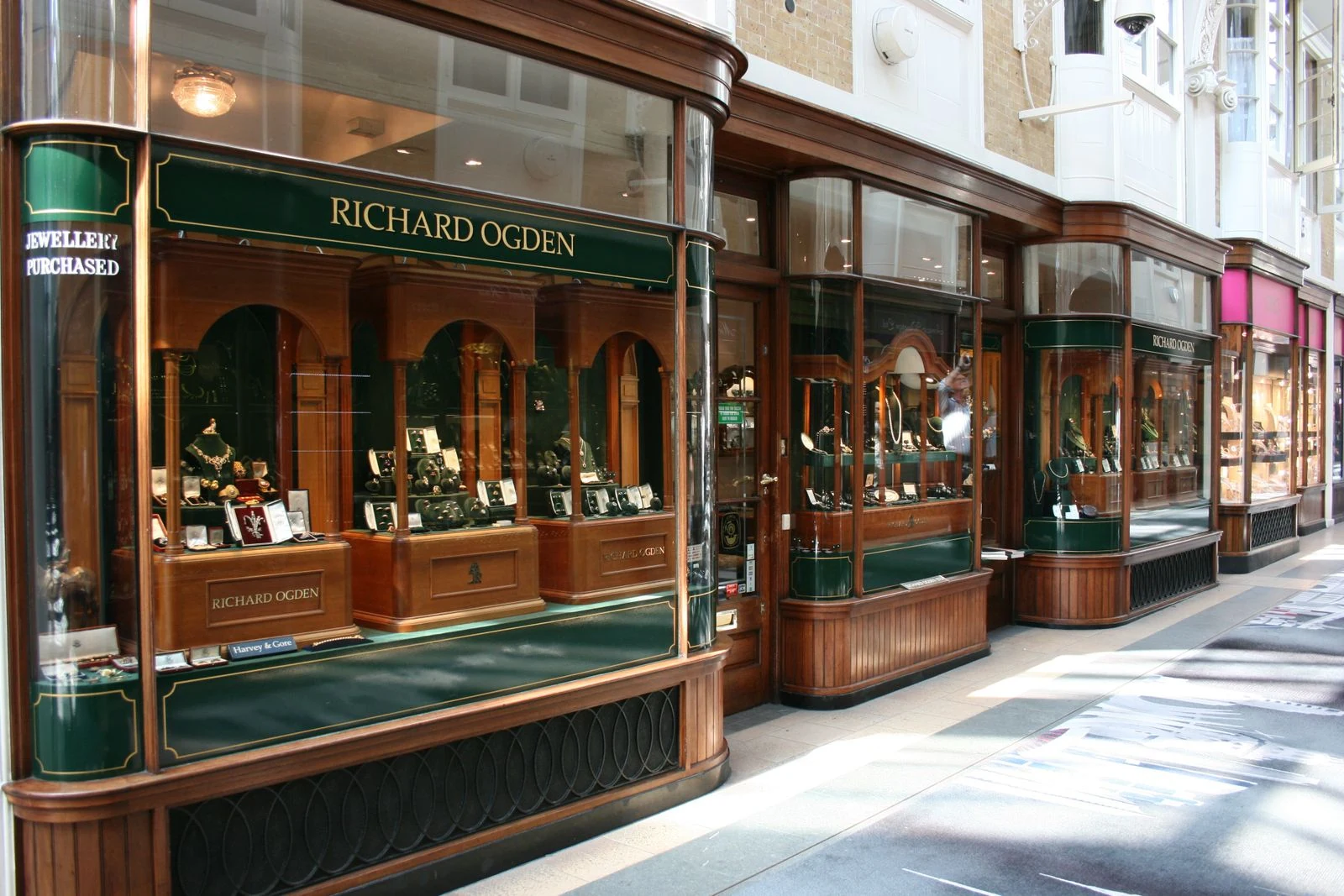
Beam Angle: Sizing the Pool to One Piece, Not the Whole Counter
Beam angle is the lever most often ignored, and the one that most often decides whether a hero piece reads as a hero. The pool diameter is:
D = 2H · tan(θ/2)
Where D is the circular pool on the case top, H is the perpendicular distance from the lens to that surface, and θ is the beam angle. On a standard jewellery floor the ceiling sits at 2.80 m and the case top at 0.95 m, so the throw is 1.85 m. At that throw:
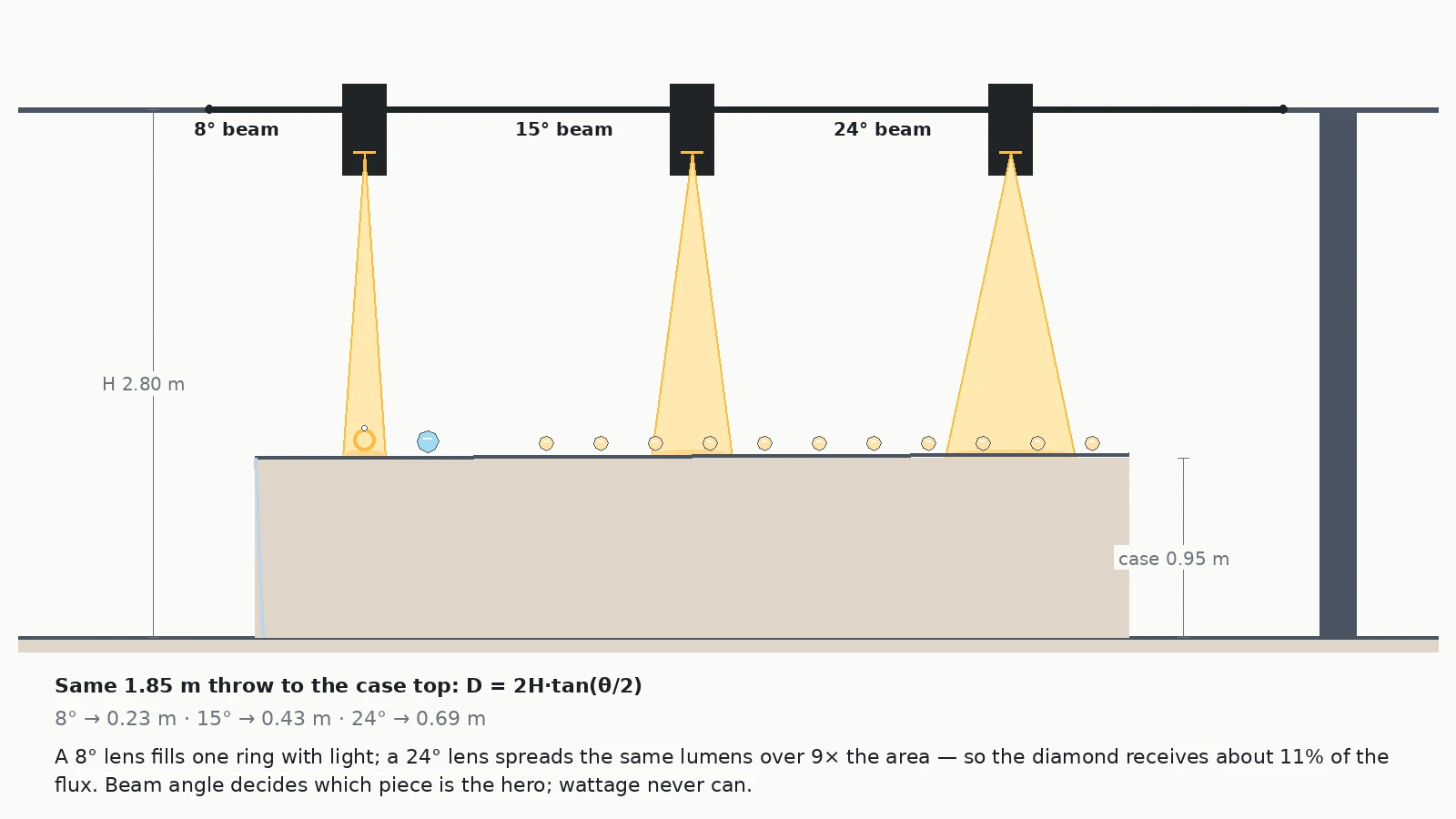
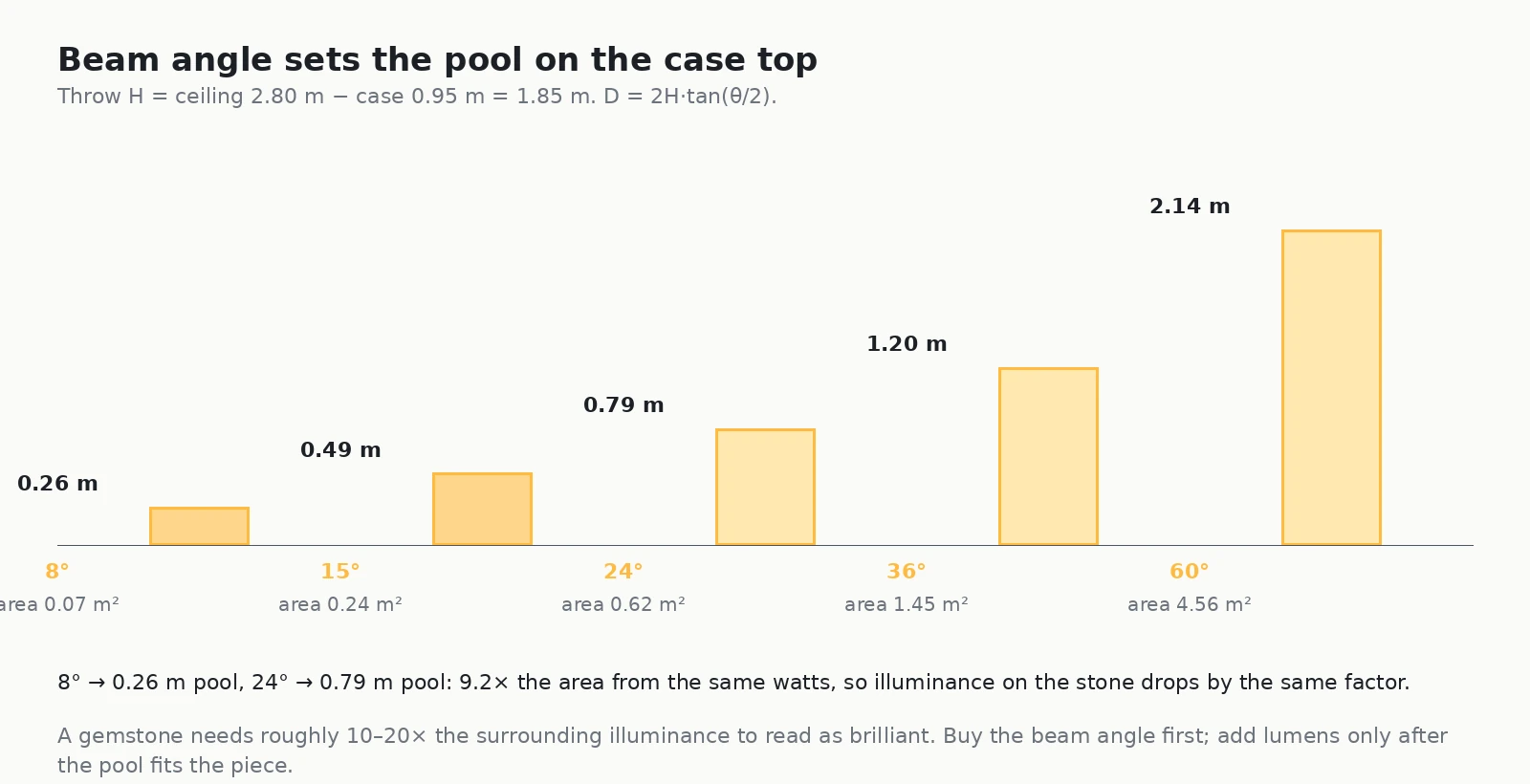
That 9.2× matters more than any lumen figure on a box. If you flood a display with a 24° lens, a 20 mm ring sits inside a pool 786 mm across — the ring occupies roughly 0.1% of the lit area and catches 0.1% of the flux. The lamp is not under-powered. It is over-spread. Narrow the lens and the same fixture becomes a spotlight.
Matching the Lens to the Merchandise
- 6°–10° — a single diamond, a solitaire, one loose stone under a loupe. Tight enough to make the facets read as sparkle rather than as a bright surface.
- 10°–15° — a ring stand, a pendant on a bust, one hero piece on a plinth. The workhorse fine-jewellery angle.
- 18°–24° — a counter run, a two-row tray, a set of matched pieces. Enough coverage for a group, still tight enough to keep contrast against the case beside it.
- 30°–40° — back walls, brand panels, price-list boards and long display runs that must read evenly.
- 50°–60° — circulation and lounge fill only. Never on a piece you are trying to sell.
Where the merchandising plan changes weekly, a zoomable head pays for itself: one optical train, any angle between 15° and 55°, adjusted in place without ordering lenses. Our FLEX-Zoomable 15W-20W covers 15°–40° (15 W) and 25°–55° (20 W) through a front adjusting ring with ±5% beam control, and its 355° horizontal / 90° vertical travel lets a single head cover a case that gets re-merchandised every season.
Height and Throw: The 1/H² Penalty Nobody Budgets For
Illuminance falls with the square of the throwing distance:
E₂ / E₁ = (H₁ / H₂)²
A showcase sitting at 1.20 m under a track is lit 1.85 m below our 2.80 m ceiling. Raising the head from 1.20 m to 1.85 m above the case costs 58% of the illuminance on the glass — you need 2.4× the wattage for the same brightness, and at the same time the head is four times easier for the shopper to see reflected in the case.
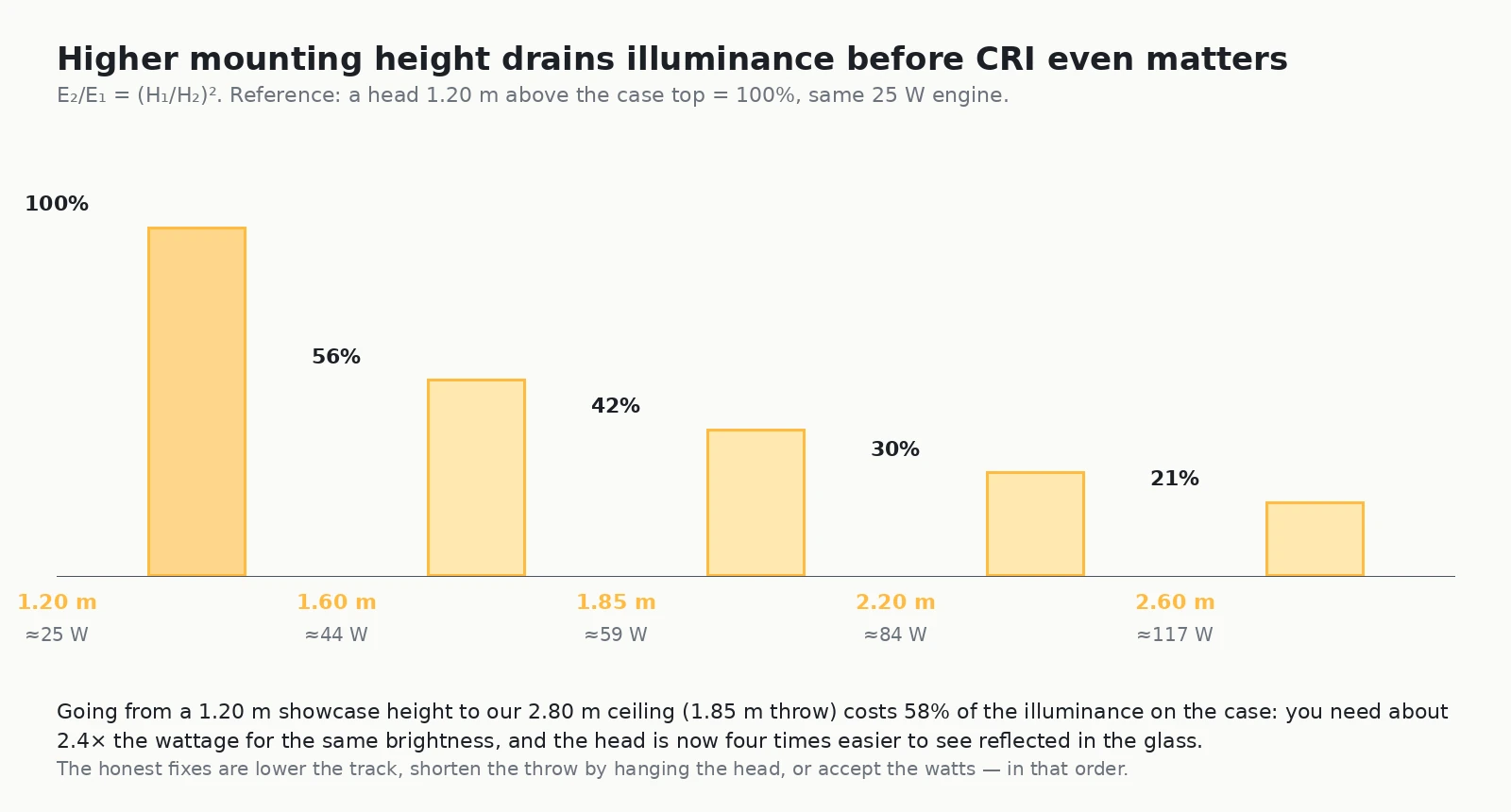
There are only three honest answers to a high ceiling in a jewellery store:
- Lower the light. Pendant or suspended track brings the lens to 2.2–2.5 m and recovers much of the loss. It also reads as deliberate rather than installed.
- Narrow the beam. The same lumens concentrated into a smaller pool raise illuminance without extra watts — the trade-off is that the pool shrinks, so aim matters more.
- Accept the watts. A 1,200–2,400 W track circuit will carry 30–45 W heads if the brief demands a flush ceiling. The limit is cost and heat, not the rail.
What does not work is holding the lens, the wattage and the mounting height all constant and expecting the case to stay bright.
CRI vs Lumens: Why R9 and TM-30 Sit Behind the Sparkle
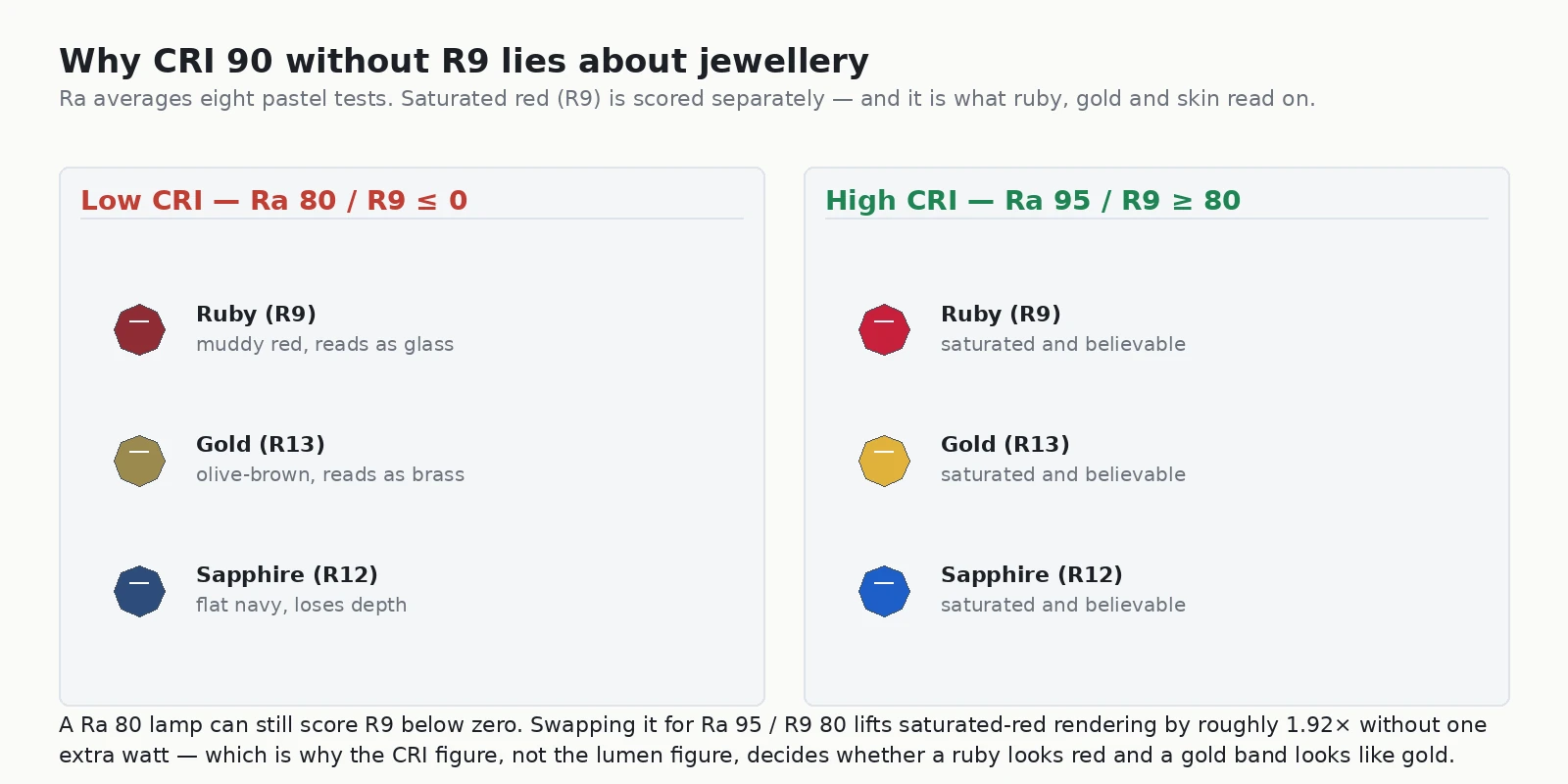
CRI was designed for a less colourful world. Ra averages eight pastel samples — R1 to R8 — with no saturated colour in the set, and it uses a reference that predates LED. A lamp can post Ra 90 while rendering ruby dull, olive-brown and lifeless, because none of the eight samples is red.
R9 fixes that specific blind spot. It is the saturated-red rendition score, listed separately, and in jewellery it is decisive:
- R9 ≥ 80 — ruby, coral, rose gold and warm skin all hold their hue. This is the floor for fine jewellery counters.
- R9 50–79 — acceptable for silver, platinum and colourless stones, where red accuracy matters less.
- R9 ≤ 0 — the lamp makes red objects worse than a reference source. Ruby goes brown and gold goes olive under this light. Plenty of “CRI 90” retail lamps sit here.
TM-30 and the Two-Number Habit
If you are writing a specification you can defend, ask for two numbers instead of one: Rf (fidelity, how close the light is to the reference) and Rg (gamut, whether saturation is boosted or flattened). For fine jewellery a good target is Rf ≥ 90 with Rg 98–104. Below Rg 95 a case looks desaturated; above about 105 it looks toy-like, and diamond fire starts to read as coloured fringing rather than brilliance. Our VEGA-Premium 30W is specified at CRI 95 with COB SDCM ≤ 2 — the pairing you want when several narrow heads share one case and must match exactly.
SDCM: Why the Second Case Looks Dirty
SDCM describes how much colour varies between individual fixtures. At SDCM ≤ 3 two heads side by side on one track are visually indistinguishable; at SDCM ≤ 2 they are indistinguishable even in a matched pair on one case. At SDCM 5–7 the drift is obvious — one case reads green, the next pink, and the customer reads that as poor quality rather than as a lighting problem. For jewellery, insist on SDCM ≤ 3 and prefer ≤ 2 wherever two heads share a case.
The Reflection Problem: Veiling Glare on Glass Cases
A glass case is a mirror with product inside. Aim a head at it too shallowly and the bright lamp is reflected straight back into the shopper’s eye — a veil over the very piece you lit. The controlling geometry is the aim angle off vertical, not the wattage:
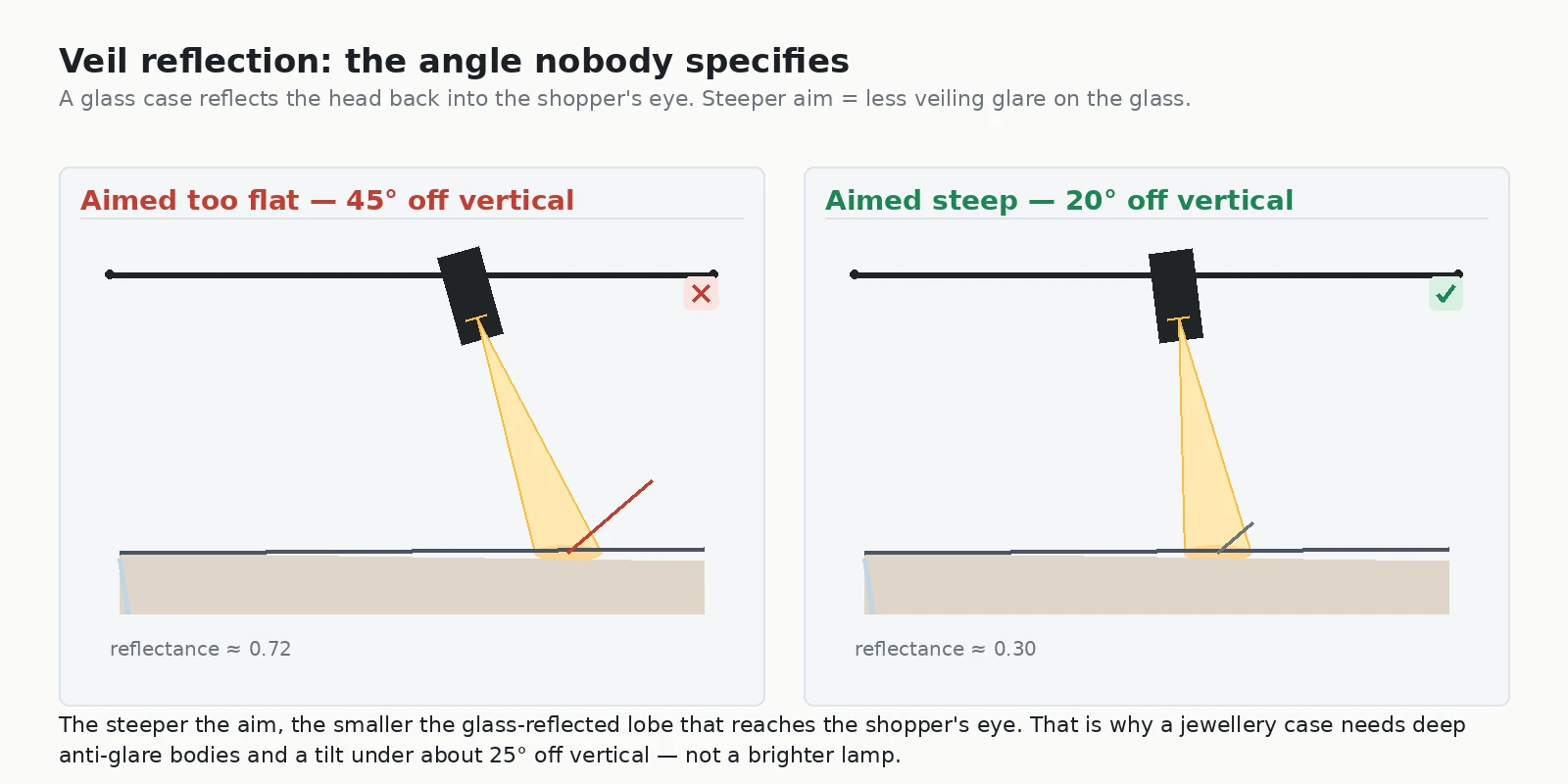
Three habits keep a case clean:
- Keep the tilt under ~25° off vertical. Steeper aim sends the specular lobe away from the standing shopper’s sightline.
- Recess the source. The cut-off angle is arctan(recess ÷ half-aperture). A 35 mm recess in a 60 mm aperture gives 49°, which keeps the lamp out of view; a flat lens in the same aperture gives nothing.
- Specify honeycomb or soft-lens accessories. They are the cheapest post-installation fix for a glary case and a hard shadow in a stone setting.
Our IMAX-Projector 10-20W was built for exactly this job in museums and high-end cases: UGR < 6, no spill light, no stray light, a 21°–34° adjustable beam, framing shutters to cut a clean edge on a rectangular plinth, and 360° pan / 90° tilt with no dead angle.
Lux by Zone: Build Contrast, Not Uniformity
The single most common jewellery lighting mistake is lighting the whole store to the same level. The eye judges brightness by difference; a case at 1,500 lux against a floor at 1,500 lux has no hierarchy, so nothing looks important. Aim instead for an 8:1 to 10:1 case-to-floor ratio.
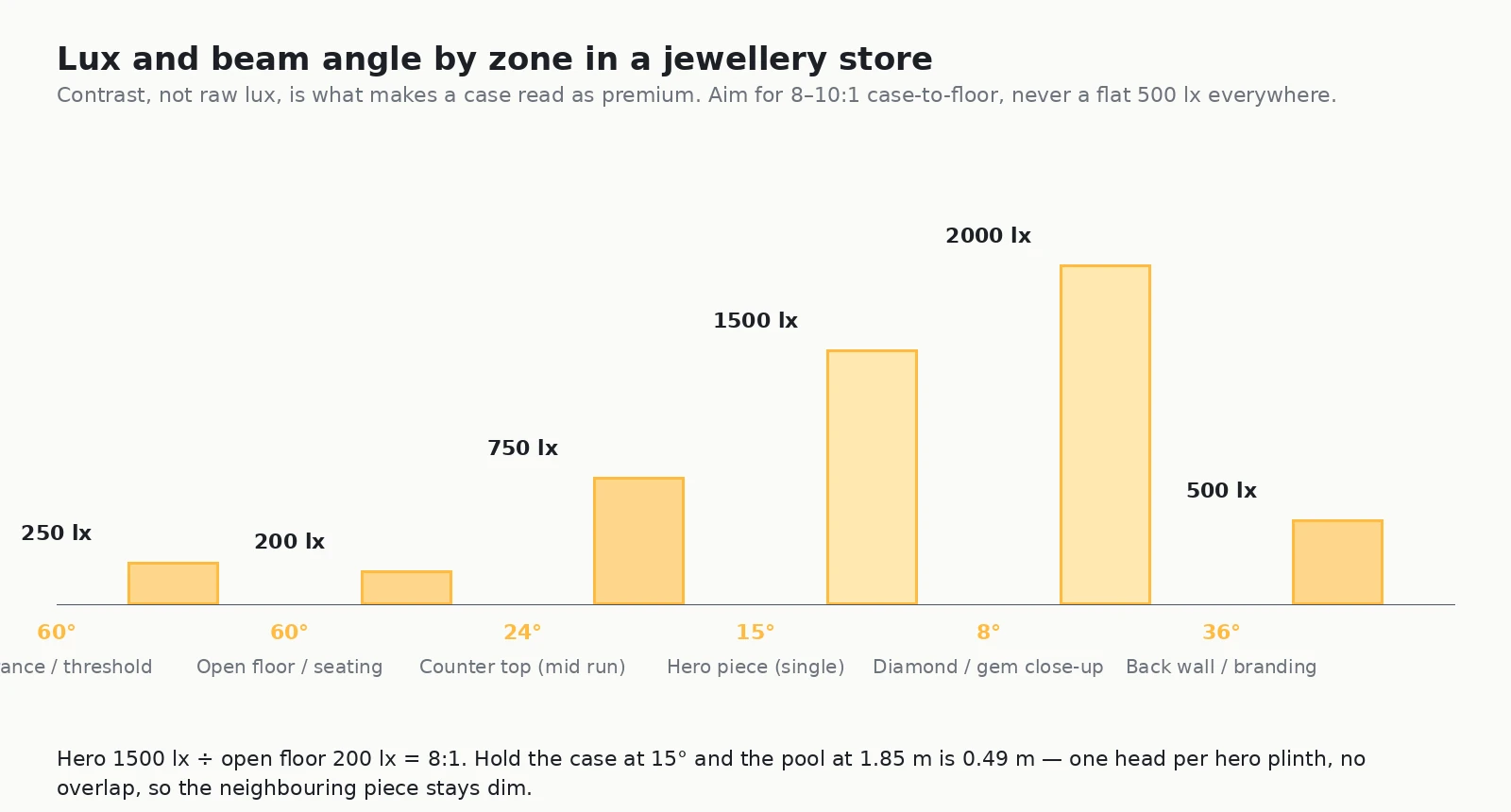
| Zone | Target lux | Beam angle | CCT / CRI | Notes |
|---|---|---|---|---|
| Entrance / threshold | 200–300 | 50°–60° | 3000 K, CRI 90+ | Adaptation zone; never brighter than the cases |
| Open floor / lounge | 150–250 | 50°–60° | 2700–3000 K, CRI 90+ | Deliberately low; it is what makes the cases read |
| Counter run (mid) | 600–900 | 18°–24° | 2700–3000 K, CRI 95+, R9 ≥ 80 | Even along the glass run; each group owned by one head |
| Hero piece (single) | 1,200–1,800 | 10°–15° | 2700–3000 K, CRI 95+, R9 ≥ 80 | One head, one plinth, 8:1 or better over the counter |
| Diamond / gem close-up | 1,800–2,500 | 6°–10° | 2700–3000 K, CRI 95+, R9 ≥ 80 | Watch for heat and fading on treated stones; UGR ≤ 10 |
| Back wall / branding | 400–600 | 30°–40° | 3000 K, CRI 90+ | Even wash; pitch = D × (1 − overlap) at 30–40% overlap |
| Fitting / viewing mirror | 400–600 (vertical) | 30°–40° | 3000 K, CRI 95+, R9 ≥ 80 | Vertical illuminance at face height, no ceiling source in view |
| Cash wrap / POS | 500–750 | 30°–40° | 3500–4000 K, CRI 90+ | Task light for paperwork and card checks |
Note the two-range split in the CCT column. Warm interiors — brass, walnut, velvet, marble — sit best under 2700–3000 K, because a warm source flatters warm materials and skin. Stones with strong native colour (emerald, sapphire, tanzanite) sometimes benefit from 3500–4000 K to add contrast against the golden body jewellery around them, but never mix the two temperatures on one continuous sightline. A 3000 K wall next to a 4000 K wall reads as a dirty patch, not as contrast.
Reading the Sparkle: Cut, Fire and the Angle of Light
What buyers call sparkle is three separate optical effects, and each responds to a different part of the specification:
- Brilliance — the white light returned from the crown. It depends on raw illuminance and the contrast against the background, so it is the effect most sensitive to lux and to a narrow pool.
- Fire — the rainbow dispersion you see as the viewer moves. It needs a source with good spectral coverage and a small physical size; a large diffused source washes dispersion out.
- Scintillation — the on/off flashing as stone, light and eye all move. It is a function of how small the source appears and how still the aim holds. A head that droops at the hinge inside two years kills scintillation before a customer ever notices why the case feels flat.
That last point is the quiet commercial one. Sell-side sparkle depends on the aim staying where the last merchandiser left it. Our own heads use a geared hinge rather than friction, so a head parks at any point in its travel and holds. It is the sort of detail that never shows up in a first-year review and always shows up in the third.
Heat, Fading and What Light Actually Does to Jewellery
Light is not chemically neutral. Before specifying 2,500 lux on a case, check what is inside it:
- UV — amber, turquoise, pearls, coral and many organic gems are UV-sensitive and lose colour irreversibly. Specify UV-free sources or UV filters; LED engines already emit very little UV, but not none.
- Heat — high-illuminance narrow beams put thermal load on one small area of glass and product. Modern LED heads run cool, but a 35 W head with no airflow in a sealed case still warms the interior.
- Visible-light fading — even with zero UV, intense visible light fades some dyes and coatings over long exposures. Rotate the hero piece rather than leaving the same stone under the same beam for years.
The practical rule: push lux on the piece the customer is being shown, keep the rest of the case moderate, and never leave a display piece under a permanent narrow beam untouched. Where fading matters, a museum-grade approach is the reference — our Museum Track Lighting guide works through lux, UV limits and aiming for objects that must survive decades of exposure.
Layering a Jewellery Floor
Fine jewellery needs three obvious layers and one that most projects forget:
- Ambient — a low, even wash at 150–250 lux. Its job is circulation and comfort, not product. Keep it deliberately dim; it is the reference the cases are read against.
- Accent — narrow heads on counters, cases and hero plinths. This is where the 8:1 to 10:1 ratio lives, and it should be the only visibly bright layer in the room.
- Task — the viewing mirror and the sales bench, lit vertically at face height so the customer sees the piece on themselves in a light that resembles where they will wear it.
- The one that gets forgotten: the case interior. A shopper looks down through glass. Light coming from the ceiling at a steep angle leaves the far wall of the case, the price tag and the card in shadow. A small in-case linear or a soft vertical wash inside each counter is what makes a case read as a full display instead of a lit spot on an empty top.

Six Mistakes We See on Jewellery Fit-Outs
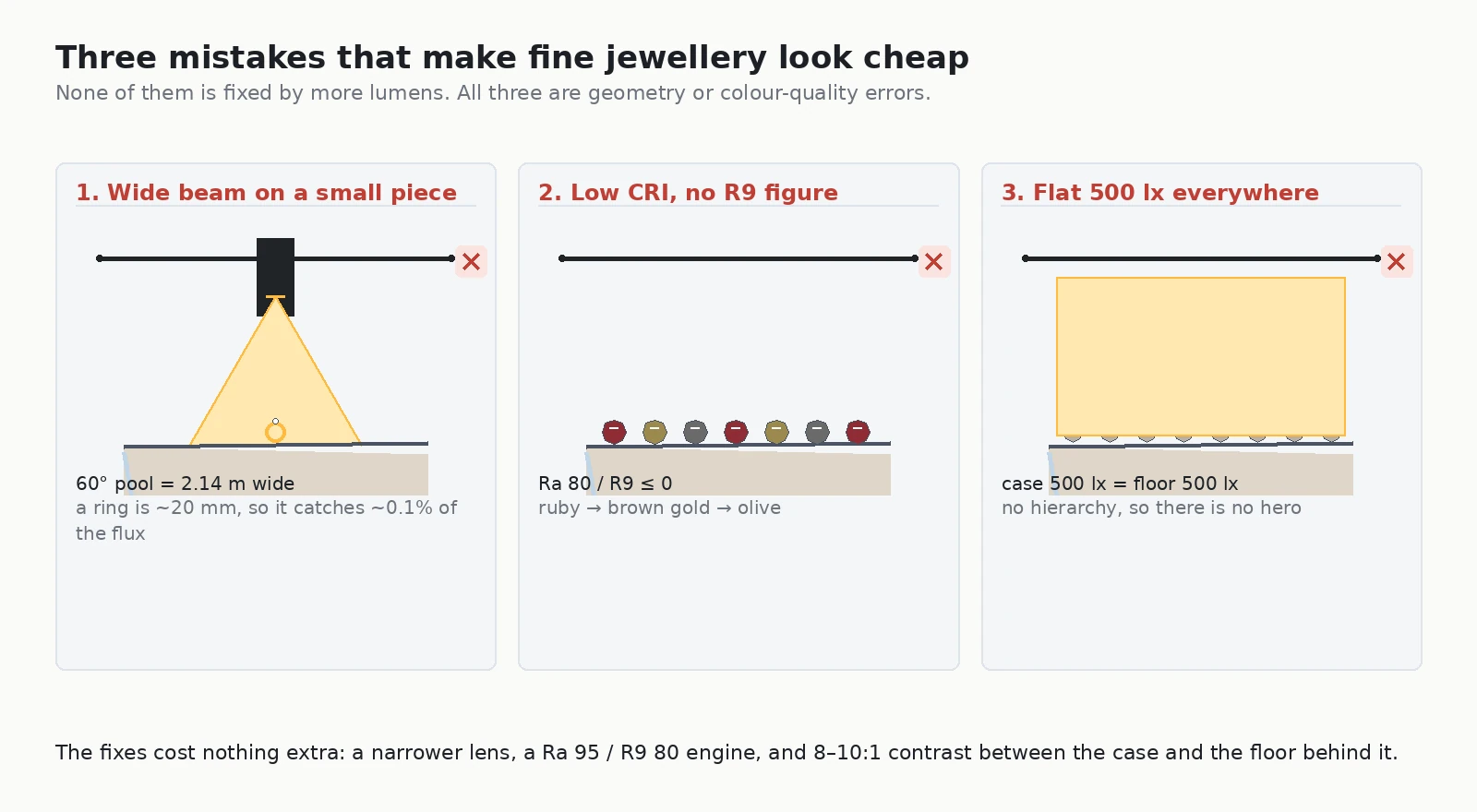
Every one of these is a spectrum or geometry error, and every one shows up in sell-through before anyone notices it in the lighting.
1. A Wide Beam on a Small Piece
A 60° lens on a 20 mm ring at 1.85 m makes a 2.14 m pool. The ring catches roughly 0.1% of the flux and the rest lights the aisle. Narrow the lens to 8° before touching the wattage — the result is brighter on the stone, cheaper to run and better looking.
2. “CRI 90” With No R9 Figure
Half the “high CRI” lamps on a trade counter post negative R9. Ask for the R9 figure in writing, and for the spectral power distribution where the stakes are high. If a supplier cannot produce either, the CRI figure is marketing copy.
3. Lighting Everything Equally
A flat 500 lux across cases and floor gives the customer nothing to look at first. The eye needs a difference of at least 3:1 to register hierarchy and about 8:1 for a piece to feel precious. Audit it with a meter — the eye adapts far too well to judge contrast, which is exactly why flat lighting gets signed off.
4. Shallow Aim and Veiling Glare
A head angled shallowly across the glass reflects straight back into the shopper’s eyes, and the harder you drive it the worse the veil gets. Aim steep, recess the source, and use honeycomb or soft-lens accessories where the case geometry forces a shallow angle.
5. One CCT Across a Multi-Material Floor
Gold, platinum and coloured stones want different colour temperatures, and a mixed-temperature floor reads as dirty rather than as depth. Separate the temperatures by a fixture run or a structural break, and keep at least 500 K of clean distance between them if both must appear in one view.
6. No Dimming Curve for Daylight
A shop window lit to a 1,500 lux daytime target looks blown out at 21:00, when the street outside is below 50 lux. Specify dimmable drivers — and ideally scene control with a daylight-linked curve — so the window can be brilliant at noon and comfortable at midnight. The same circuit logic applies to an entrance display facing glass.
Specifying the Track and the Heads
The lighting is only as good as the rail carrying it, and the rail is usually the one line nobody specifies:
- Voltage. Line-voltage track carries the driver in each head; 24 V systems carry it remotely, which dims more cleanly per head but draws over 4 A on a 100 W circuit, so long runs need heavier copper or repeated feeds.
- Circuit count. A two-circuit track switches accent and ambient independently on one rail. This is what makes a dimming strategy and a weekly re-merchandise practical.
- Accessory ecosystem. Honeycomb louvers, soft lenses, oval filters and framing shutters are the cheapest way to fix a glare, spread or spill problem after handover. Specify heads that accept them.
- CCT and CRI consistency. A chain of stores needs the same engine family everywhere, at SDCM ≤ 3 or better, or the tenth store will not match the first.
Browse the full LED track lighting range for the heads, rails and accessories referenced above, or start from our track lighting in retail stores guide for the wider merchandising picture.
Frequently Asked Questions
What CRI do I need for a jewelry store?
CRI 95 or better with R9 ≥ 80 for fine jewellery, and never below CRI 90 / R9 50 anywhere product is shown. CRI (Ra) averages only eight pastel test colours, so a Ra 90 lamp can still render saturated red badly — insist on the R9 figure, and ask for Rf ≥ 90 / Rg 98–104 if the supplier quotes TM-30. For consistency between adjacent heads specify SDCM ≤ 3, and ≤ 2 wherever two heads share one case.
What beam angle should I use for jewelry display lighting?
Size it from the piece, not the ceiling. Compute the throw (ceiling height minus case height), then solve θ = 2 · arctan(pool diameter ÷ (2 × throw)). For a 20 mm ring at a 1.85 m throw, use 6°–10°; for a ring stand or pendant, 10°–15°; for a counter run or tray, 18°–24°; for back walls and long runs, 30°–40°. A 60° flood belongs on the circulation floor, never on a hero piece.
Is 2700 K or 3000 K better for jewelry?
Both work; the choice follows the materials and the store’s interior. 2700 K flatters gold, brass, walnut, velvet and warm skin, which is why most luxury boutiques default to it. 3000 K is the safer general choice where gold sits beside platinum and mixed coloured stones, because it keeps whites from going cream. What matters more is never mixing two colour temperatures on one continuous sightline — the step reads as a dirty patch, not as contrast.
How many lux do I need on a jewelry case?
Counter runs 600–900 lux, a single hero piece 1,200–1,800 lux, and a diamond or gemstone close-up 1,800–2,500 lux, with the retail floor held at 150–250 lux. The ratio matters more than the absolute number: keep 8:1 to 10:1 between the case and the floor behind it, and use 10°–15° lenses so each pool falls on one piece instead of spreading across the whole counter.
How do I stop glare and reflections on glass jewelry cases?
Keep the aim under about 25° off vertical so the specular lobe misses the standing shopper’s sightline, recess the source deeply (a 35 mm recess in a 60 mm aperture gives a 49° cut-off), and add a honeycomb louver or soft lens where the geometry forces a shallow angle. Specify UGR ≤ 10 for jewellery, and remember that halving the beam angle roughly quadruples source luminance — narrow hero spots need deep, baffled bodies.
Can I use the same track head for the case and the floor?
Only with a zoomable or motorised head. A fixed lens cannot be both an 8° hero spot and a 60° ambient wash, which is why stores that try it end up either flat or over-contrasted. Zoomable heads (15°–55°) and motorised heads (18°–60°) solve it in place without ordering lenses — and a motorised head such as our MOVIA Motorized Track Light 30W lets a whole scene be re-aimed from a phone rather than a ladder, with 360° pan, ±140° tilt, 18°–60° zoom and 2700 K–6000 K tuning.
Does high-CRI lighting damage jewelry?
No — but high illuminance with UV does. Amber, turquoise, pearls, coral and many treated stones are UV- and heat-sensitive and fade irreversibly. Modern LED heads emit very little UV but not none, so specify UV-free or UV-filtered engines on sensitive cases, avoid parking one narrow 35 W beam on the same stone for years, and rotate hero pieces where fading is a risk.
Make the Spectrum Do the Selling
Jewelry store lighting rewards arithmetic more than it rewards budget. A pool sized to one piece, a spectrum with an R9 figure you can read, an aim angle that keeps the lamp out of the glass and out of the customer’s eye, and a contrast ratio that tells the eye where to look — those four decisions move more cases than any increase in wattage, and they cost less to get right the first time than to correct after handover.
If you are specifying track lighting for a boutique, a chain or an OEM programme, send us your ceiling height, case dimensions and the material mix you are showing. We will come back with beam angles, lux targets, CRI and R9 requirements, head counts and a photometric sheet you can check — including IES files for the heads we quote. Request a jewellery lighting specification, or start from the full track light range.
Related reading from our lighting library: Track Lighting in Retail Stores: How to Boost Sales with Smart Lighting Design, Retail Display Lighting Specs: Lux, Beam & Glare Guide, Retail Display Lighting: How Track Heads Sell Product, Lux vs Lumens: Understanding Lighting Metrics, and Museum Track Lighting: Lux Levels, UV Limits & Aiming Specs.
Further reading: the DesignLights Consortium for qualified-product lists and colour-quality requirements, the U.S. Department of Energy Solid-State Lighting programme for colour quality and photometric testing guidance, and NIST Photometry for how illuminance and colour metrics are actually measured, and the Lighting Facts label programme for standardised lumen, CRI and R9 reporting.