
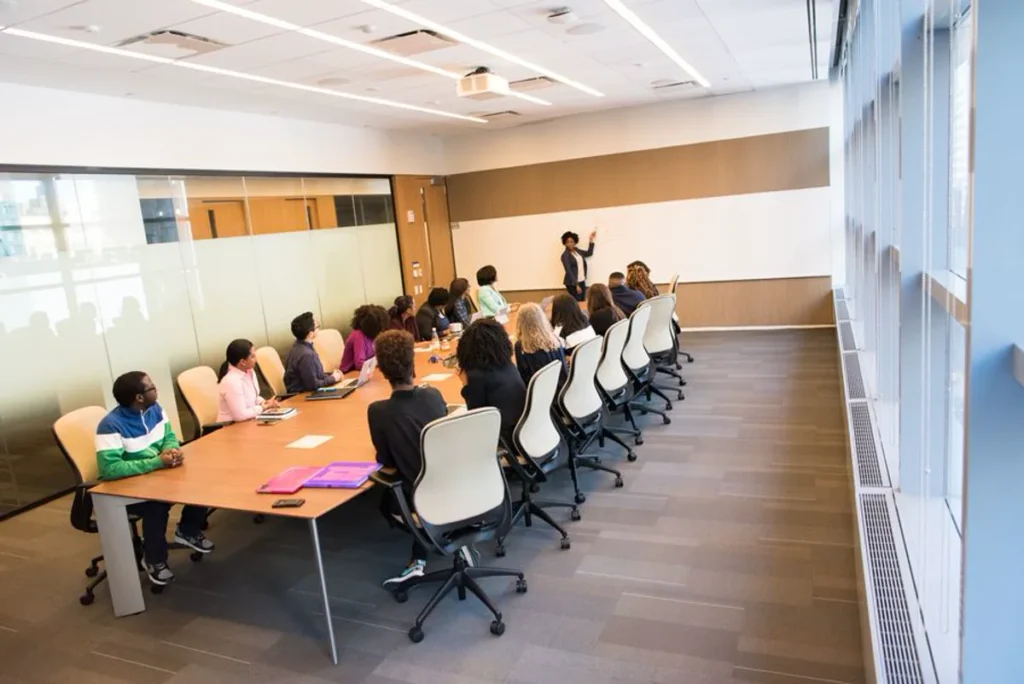
School lighting track systems are not decorative extras — they are the delivery mechanism for the single most measurable comfort factor in a classroom. Get the numbers right and attention spans, reading speed and board legibility all improve. Get them wrong and you get glare on whiteboards, headaches under flickering drivers, and half the room squinting.
This guide gives you the actual specification numbers behind a school track lighting system: lux levels by grade and room type, colour temperature, CRI, UGR, flicker limits, and why a track-and-linear combination beats a fixed grid of recessed panels for flexible learning spaces.

Why Education Lighting Is Task Lighting, Not Mood Lighting
In a hotel corridor you light a feeling. In a school you light a task. A student reading a textbook at 400 lux sees something very different from a student reading the same page at 200 lux: contrast on the paper drops, the pupil dilates, the eye muscles work harder, and fatigue arrives earlier in the lesson.
That is why education lighting standards — CIBSE LG5, IES RP-3 and the European EN 12464-1 interior lighting standard — set a target maintained illuminance on the task plane, typically 300 lux at 0.8 m desk height for general teaching. The word “maintained” matters: it is the value after depreciation, not the value on day one with brand-new lamps.
Because the light has to land on the desk, not just exist in the ceiling, the mounting method and the beam control matter as much as the wattage. That is the argument for a track-based school lighting system: the fixture types, beam angles and aim points can all be changed as the room changes.
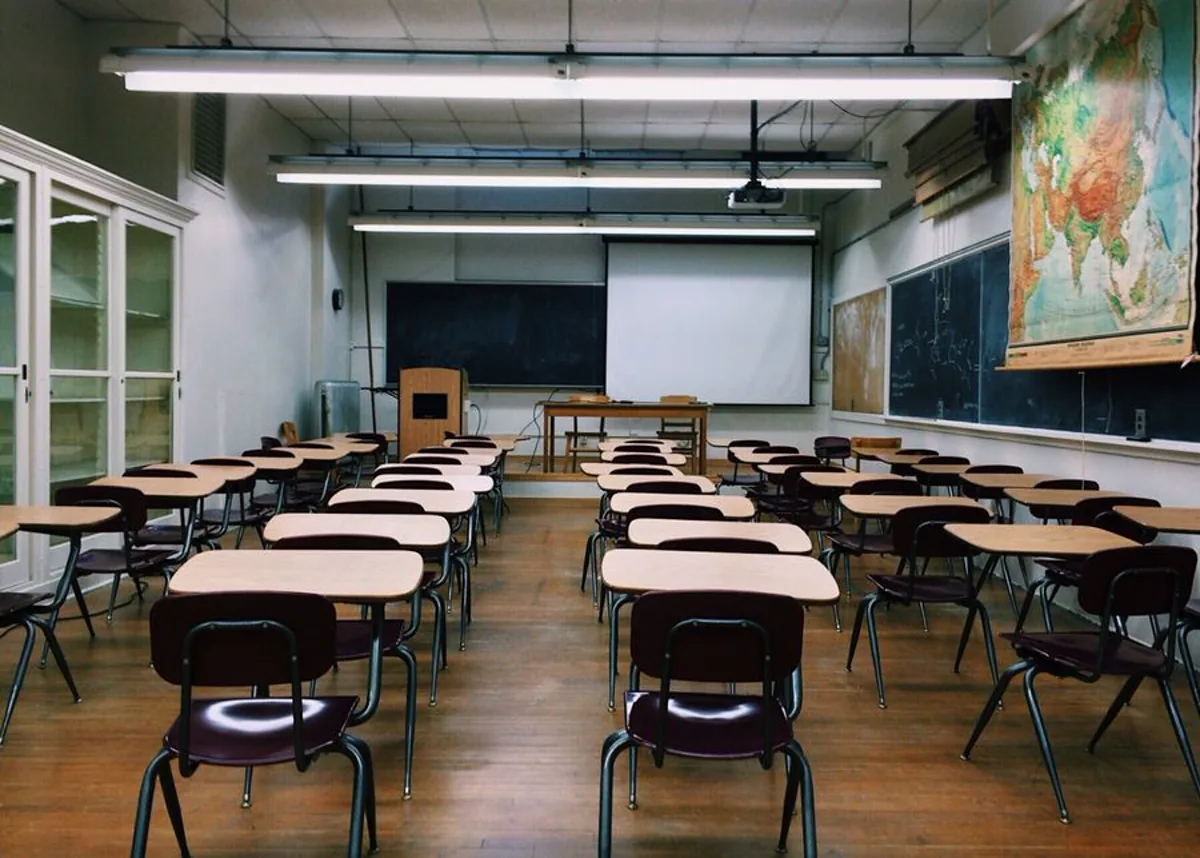
The Five Numbers Behind a School Lighting Track Specification
Before you choose a fixture, fix these five values. They define the whole project and they are what a lighting designer will ask you for first.
1. Illuminance (lux) — the target on the desk
Teaching spaces need 300–500 lux on the task plane, with 500 lux where there is sustained close reading or fine motor work. Uniformity should hold at Uo ≥ 0.60 across the seating area, otherwise the back row reads in shadow while the front row is over-lit. Corridors and circulation drop to 100–150 lux — enough to move safely, not enough to glare into an open classroom door.
2. Colour temperature (CCT) — 3000K to 5000K
Cooler light supports alertness; warmer light supports calm. For schools the practical split is: 3000K–3500K for early-years and reading nooks, 4000K as the default for general classrooms, and 4000K–5000K for science labs, art studios, technical workshops and university seminar rooms where colour judgement and detail matter.
3. Colour rendering (CRI) — 80 minimum, 90 for colour work
CRI 80 is the recognised floor for education spaces. Push to CRI 90+ in art rooms, textiles, design studios and any space where students judge colour, because a low-CRI source will make reds and blues drift and students will misread their own work. R9 (deep red rendering) is the number that usually reveals a cheap source.
4. Glare (UGR) — keep it under 19, aim for under 16
Glare is the single most common failure in school lighting. Bright visible lamp surfaces in the field of view cause discomfort, and children are more sensitive to it because their eyes are still developing. UGR ≤ 19 is the EN 12464-1 ceiling for teaching rooms; well-designed classroom lighting lands at UGR < 16, and where a fixture sits directly above a sightline — board positions, science benches — UGR < 10 is achievable with grille optics.
5. Flicker — drive it under 5% and away from camera range
Mains ripple on a poor driver produces flicker that is barely visible to the eye but measurable in fatigue and headaches. Choose drivers with flicker < 5%, and for any room with video conferencing, hybrid teaching or recording, ensure the driver’s flicker frequency sits well away from typical camera shutter ranges. This is a driver-quality question, not a fixture-shape question — and it is where budget school lighting quietly falls apart.

School Lighting Requirements by Room and Grade
The table below is a working starting point for a school lighting layout. Adjust for ceiling height, window orientation and the reflective finishes in the room — a matte ceiling and light desk surfaces will recover 10–20% of the illuminance you would otherwise have to add.
| Space | Maintained lux (task plane) | CCT | CRI | UGR | Recommended approach |
|---|---|---|---|---|---|
| Kindergarten / early years | 300 | 3000K–4000K | 80+ | < 19 | Continuous linear runs plus low-glare wall-wash, no exposed bright sources at child eye level |
| Primary classroom | 300–400 | 4000K | 80+ | < 19 | Linear perimeter runs with a track-mounted centre run for board and display lighting |
| Secondary classroom | 300–500 | 4000K | 80+ | < 19 | Track lighting with 20°–40° spots for the board, linear runs over desks |
| Science lab / workshop | 500 | 4000K–5000K | 80+ (90 in art) | < 19 | High-CRI linear over benches, grille optics for UGR < 10 above sightlines |
| Library / media centre | 300–500 | 3500K–4000K | 80+ | < 19 | Continuous linear spine runs, shelf wall-wash, task spots over study tables |
| University lecture hall | 300 (500 at note-taking) | 4000K | 80+ | < 19 | Tiered linear runs following seat rows, dimmable for projection, controlled separately from the board |
| Corridor / circulation | 100–150 | 3000K–4000K | 80+ | < 22 | Linear runs parallel to travel direction, wall-mounted spill to avoid door glare |
| Cafeteria / multipurpose | 200–300 | 3000K–3500K | 80+ | < 22 | Dimmable track with wide distribution, scene control for assembly use |
Why a Track System Beats a Fixed Grid in Flexible Classrooms
A fixed ceiling grid assumes the furniture will never move. Modern schools assume the opposite. Rooms become two teaching zones, a reading corner, an exam hall or a hybrid classroom with a camera at the back — sometimes within a single week. A grid of recessed panels cannot follow that. A track lighting system can, and the reasons are structural rather than aesthetic.
Aim the light where the task actually is
Move a desk group and you move the illuminance requirement with it. Track heads can be re-aimed, added or removed without touching the ceiling or calling an electrician. Over a term, that turns a lighting installation into an adjustable tool rather than a fixed cost.
Build layers instead of a single flat wash
Good school lighting is layered: uniform linear light for the ambient level, narrower spots for the board and demonstration benches, and wall-wash for display and vertical surfaces. Track is the only mounting system that lets all three live on one line of power and be controlled separately.
Retrofit without demolition
Older school buildings rarely have accessible ceiling voids. Surface-mounted track and pendant linear fixtures install on the slab with no ceiling cutting, which means a lighting upgrade can happen between terms rather than during a summer shutdown.
The Linear LED Systems That Do the Work
Track distributes power and position; the linear luminaire does the actual work of delivering low-glare, uniform light. Two systems cover most school projects.
SLEM 2.4in Linear Light System — modular ambient runs
SLEM is built for continuous classroom runs. It comes in 2FT, 4FT and 6FT (598 / 1192 / 1786 mm) with 20W, 40W and 60W options in 3000K, 4000K and 5000K, and it can run downlight or up/downlight for a soft ceiling bounce. The optics are PC diffuser at 100° for wide, even coverage or a 60° grille cover for tighter control and lower glare, at up to 120 lm/W. For schools the practical appeal is the connection system: L, X and T link accessories let a single run turn a corner, form a U around a reading zone, or split two teaching areas without a second feed — and the patent-pending single-screw splice plus tool-free push-to-pop-off mechanism means a fitting can be swapped without a lift and a full crew. See the SLEM 2.4in linear light system.
ATRO 26mm Linear Light System — glare-critical rooms
Where glare matters most — science benches, art rooms, seminar tables facing a wall of white — the ATRO 26mm pendant is the sharper tool. Its grille cover delivers UGR < 10, which is exactly the range you want above a sightline, while the PC diffuser at 110° gives a wide wash. Available in 960 / 1200 / 1800 mm at 25W, 30W and 50W, 2700K through 5000K, 110 lm/W, with slidable pendants and adjustable suspension spacing so a run can be positioned over the desk grid rather than the structural grid. See the ATRO 26mm linear light system.
Both live in the wider linear lighting collection alongside the 5mm magnetic track range for retrofit projects where a slim profile and tool-free lamp changes are the priority.
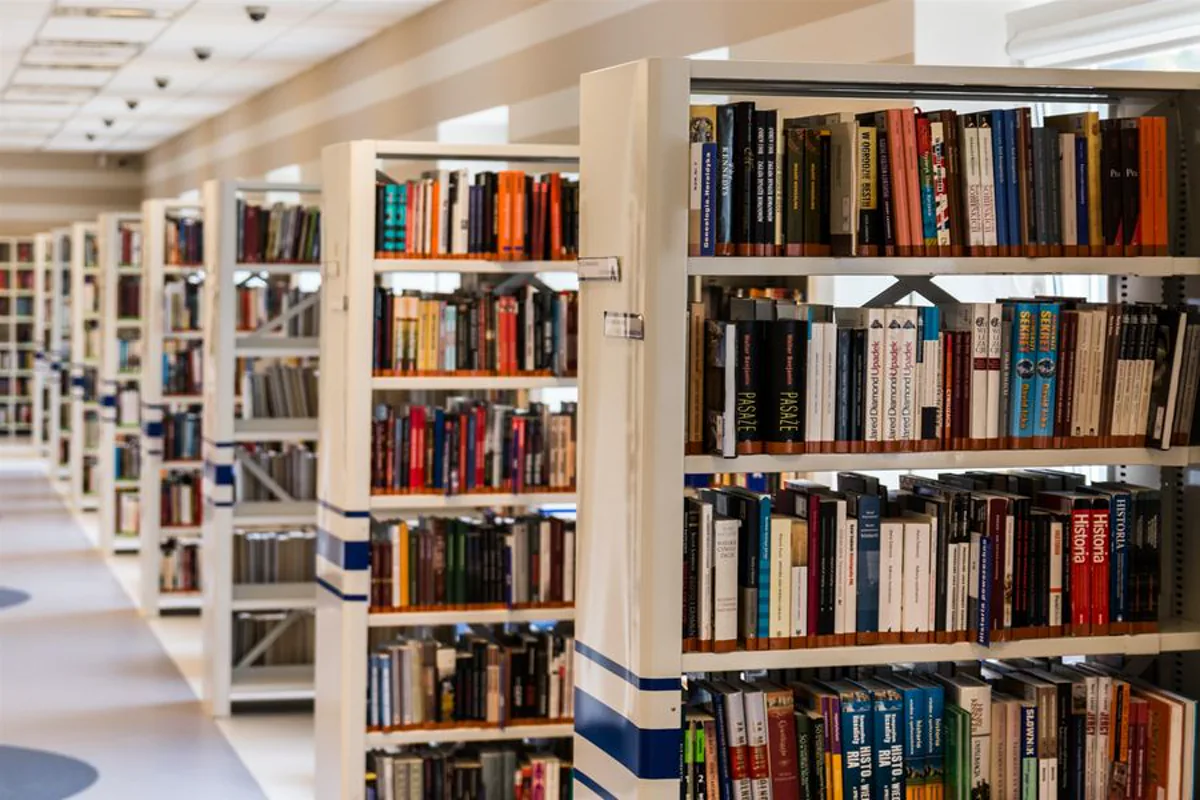
Glare, Blue Light and Certification: What to Actually Check
Three claims come up in every school lighting tender, and two of them are usually overstated.
Blue light. At normal classroom illuminance, LED blue-light exposure is a fraction of the recommended limit and far below daylight. The real risk is not retinal damage but circadian disruption from cool, high-intensity light late in the day — which is why dimming and scene control matter more than the spectrum alone.
Flicker. This one is real and under-specified. Ask for the driver’s flicker percentage and confirm it holds across the full dimming range, not just at 100%.
Certification. For US school projects, look for ETL or UL listing on the luminaire and driver, and confirm the listing covers the mounting method you are using. A fixture listed for surface mount is not automatically approved for pendant suspension. Encore’s ETL-listed range and patent documentation are covered on the technical requirements side of our lighting guides if you need the reference detail.
Common School Lighting Track Mistakes
- Specifying lux without uniformity. A 500 lux average with Uo 0.35 means bright pools and dark desks. Uniformity is the number students feel.
- Over-cooling the whole school. 5000K everywhere is harsh and clinical. Reserve it for labs and technical rooms.
- Ignoring vertical illuminance. Students look at walls, boards and each other’s faces, not only at paper. Add wall-wash.
- No separate board circuit. Projection and whiteboard zones need their own dimming so the front of the room can drop while the desks stay lit.
- Buying fixtures before the layout. Track positions and head counts come from the photometric calculation. Choose the layout first, then the luminaire.
- Forgetting maintenance. Accessible, tool-free fittings get re-lamped; sealed, awkward ones do not.

School Lighting Track FAQs
How many lux does a classroom need?
300 lux maintained on the desk plane is the baseline for general teaching, 500 lux for sustained reading, fine detail or examination work. University teaching spaces and science labs typically sit at 500 lux. Always specify the maintained value after depreciation, not the initial output.
Is 4000K or 5000K better for schools?
4000K is the best default: neutral, alert, and comfortable for long sessions. Use 3000K–3500K in early-years and reading areas, and 5000K only in science, technical and art rooms where colour and detail judgement matter.
Can track lighting really replace recessed ceiling panels in a school?
Yes, and it is usually the better choice for flexible rooms. Track gives you the same or better uniformity on the task plane, plus re-aimability, layered control and a retrofit path that does not require ceiling demolition. Recessed panels still make sense in fixed, high-ceiling auditoria where a uniform grid is genuinely permanent.
What UGR value should I demand for a classroom?
UGR ≤ 19 is the compliance ceiling. Specify UGR < 16 for general teaching, and UGR < 10 for any position directly above a sightline — science benches, board-facing seminar tables, art workstations.
Do school lighting upgrades need new wiring?
Usually not. Surface-mounted track and pendant linear systems run on the existing lighting circuit; the change is in the mounting and control layer. Adding a separate board circuit or dimming zone is the one upgrade worth planning for during the electrical phase.
Build the Specification Before You Buy the Fixtures
A school lighting track project succeeds or fails on five numbers — lux, uniformity, CCT, CRI and UGR — plus a driver that does not flicker. Fix those, layer linear ambient with aimed spots, and keep the board on its own control. The fixtures are then a detail rather than a gamble.
If you want a starting point for your specific rooms, send us the floor plan and ceiling height and we will return a photometric layout with fixture positions, predicted lux and uniformity per teaching zone. Get a free school lighting layout and specification from Encore.