
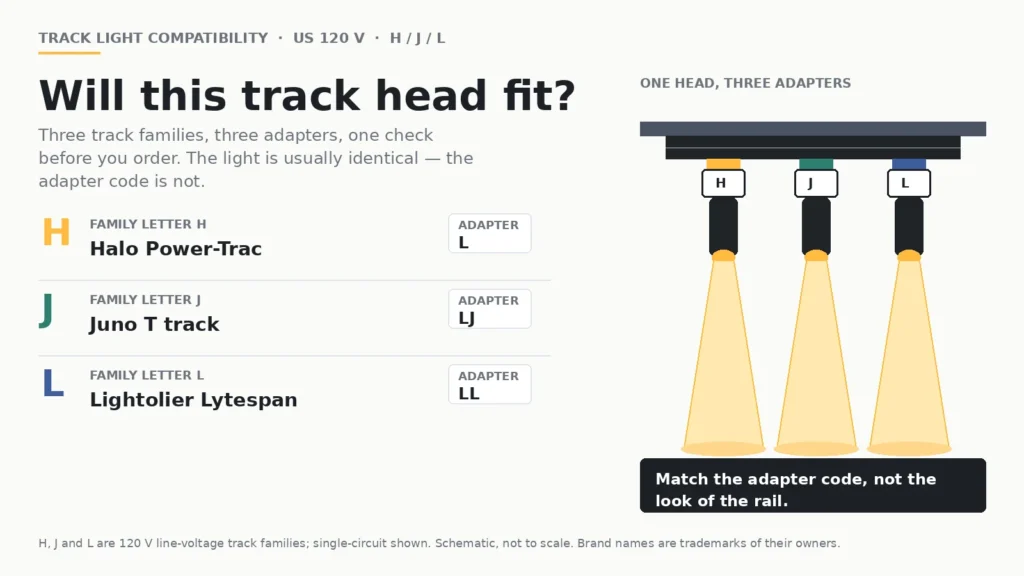
Short answer: a track head fits only if its adapter matches the family of the track you already own — H, J or L — and the match is set by the adapter code, not by how the rail looks. In the US those three families are all 120 V line-voltage systems, they are all still sold, and they are all still installed. The same fixture is frequently built in all three versions, which is why the ordering line, not the photograph, is the thing to compare.
This article is only about fit. If you do not yet know which of the three rails is on your ceiling, read our guide to identifying H, J and L track first: it works from the cross section, the conductor count and the conductor position. Come back here once you know the letter. What follows assumes you know the family and now have to answer one question — will this head actually go on, light up and stay lit.

What “compatible” actually means for a track head
Four things have to line up before a head is compatible. Three are mechanical and one is electrical, and a head that fails any one of them is the wrong head even if it rotates into the rail and lights the lamp.
| What has to line up | What it controls | How it fails when it does not |
|---|---|---|
| Slot silhouette and depth | Whether the adapter can enter the channel at all | It will not seat; forcing it damages the extrusion |
| Contact geometry and spacing | Whether the pins land on the bare conductors | It seats, lights, and runs hot or flickers later |
| Circuit count and contact set | Whether switching behaves as wired | The head lands on the wrong circuit, or both circuits at once |
| Voltage and listing | Whether the pair is legal and safe to energise | Works on the bench, fails an inspection |
The first three are why the adapter code exists. The fourth is why “it works” is not the same statement as “it is compatible”.
One fixture, three adapter codes: how the ordering line works
On spec-grade track fixtures the adapter is a line item. A single fixture family is built with a mechanically interchangeable adapter, and the ordering code selects it. Two published examples make the pattern clear, and both are worth reading before you buy from anyone.
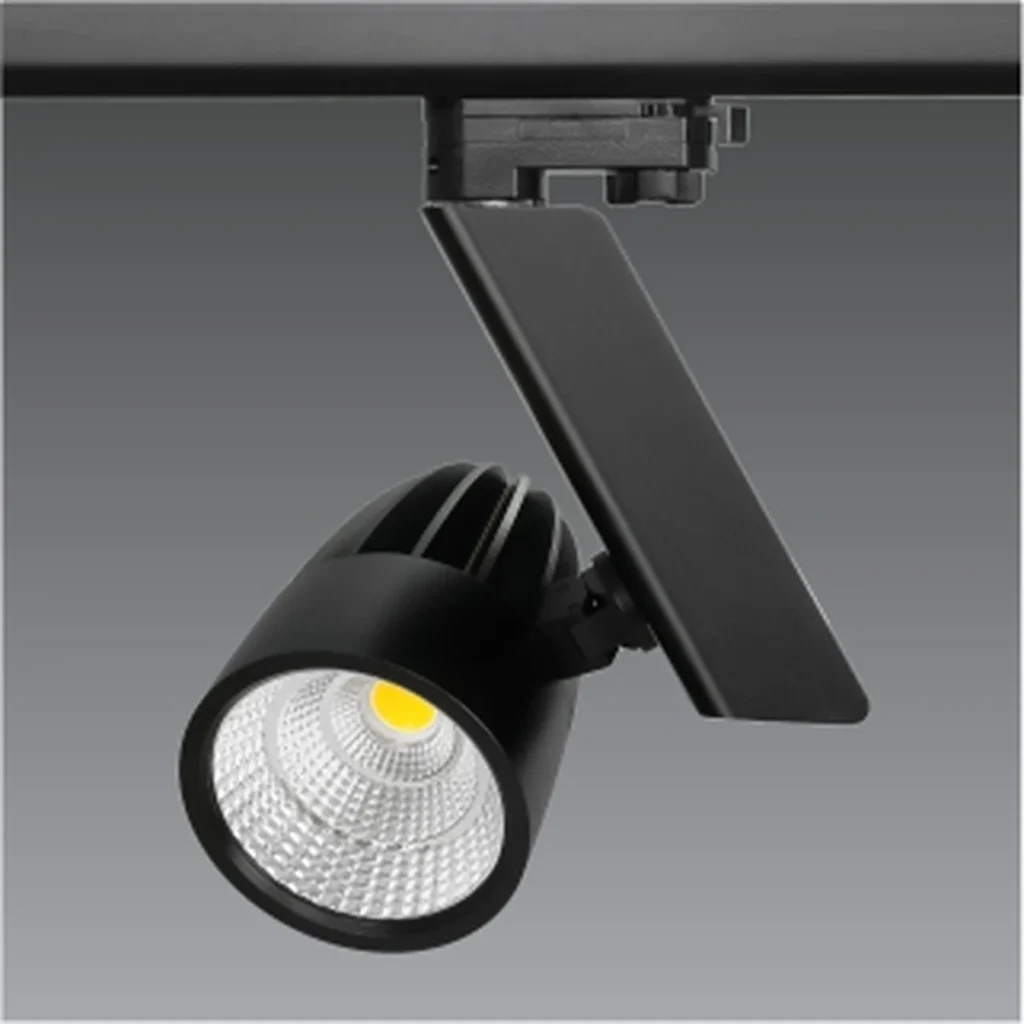
Cooper Lighting HALO L806 / L807
The HALO L806 / L807 LED track luminaire specification sheet (TD518040EN, 2021) lists four adapter codes in the ordering information: L for Halo Power-Trac and Lazer Track, LJ for Juno track, LL for Lightolier track, and L2G for Global TEK or HTEK. The same light engine, four different interfaces.
Lumenture T80
Lumenture’s T80 track head specification lists the adapter as a factory-installed option in the same way: J-Type, H-Type, L-Type and GA (Global) adapters, all at 120 V. Its compatibility page then states what each one is designed to work with — the J-Type adapter for Juno and Contech track, the H-Type for Halo track, the L-Type for Lightolier one-circuit track, and the G-Type for Global Trac 2C/2N.
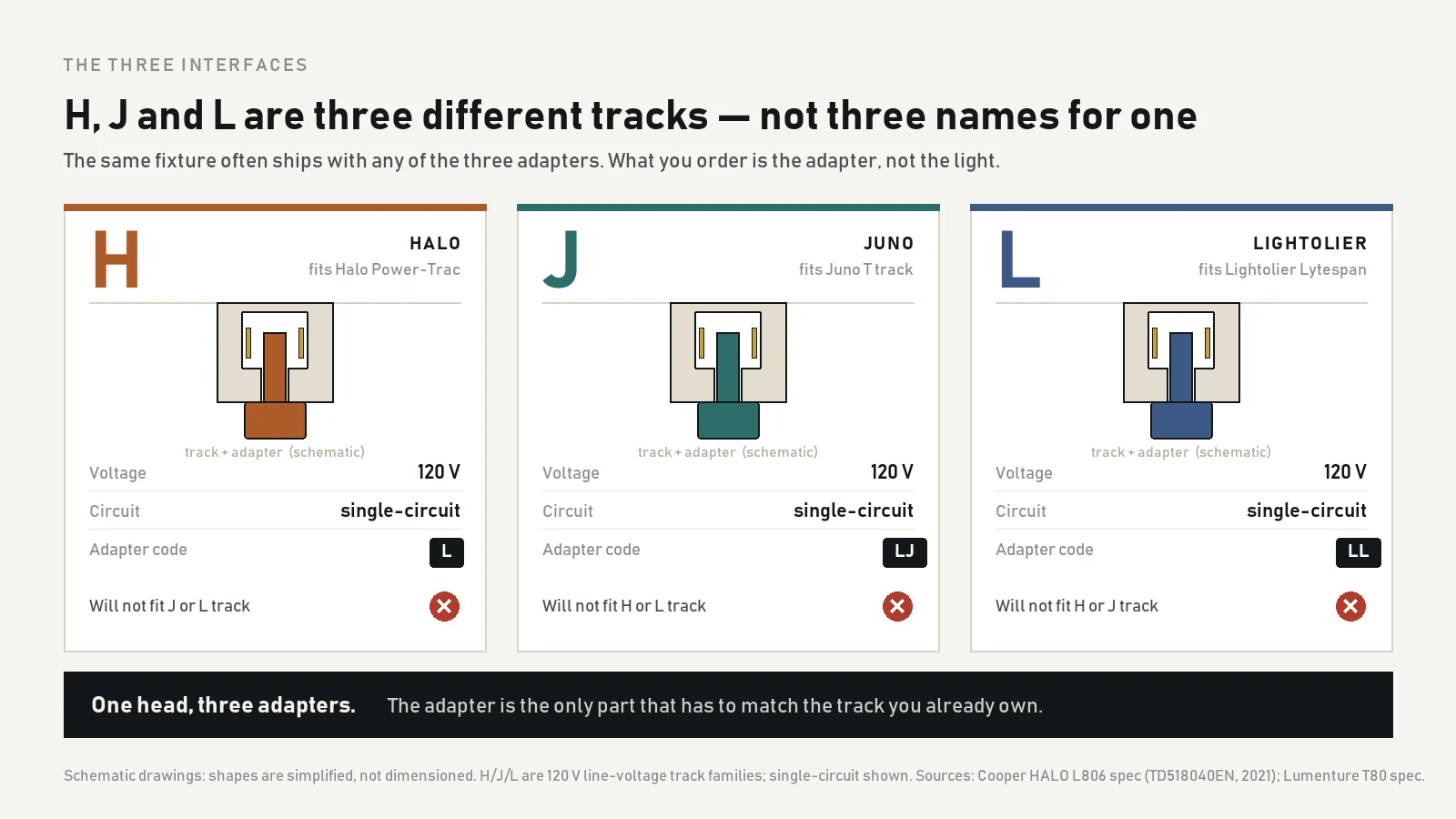
That is the whole naming problem in one paragraph: “H”, “J” and “L” are family letters, and the adapter code on a head is not always the same letter as the family it fits. A Halo-family adapter is coded L. Anyone who assumes “H track takes an H head” gets it backwards on the largest family in the country.
Why two letters for one family
Because the letters were never a standard — they are brand shorthand that the market adopted. Halo’s own code for its own track is L, which is short for a product line rather than the family. Juno heads are marked with a J, and a cross-family head will be marked LJ. Lightolier heads are marked L or LL. None of this is designed for the buyer’s convenience, and it is normal to see a head labelled L that will not go anywhere near an L-family rail.
The compatibility matrix: what fits what
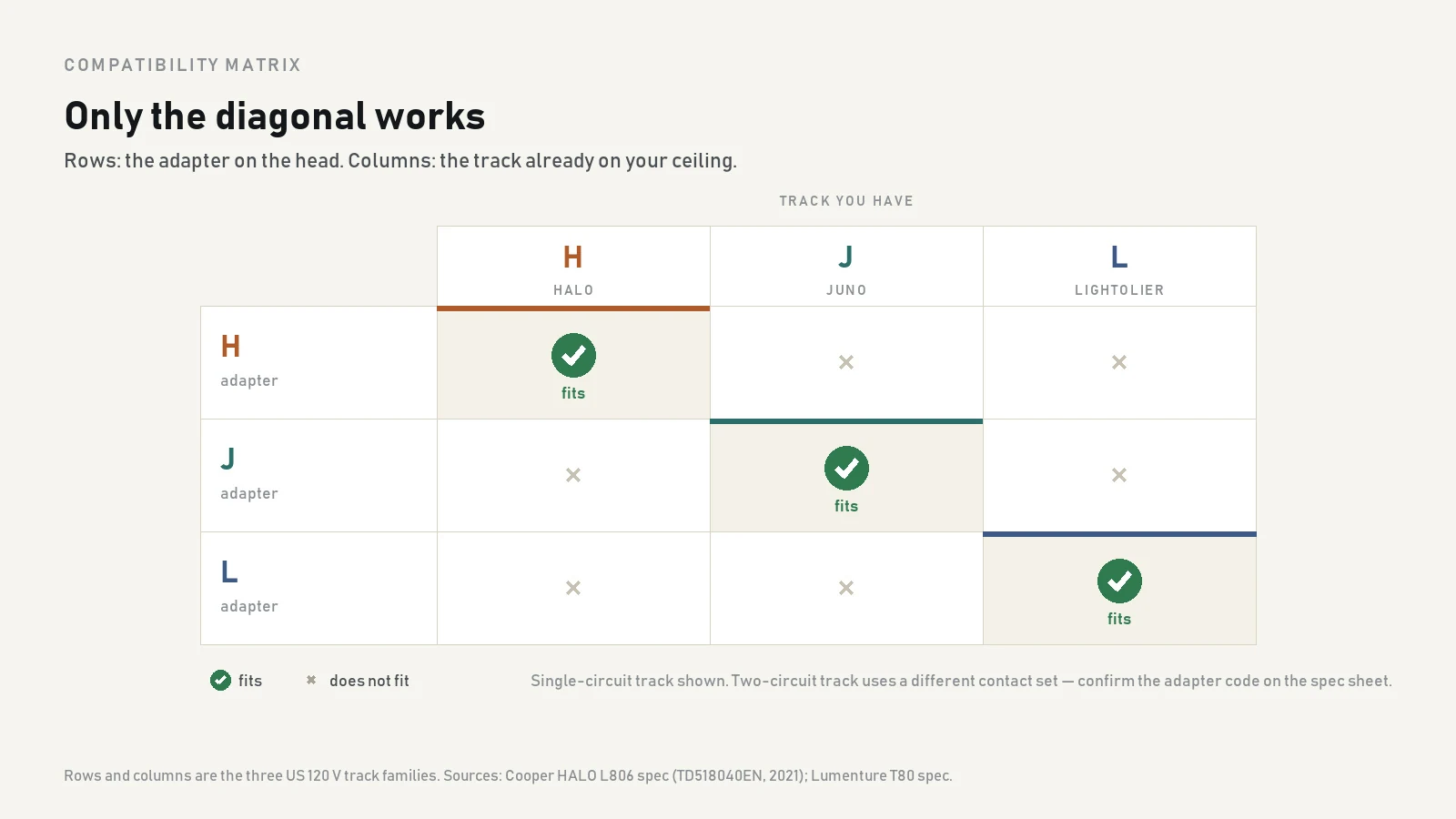
Read the rows as the adapter on the head and the columns as the track already on your ceiling. Everything off the diagonal is a no. Single-circuit track is what the table describes; two-circuit track is a separate contact set and needs a separate check, which is covered further down.
| Adapter on the head | H family track (Halo) | J family track (Juno) | L family track (Lightolier) |
|---|---|---|---|
| H family — commonly coded L (Halo-style heads) | Fits | Does not fit | Does not fit |
| J family — commonly coded J or LJ | Does not fit | Fits | Does not fit |
| L family — commonly coded L or LL (Lightolier) | Does not fit | Does not fit | Fits |
| G family — coded L2G or GA (Global TEK / HTEK) | Does not fit | Does not fit | Does not fit |
The fourth row matters because it is the one people miss. Global TEK and HTEK are a different family again, and they are the only place the 277 V variant appears on the HALO sheet. If your building is 277 V, the H, J and L column of this table does not apply to you at all.
Read the adapter code before you read anything else
The cheapest compatibility check in the industry takes ten minutes and uses two labels and one photograph. It is worth doing in this order, because each step can end the question on its own.
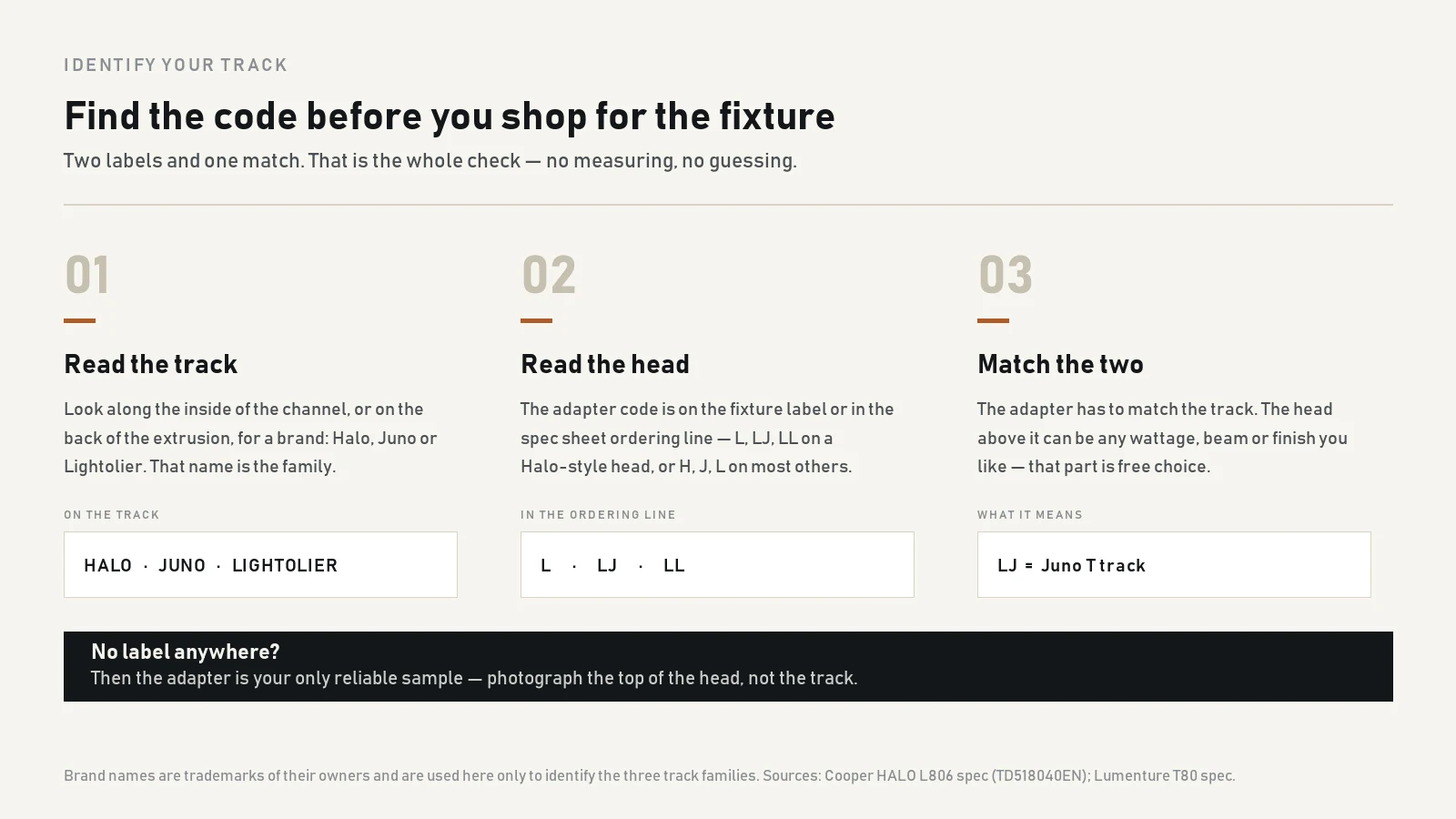
1. Read the track
Look along the inside of the channel, or on the back of the extrusion, for a brand — Halo, Juno or Lightolier. Some rails carry a printed name, some a moulded mark, some only a sticker at the dead end. That name is the family. If the rail is unbranded, skip to the adapter check; there is nothing else to read.
2. Read the head
The adapter code is on the fixture label or in the ordering line of the spec sheet — L, LJ, LL on a Halo-style head, or H, J, L on others. On a head you already own, the code may also be moulded into the adapter body itself, hidden under the canopy where it meets the rail. Photograph the top of the head, not the side: the adapter is the part that has to match.
3. Match the two, and stop
If the adapter is listed for the track you have, you are done, and every other decision — wattage, beam angle, CRI, finish — is free choice. That is the useful asymmetry in all of this: the adapter is constrained, the light above it is not.
Where “it fits” stops being “it is compatible”
Five situations come up often enough on jobs to be worth naming. In four of them the head will physically install. That is exactly what makes them expensive.
Single-circuit head on two-circuit track
A single-circuit adapter lands on one contact set on a two-circuit rail. It seats, it lights, and one of the two switching circuits simply never reaches it — the head is now permanently on the wrong switch. The reverse case is worse: a two-circuit head on a single-circuit rail can bridge both contacts to the same live bar, which is the sort of thing that shows up as a tripped breaker with nothing obviously wrong.
Listed for its own family, classified for others
The HALO L806 sheet is unusually honest about this and it is worth quoting the shape of it: the fixture is listed for use with its own track, and classified for use with the other two families. Those are different words with different meanings in a UL file. If your project is being inspected, or your insurer is asking, “it fits and it lights” is not the question being asked.
Voltage
H, J and L are 120 V families in the US. The 277 V version of the HALO fixture exists only on the Global TEK/HTEK adapter, which tells you what a 277 V track installation actually is: not these three families with a different transformer, but a different system. Do not buy a 120 V head and plan to “sort the voltage on site”.
Aftermarket adapters sold as universal
Adapters that claim to fit “H/J/L” are claims about the adapter, not about your rail. Some are genuinely listed for a specific pair; the ones that are not specific are the ones that seat loosely. If a seller cannot name the track families their adapter is listed for, that is the answer.
Finish and appearance
Nothing about the colour, the diameter or the style of the rail tells you the family. Black rails exist in all three families, and so do white ones. This is the first mistake in the field, and it is the one the adapter code exists to prevent.
If it does not fit: three ways out, cheapest first
A mismatch is almost never a reason to return the light you chose. It is a reason to look at the adapter.
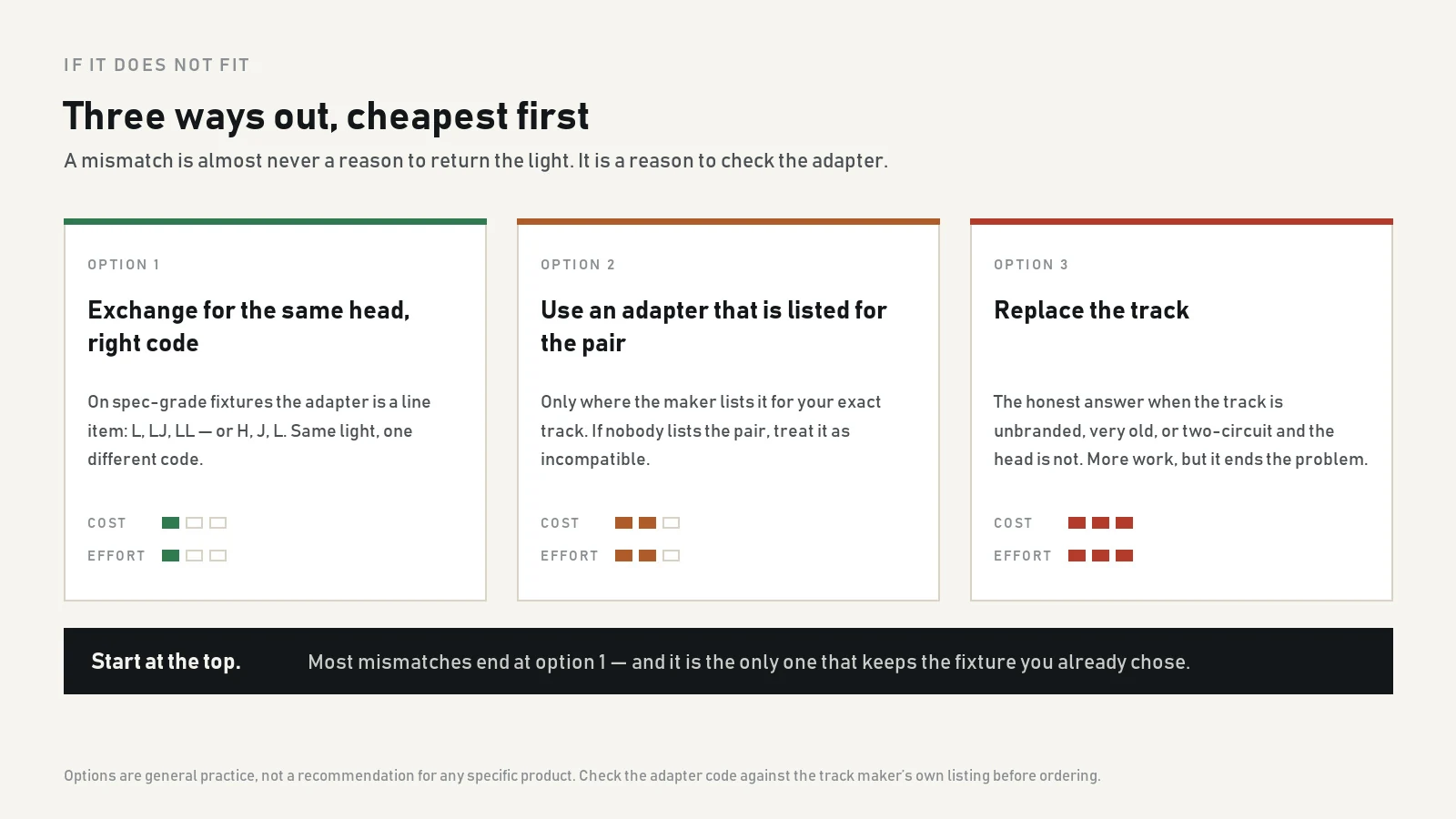
Option 1 — exchange the head for the same light, right code
On spec-grade fixtures the adapter is a line item, so the same fixture exists in the code you need. This is the cheapest route in money and in outcome, and it is the only one that keeps the light you already specified. It requires knowing the family, which is why the ten-minute check pays for itself here.
Option 2 — use an adapter that is listed for that exact pair
Legitimate where the manufacturer lists the pairing for your specific track. Not legitimate as a guess: an adapter that “should work” and is not listed for the pair turns a simple compatibility answer into an unknown. If nobody lists it, treat it as incompatible.
Option 3 — replace the rail
The honest answer when the rail is unbranded, very old, bent, or two-circuit while the head you want is single-circuit. It is more work and it is the only route that ends the problem instead of managing it. On a rework, the argument for replacing is a single polarity convention and one spare-parts list across the space; that case is set out in the identification guide.
Specifying heads for a rail you already own
If the rail stays, the brief to a supplier is short: the family, the circuit count, the voltage, and the fixture performance you actually need. Everything else is the supplier’s job to match, and a supplier who cannot tell you which adapter code they are shipping is not a supplier for this job.
Our own track range is built as families, so the interface is never the open question. For the head, the choice is optical rather than mechanical:
- CADIO 20/25/30 W — 15°/24°/38°/60°, tool-free interchangeable reflectors, separated driver compartment for Triac and 1–10 V dimming, honeycomb anti-glare accessory.
- VEGA-Premium 30 W — 3,809 lm at 125 lm/W, CRI 90+ with COB SDCM ≤ 2, 24°/30°/40°/52°, in-track driver for Triac, DALI and wireless control.
- VEGA-Standard 15/20/30 W — 15°/24°/38°/50°, 360° rotation and 90° tilt, interchangeable honeycomb, soft lens and oval filter.
- MEGA 15/20 W — 10°/25°/40°/60°, CRI 95+ option, snap-on filters that convert one head between spot, flood and wall wash, for museum and gallery work.
- EVO 10/15 W — compact body, UGR < 16 (under 10 with honeycomb), 24°/36°/50°, for retail runs where the head should not dominate the ceiling.
Where the rail is being retired anyway, the alternatives change the question rather than answering it: a linear lighting system replaces the rail with an architectural line, and a magnetic track system replaces the mechanical interface with a magnetic one — which is worth reading about before you commit to another twenty years of the same slot.
Before you order: the four-item check
Fill this in with the rail in front of you, not from memory. It is the difference between one order and three returns.
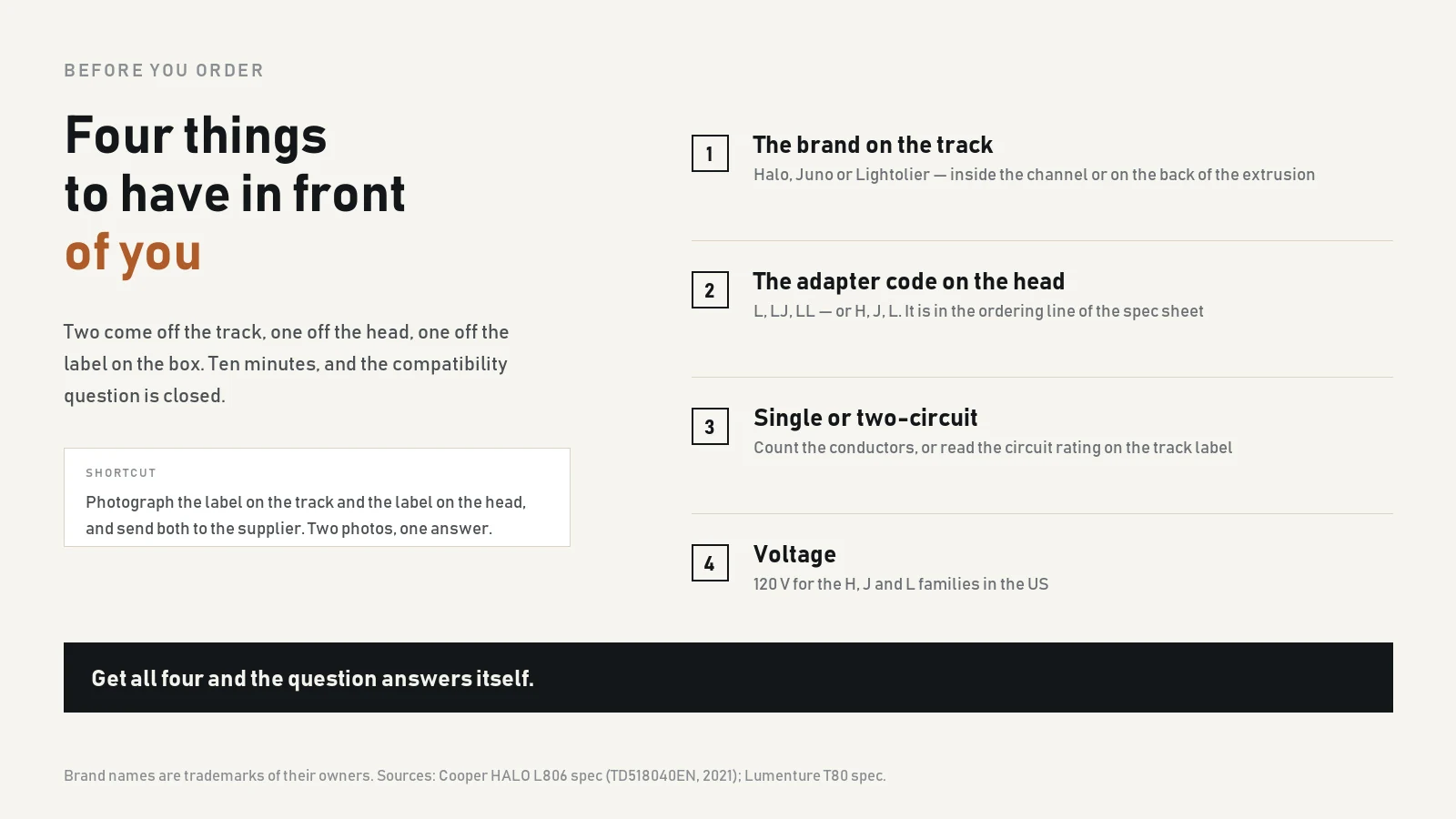
- The brand on the track — inside the channel or on the back of the extrusion: Halo, Juno or Lightolier.
- The adapter code on the head — L, LJ, LL on a Halo-style head, or H, J, L on most others.
- Single or two-circuit — count the conductors, or read the circuit rating on the track label.
- Voltage — 120 V for the H, J and L families in the US.
If there is no label anywhere, the adapter is the only reliable sample you have: photograph the top of the head and send that. Two photographs — one label, one adapter — usually close the question in a single message, and it is what our specification team will ask for if you send the project to us.
FAQ
Will a Halo track head fit a Juno track?
No. Halo, Juno and Lightolier are three separate 120 V track families with different slot geometry and contact spacing, and a head built for one will not seat correctly on another. The same fixture is usually available with the adapter for the family you have, so the fix is the adapter code, not the light.
Is H track the same as J track?
No. They are different families, from different manufacturers, with different adapter codes and different contact sets. The letters look similar because they were brand shorthand adopted by the market, not because the systems are related.
Why is the adapter code on a Halo head “L” if it fits H track?
Because the codes come from brand product lines rather than from the family letters. HALO’s ordering information lists L for Halo Power-Trac and Lazer Track, LJ for Juno track and LL for Lightolier track. The letter in the code is not a family name — this is exactly why the ordering line, and not the box label, is the thing to check.
Can I put a single-circuit head on two-circuit track?
It will usually seat and light, and that is the problem: the head lands on one contact set, so one of the two switched circuits never reaches it. Two-circuit track needs a head with the matching two-circuit contact set, and the change should be confirmed against both the track and the head manufacturer’s listing before it is energised.
Do universal H/J/L adapters exist?
Adapters sold as universal are making a claim about the adapter, not a guarantee about your rail. Where a manufacturer lists its adapter for a specific track family, that pairing is the reliable statement. Where nobody lists the pair, treat the combination as incompatible.
Can I use a 277 V track head on a 120 V rail?
No. In the US, H, J and L are 120 V families. The 277 V version of the HALO fixture is offered only with the Global TEK/HTEK adapter, which is a different family altogether. Voltage is a system decision, not an adapter decision.
What if I cannot find a label anywhere?
Then the adapter on the head is your only reliable sample. Photograph the top of the head, straight on, with a ruler in frame for scale, and send it with a photograph of the rail with the heads removed. That pair of photographs usually settles the family without any further back-and-forth.
The one line to remember
Track heads do not fail to fit because of the light. They fail because the adapter was specified for a different family, or because nobody read the code before ordering. Match the adapter, confirm the circuit count, confirm the voltage, and the rest of the specification — wattage, beam, CRI, finish — is genuinely free.
If you are weighing the interface question at a higher level — whether the rail itself is still the right answer for the space — our magnetic versus traditional track lighting comparison sets out where each one wins. And if the project is going out to tender, the track lighting RFQ guide lists what a supplier needs to quote the right adapter the first time.
Further reading: Cooper Lighting HALO L806/L807 specification sheet (TD518040EN) and Lumenture T80 track head specification — both show the adapter as an ordering option and list the families each code is intended for.