
In 1961, a designer at a New York lighting company grew frustrated with a fundamental problem: once a light fixture was installed, it stayed exactly where it was pointed. No flexibility. No adaptability. No room to change your mind.
That designer was Anthony Donato — and his solution to that frustration became one of the most influential lighting innovations of the 20th century.
At the time, traditional lighting fixtures were fixed in position the moment they were mounted. Adjusting them meant climbing a ladder, loosening hardware, and re-aiming by hand. For most spaces, this was a minor inconvenience. But for spaces where lighting needs shifted constantly — art galleries, retail stores, museum exhibitions that rotated with the seasons — it was a genuine operational headache.
Donato was working at Lightolier, a well-established New York-based lighting manufacturer founded in 1904. His background in industrial design from the Pratt Institute gave him a problem-solver’s eye: he didn’t just accept the limitation of traditional fixtures as inevitable. He designed around it.
His answer was the track lighting system: a continuous track mounted to the ceiling or wall, conducting electrical power along its length, with individual light fixtures that could slide freely along the track, pivot to any angle, and be repositioned or added without rewiring. In 1961, Donato received the first patent for this design.

The Technical Innovation Behind Track Lighting
What made Donato’s invention so impactful wasn’t a single breakthrough component — it was a rethinking of how lighting infrastructure and light fixtures relate to each other.
Traditional ceiling lighting tied fixtures directly to electrical wiring. Change the layout, and you’re calling an electrician.
Track lighting decoupled those two systems. The track serves as the electrical highway; the fixture serves as the modular passenger. This separation unlocked several advantages:
- Repositioning without tools — fixtures slide along the track by hand and lock at any point
- Directional aiming — each fixture pivots independently to focus light exactly where needed
- Scalability — additional fixtures can be added or removed without altering the wiring
- Circuit flexibility — multi-circuit track systems allow different zones to be controlled independently
The system was elegant precisely because it was simple. It transformed lighting from a static infrastructure decision into a dynamic, user-controlled element of interior design.
How Track Lighting Changed Museums and Galleries
Before flexible track systems, museums faced a difficult tradeoff. Art conservation required tight control over light exposure — UV damage, infrared radiation, and excessive lumen levels all accelerate the degradation of pigments, textiles, and organic materials. Yet the need to rearrange exhibitions meant constantly reinstalling or re-aiming fixed fixtures.
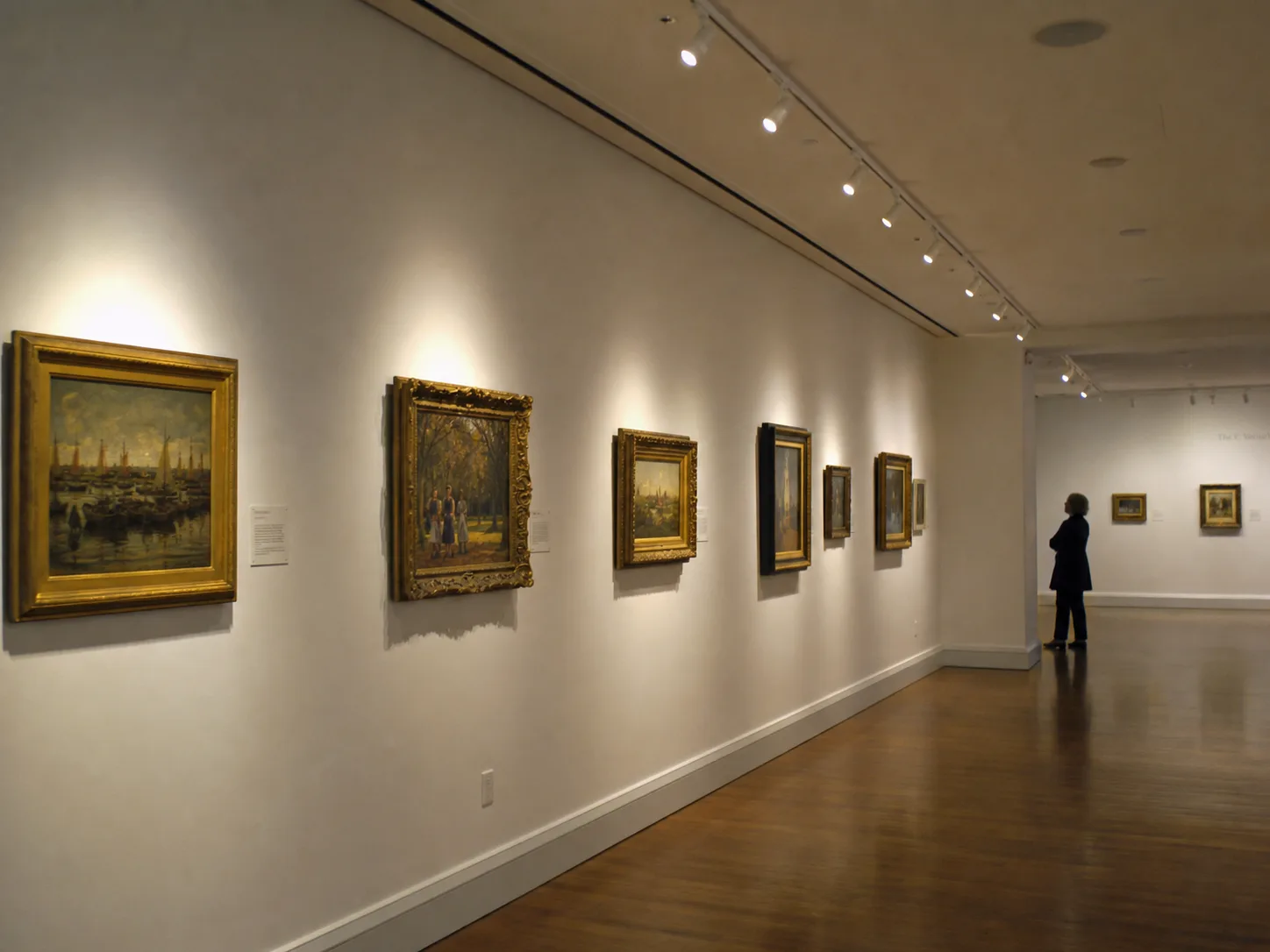
Museum track lighting gave museum designers a tool that could serve both goals simultaneously. High-CRI track fixtures could provide the precise, even illumination conservation specialists required, while the system’s flexibility allowed galleries to reconfigure their layouts without sacrificing lighting quality.
Today, track lighting remains a staple in institutions including the Museum of Modern Art and the Smithsonian — institutions that demand both technical performance and aesthetic refinement.
From Art Institutions to Retail and Hospitality
The same qualities that made track lighting valuable for museums made it equally transformative for retail environments.
In a retail store, floor plans change with every product launch, seasonal shift, or promotional display. In a restaurant or hotel lobby, event configurations and furniture arrangements evolve constantly. In a gallery, new artists and exhibitions demand new lighting approaches on a regular cycle.
Track lighting addressed all of these scenarios with one system. A retailer could spotlight new merchandise in the morning and reconfigure the lighting for an evening event that same day — without a maintenance call, without tools, and without compromise.
The commercial lighting industry quickly recognized this versatility. Lighting manufacturers across the industry adopted and refined the track lighting concept, expanding it into an entire product category that serves art, retail, hospitality, and residential applications worldwide.
Anthony Donato’s Legacy in the Lighting Industry
Donato didn’t stop with one patent. Over the course of his career, he accumulated 32 U.S. patents — a prolific output that reflected his ongoing commitment to advancing how people interact with light in built spaces.
His work was formally recognized by the Illuminating Engineering Society (IES), which honored him as a Fellow — one of the industry’s highest professional distinctions. The IES Fellowship is reserved for individuals whose contributions have significantly advanced the art and science of lighting, a standard Donato clearly met.
Anthony Donato passed away on January 13, 2014. But his thinking left a permanent mark on every track-lit space in the world. The flexibility he built into his lighting system became the default expectation: that a light fixture should adapt to the space, not the other way around.
Today, whether you’re walking through a museum gallery, shopping in a boutique, or dining in a restaurant with carefully aimed accent lights, you’re experiencing the practical result of one designer’s refusal to accept that a light had to stay in one place.
Track Lighting History: FAQ
When was track lighting invented?
Track lighting was invented in the early 1960s. American industrial designer Anthony Donato developed the concept while working at Lightolier, and it was introduced commercially around 1962 before gaining widespread popularity through the 1970s and 1980s.
Who invented track lighting?
Anthony Donato, an industrial designer at Lightolier, is credited with inventing track lighting. He designed the system to allow individual light fixtures to be repositioned along a rail, adapting to how people actually use a space rather than forcing the space to fit fixed lights.
Why was track lighting invented?
Track lighting was invented to solve the problem of inflexible fixed lighting. Donato observed that a room’s lighting needs change — displays move, art is rearranged, functions shift — and designed a rail system that let users aim and reposition each fixture without rewiring.
When did track lighting become popular?
Track lighting became a design staple in the 1970s and 1980s, particularly in art galleries, retail stores, and modern homes. It experienced a resurgence in the 2010s with the rise of low-voltage magnetic track systems and energy-efficient LED fixtures.
Is track lighting still used today?
Yes. Track lighting remains widely used in retail, hospitality, museums, and residential spaces. Modern LED and magnetic track systems offer even greater flexibility, higher efficiency, and smart-control integration than the original incandescent designs.
Conclusion
Anthony Donato invented track lighting not as an exercise in technical complexity, but as a direct response to a real limitation he observed in the built world. His industrial designer’s mindset — understanding how people actually use spaces — drove him to create something that felt obvious in hindsight but had never existed before.
In doing so, he didn’t just solve a lighting problem. He defined a new category of track lighting fixtures that serves art, commerce, and daily life across the globe. That is the legacy of the track lighting inventor: a simple idea, applied brilliantly, that changed how we think about light.
Sources
- Radiant History — Anthony Donato: The Mastermind Behind Track Lighting (radianthistory.com)
- Alcon Lighting — History and Function of Track Lighting (alconlighting.com)
- Lightolier / Genlyte Solutions (signify.com)
- Architect Magazine — Anthony Donato, Inventor of Track Lighting (Obituary)