
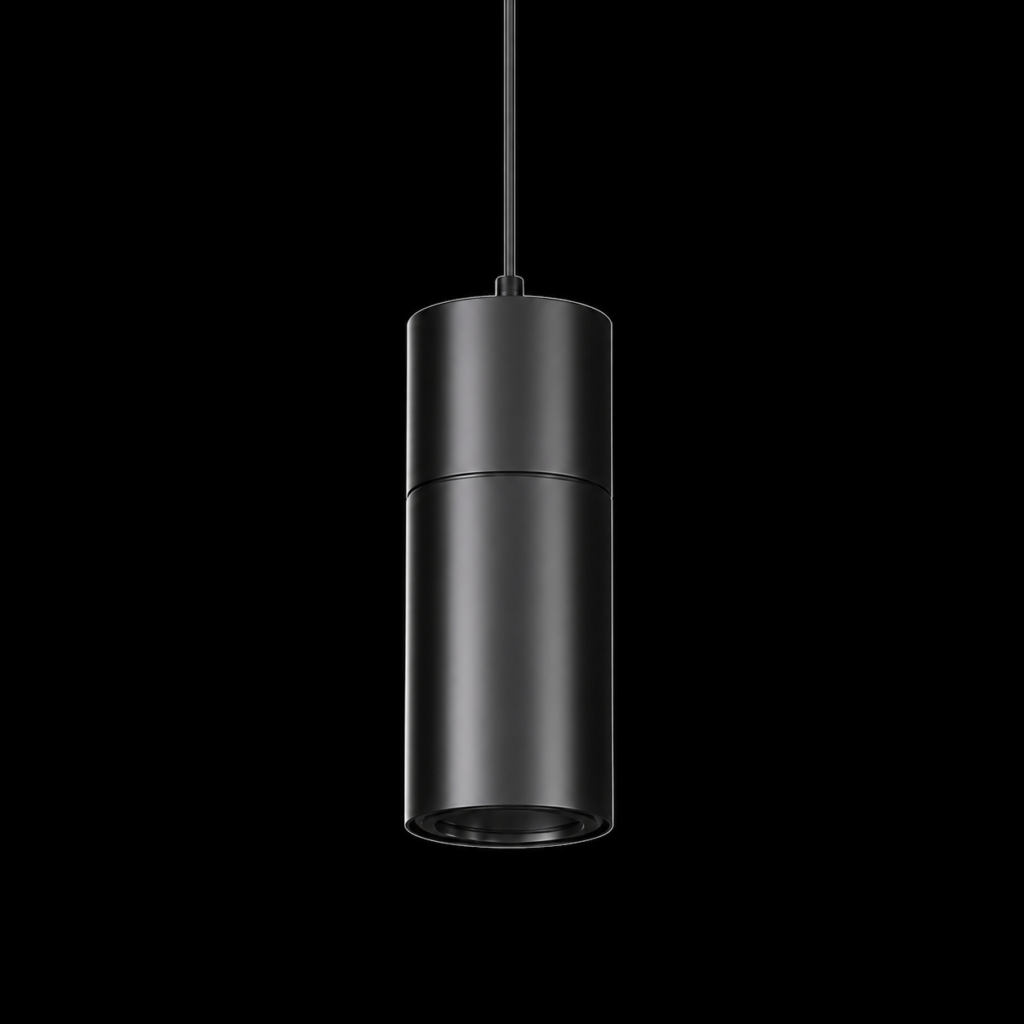
Lighting an art gallery is a balancing act: the artwork must look stunning, but every hour of light also causes measurable, irreversible damage. That is why professional gallery lighting is governed by standards — published lux limits, color rendering requirements, and aiming rules that real museums follow. This guide condenses those standards (IES RP-30, Getty guidelines, and conservation practice) into a practical spec sheet: target illuminance by material, CRI and color temperature, beam angle and the 30-degree rule, UV protection, fixture selection, and a verification checklist you can use before your next opening.
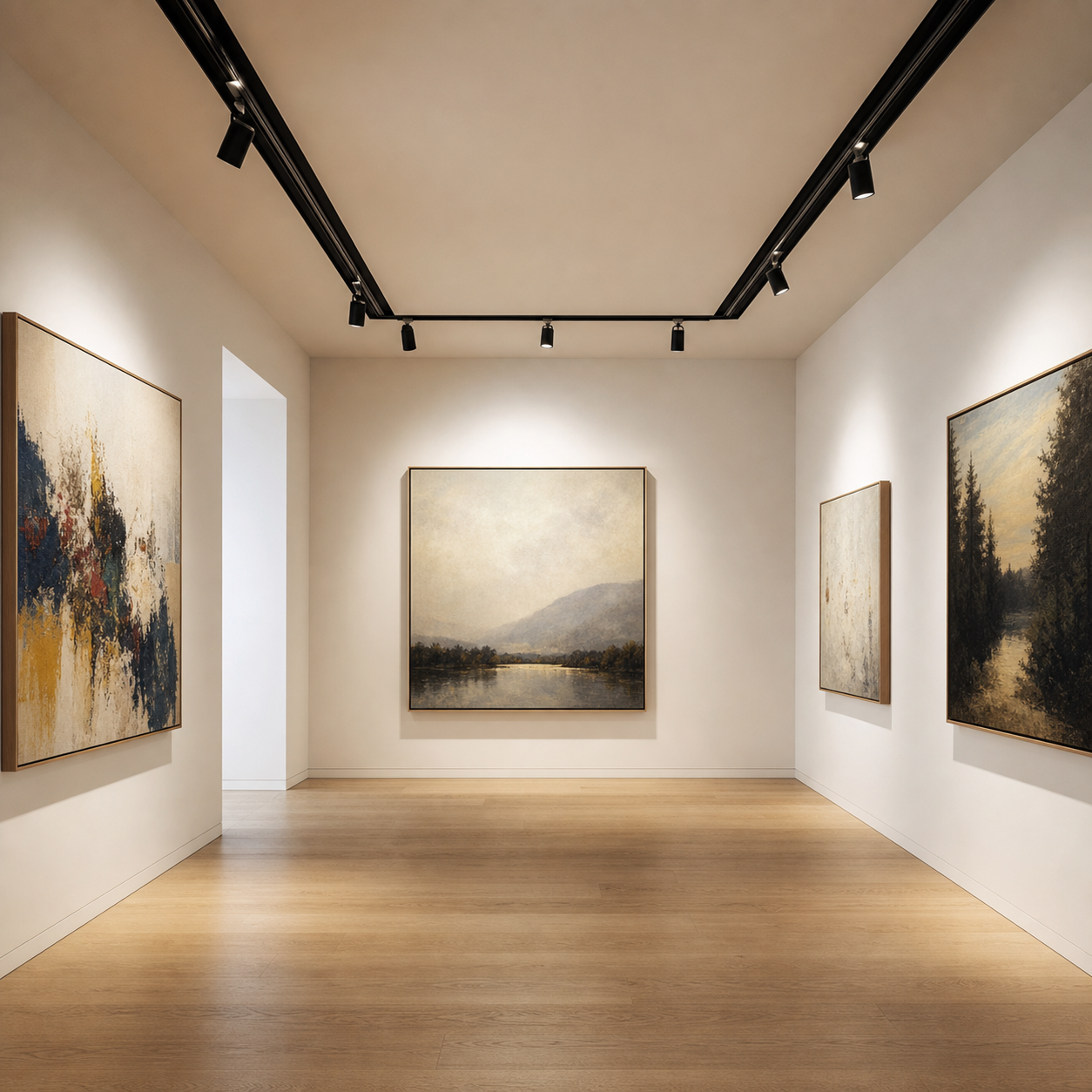

Why Art Gallery Lighting Needs Standards
Light damages art in two ways: radiant damage (ultraviolet and infrared energy breaks down pigments, paper and varnish) and visible-light damage (fading and yellowing caused by cumulative lux exposure). Museums therefore treat light as a finite budget. The Illuminating Engineering Society publishes RP-30, Recommended Practice for Museum and Art Gallery Lighting, which balances conservation with visitor experience. Conservation bodies (the Canadian Conservation Institute, the CCAHA, Museums Galleries Scotland) publish complementary limits.
For a gallery owner or specifier, the practical takeaway is simple: define a target lux level for each artwork category, choose high-CRI fixtures, control UV and infrared, and limit exposure hours. Get those four numbers right and everything else — beam angles, layout, dimming — falls into place.
Illuminance Levels: The Gallery Lux Table
Illuminance is measured in lux (lumens per square meter) or foot-candles (1 fc ≈ 10.8 lux). The standard approach is to classify artwork by sensitivity and cap the illuminance accordingly. Conservation consensus, reflected in Museums Galleries Scotland guidance and the 2026 Nature review of lighting guidelines, is:
| Material Sensitivity | Typical Artwork | Maximum Illuminance | Annual Exposure Budget |
|---|---|---|---|
| Extremely sensitive | Watercolors, photographs, prints, silk, dyed textiles | 50 lux (5 fc) | ≈ 50 lux x 6 months over 5 years |
| Moderately sensitive | Oil paintings, tempera, undyed leather, lacquer | 150 – 200 lux | ~200,000 lux-hours / year |
| Insensitive | Stone, ceramic, metal, glass, enamel | 300 lux | Higher budgets acceptable |
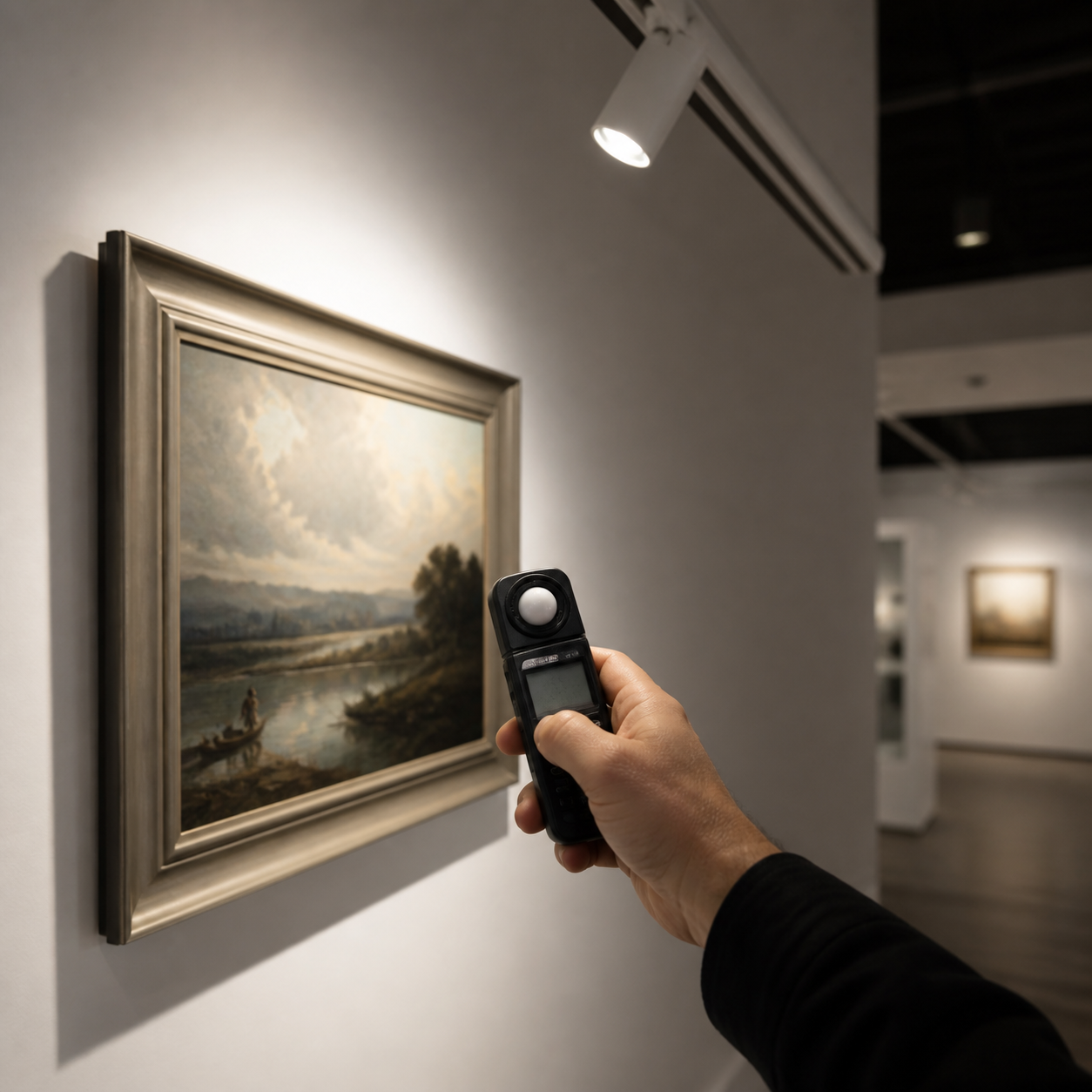
Real-world targets: most galleries run oil paintings at 150–200 lux (browsing is comfortable from 100 lux up), works on paper at 50 lux, and sculpture at 150–300 lux depending on material. The recommended IES baseline for viewing is about 200 lux on the artwork surface, dimmed during non-peak hours. Measured with a lux meter at the artwork plane, not at the floor — a common rookie mistake.
Color Quality: CRI, R9 and Color Temperature
Illuminance tells you how much light; color rendering tells you how true the light is. For galleries, three numbers matter:
- CRI (Ra): the standard color fidelity score, 0–100. Gallery-grade fixtures should deliver CRI 90+ at minimum, 95+ for museum display. Below 90, subtle hue shifts in skin tones, reds and earth pigments become visible.
- R9: deep-red rendering, the most telling weakness of cheap LEDs. Demand R9 ≥ 50 (many spec-grade fixtures reach 90+) — oil paintings, especially portraits, live or die by red rendering.
- Color temperature (CCT): 2700K flatters traditional oils and warmly patinated works; 3000K is the standard for modern galleries; 3500–4000K suits contemporary and minimal spaces. Pick one CCT and stay consistent across the room — mixed color temperatures read as sloppy installation.
One more spec to check: LED binning and driver quality. A fixture may claim CRI 95 on paper but drift between batches. Specify a narrow CCT tolerance (±150K) and a flicker-free driver (PWM-free or high-frequency) — visible flicker is not only unpleasant but can strobe under camera shutters in galleries that allow photography.
Beam Angle, Aiming and the 30-Degree Rule
Beam angle chooses the footprint of light on the wall; aiming angle controls where it lands relative to the viewer. The gallery standards:
| Beam Angle | Best For | Typical Mounting Distance |
|---|---|---|
| 10° – 15° (narrow spot) | Small pieces, 3D objects, highlights on sculpture | 2–3 m from wall |
| 20° – 35° (medium spot/flood) | Most framed paintings, medium canvases | 2.5–4 m from wall |
| 36° – 60° (wide flood) | Large canvases, wide walls, general wall wash | 3–5 m from wall |
| Framing / projector optics | Exact rectangular cuts on framed or oddly-shaped art | Any; requires aiming |
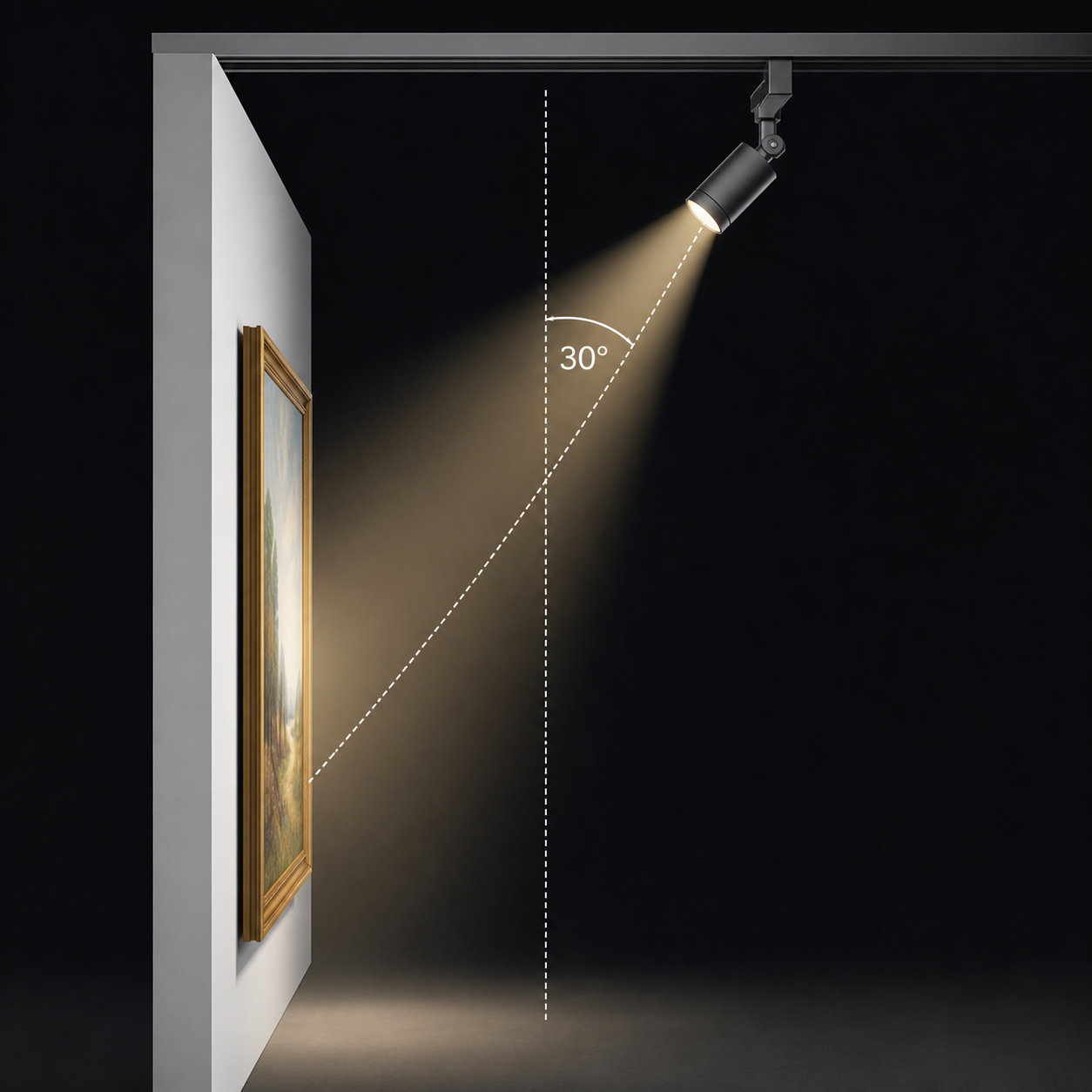
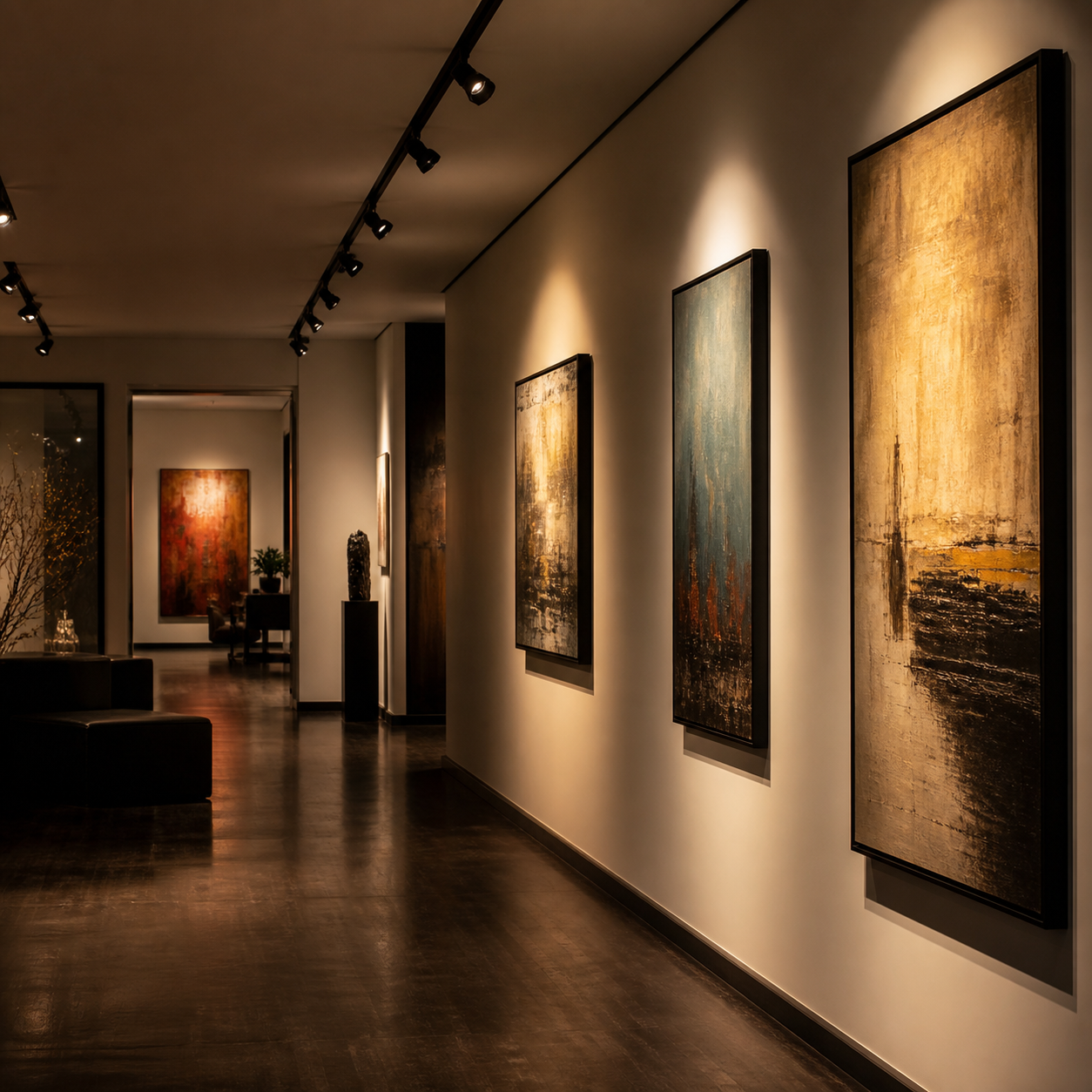
The famous 30-degree rule (from ERCO and museum practice): aim the fixture so the beam hits the artwork center at about 30° from vertical. At this angle the viewer does not cast a shadow on the work, and reflected glare bounces away from the viewing position rather than back into the viewer’s eyes. For tall works hung high, increase the angle slightly; for works with glass, reduce it and add a narrow beam to keep reflections off the glass plane. Paintings with heavy impasto (textured brushwork) benefit from a slightly raking angle (35°–45°) to reveal texture without harsh shadows.
UV, Infrared and Light-Damage Protection
Standards for UV/IR are blunt: eliminate direct sunlight (the CCI benchmark is effectively zero UV and IR reaching exhibits), keep light-sensitive objects away from windows, and apply solar-control film to any skylights. Artificial sources should emit no measurable UV and minimal infrared.
This is where LED track lighting wins decisively: LEDs produce essentially no UV, very little IR (heat), and no heat in the beam itself, so you can light a watercolor at 50 lux without cooking the paper. Incandescent and halogen sources emit UV that must be filtered. Beyond source choice, three numbers control fade risk:
- Illuminance (lux) — cap per the table above.
- Exposure hours — use occupancy sensors and dimming; museums often run 20–30% below peak after hours.
- Total lux-hours per year — the real damage currency. A 50-lux cap means nothing if the lights run 12 hours a day; budget lux-hours instead.
Glare, Flicker and Light Distribution
Two quality metrics rarely on a homeowner’s radar but mandatory in galleries: glare control and uniformity.
Glare: bare high-brightness LED sources cause disability glare that makes fine detail and low-contrast brushwork impossible to read. Spec deep-baffled or lensed fixtures with a low UGR rating (≤ 16 for galleries is a common target), and never aim a fixture so the lamp is visible from the main viewing position. The 30-degree rule largely solves this for wall art; for sculptures displayed in the round, use two or three narrow beams from different angles instead of one bright spot.
Uniformity and contrast: museums aim for a 3:1 to 5:1 ratio between the artwork and its immediate surrounding wall — enough drama to draw the eye, not so much that dark corners strain. General ambient light (wall washers, coves) should sit around 100–150 lux, with accent spots delivering the 150–300 lux on the art. This ratio is what separates a gallery from a warehouse of spotlights.
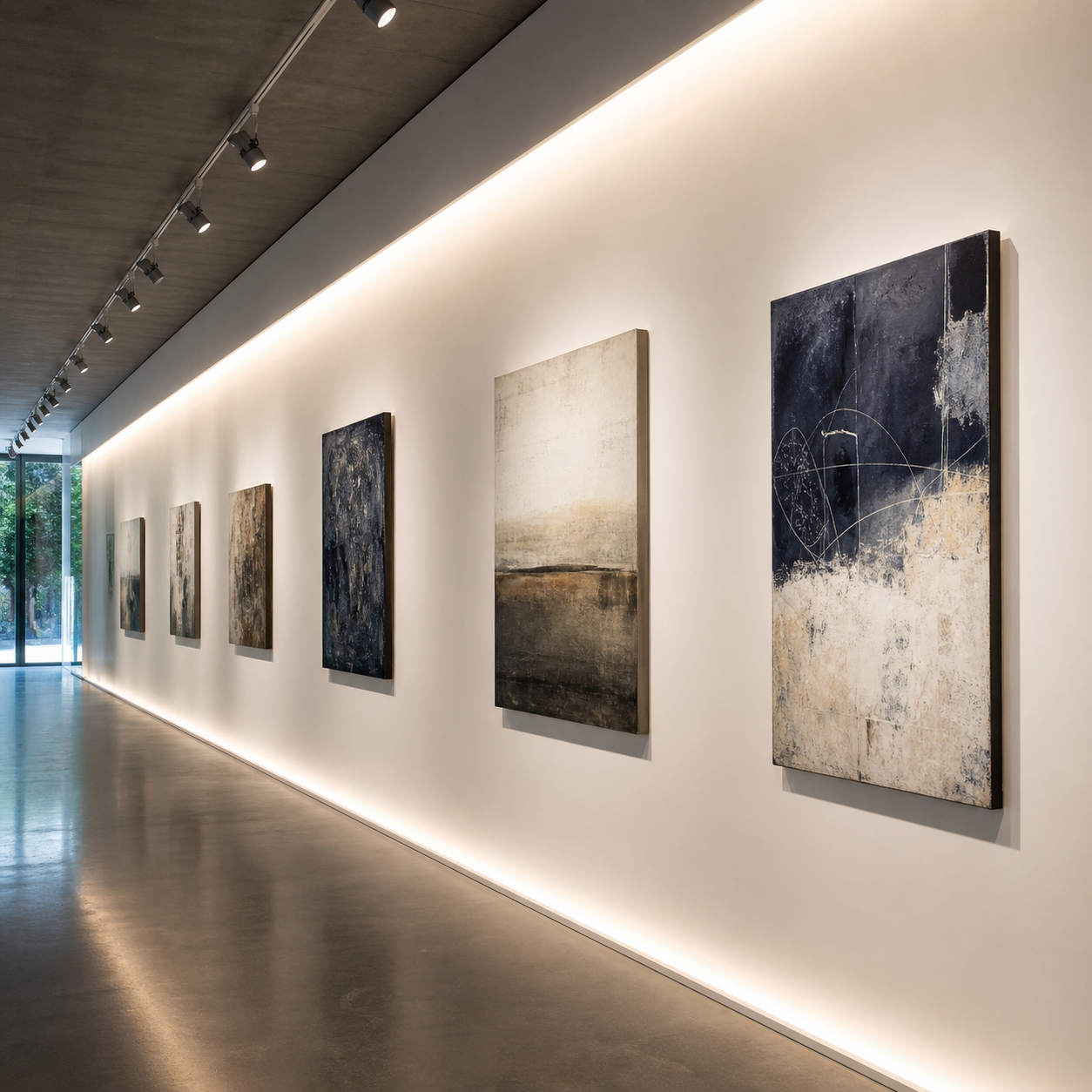
Choosing the Fixtures: Track Lighting for Galleries
Track lighting is the de facto standard for galleries because it is repositionable: hang a track, move fixtures as the collection changes, convert a spot to a flood in seconds. What to look for in a gallery-grade track fixture:
- CRI 95+ / R9 ≥ 50, verified, not just printed on the box.
- Interchangeable optics: narrow spot (10°–15°), spot (20°–30°), flood (36°–60°) or framing/projector optics for exact cuts.
- Full-range dimming without flicker, ideally 0–10V or DALI for scene control.
- Precise aiming: 90° vertical tilt and 360° rotation on quality yokes.
- Low brightness finish: deep baffles, black interiors, anti-glare rings.
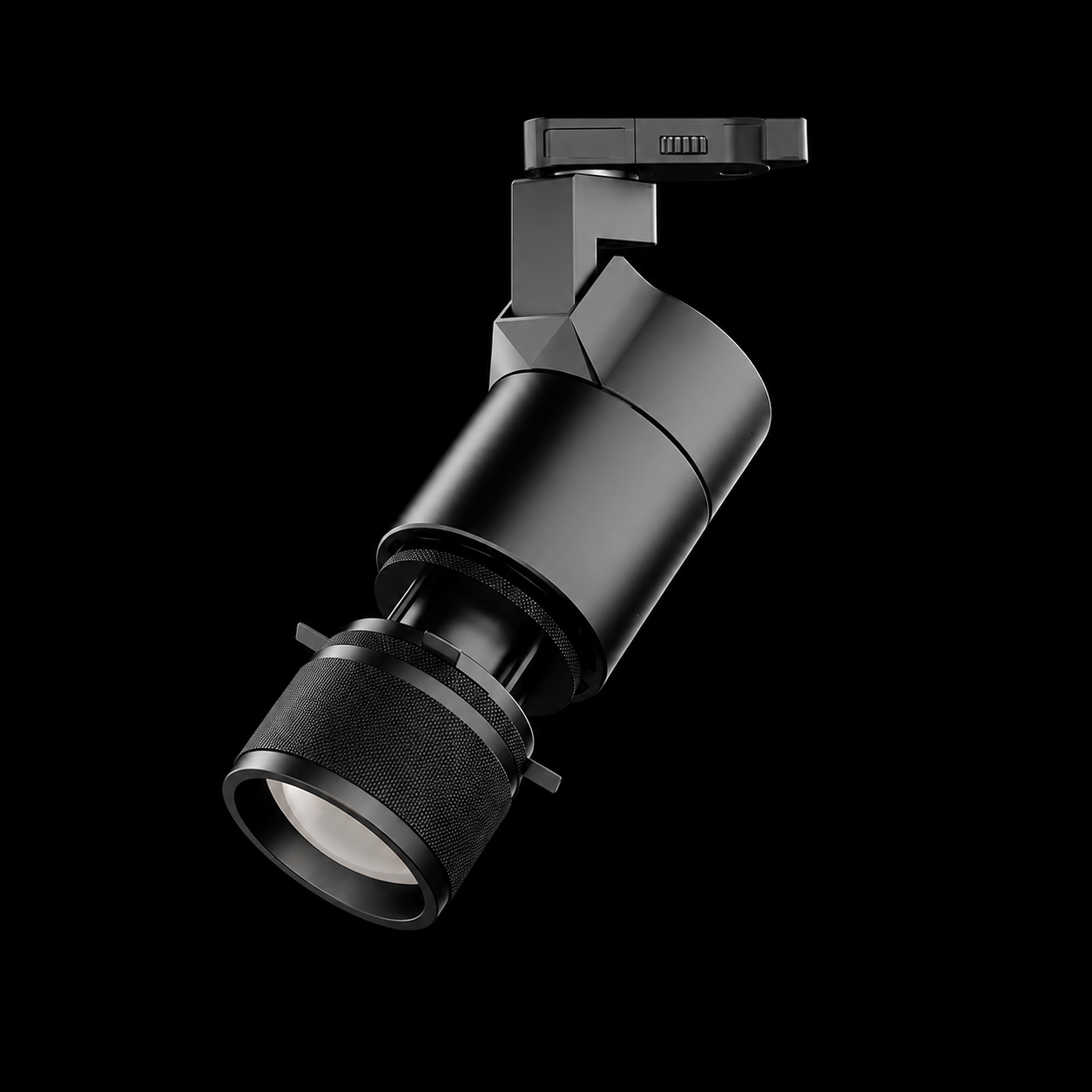
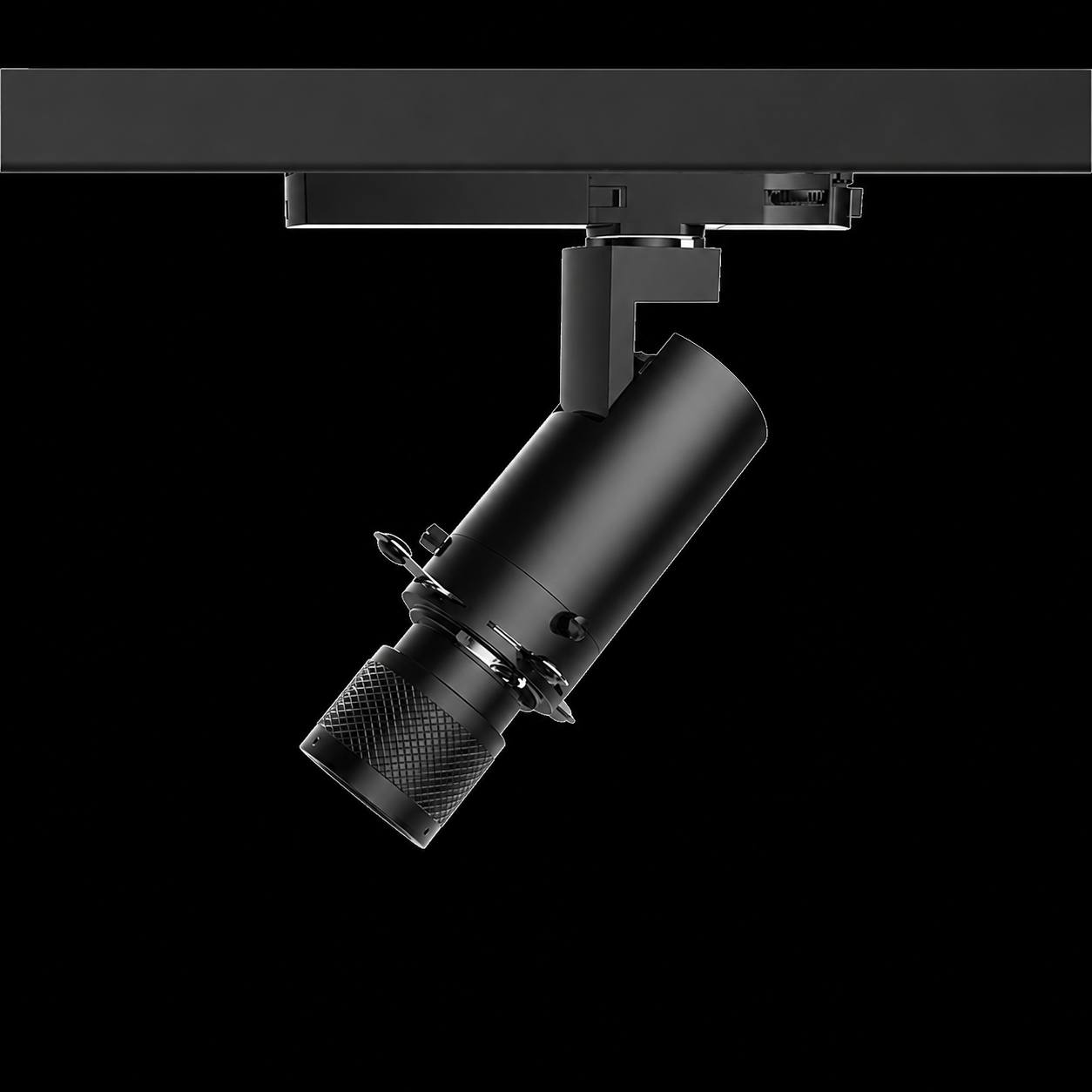
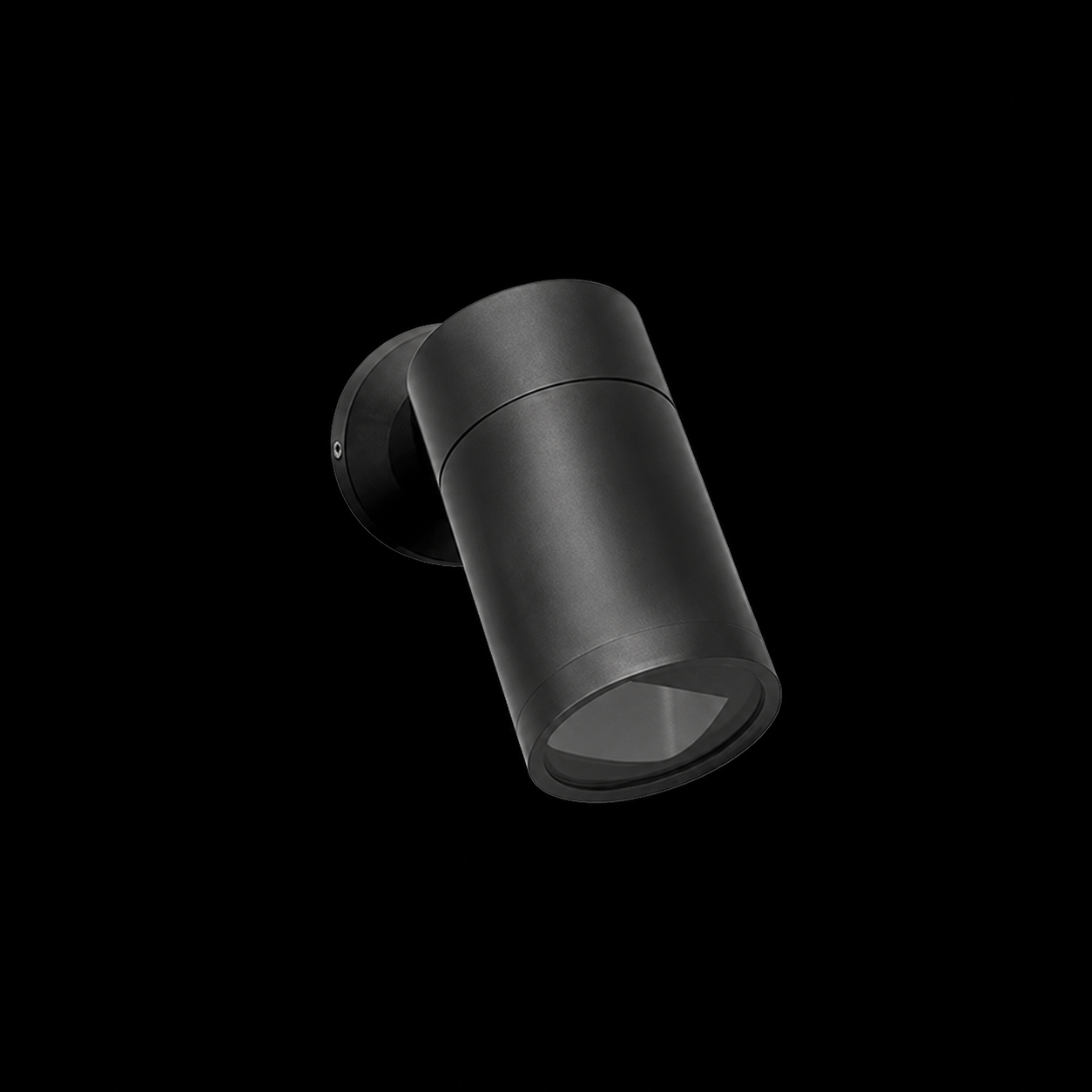
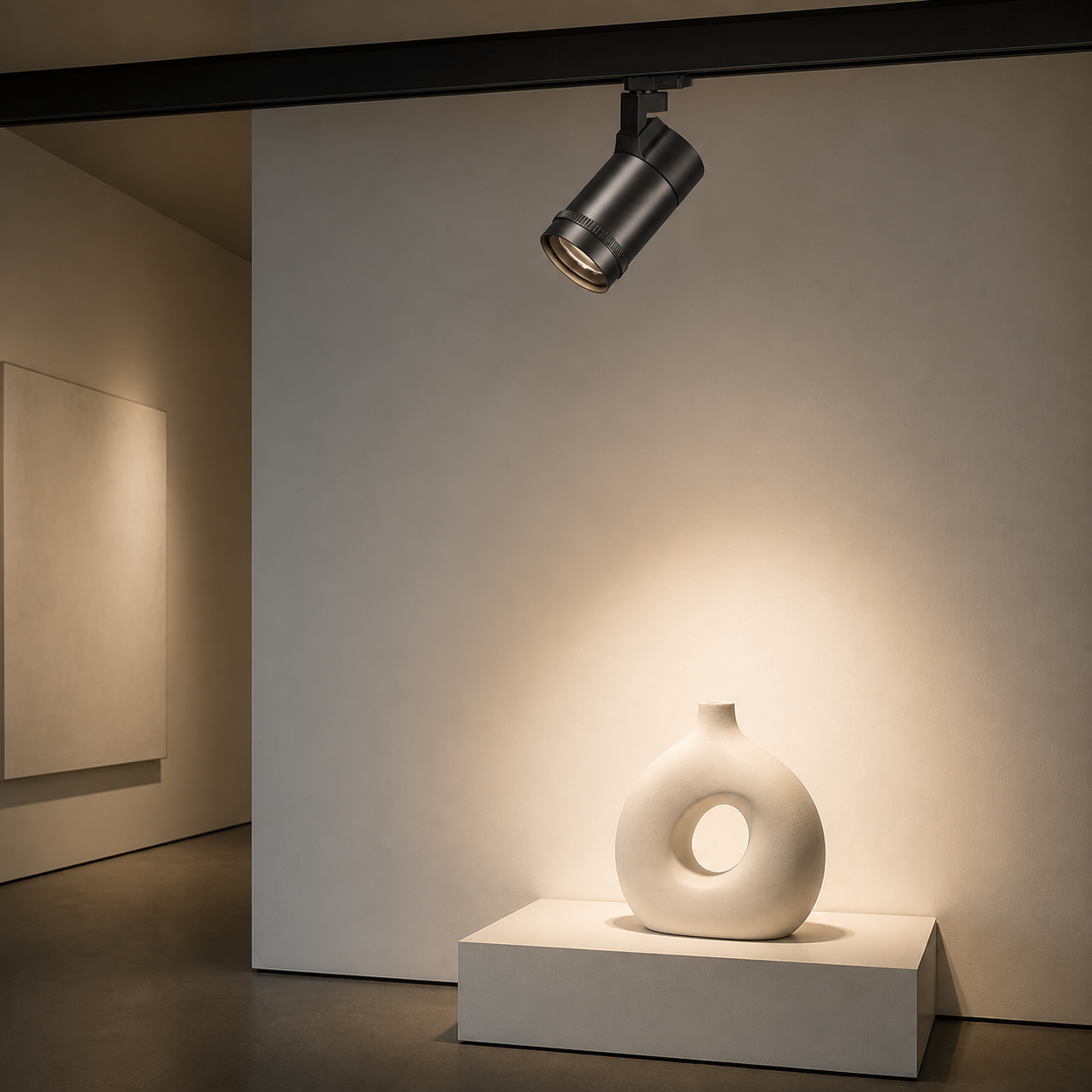
On our shop you will find spec-grade options for each role. The OVEGA Cylinder-Narrow Beam delivers a tight 10°–15° cone perfect for small pieces and sculpture highlights; the OVEGA Wall Washer 10W–20W produces the smooth vertical gradient galleries need for ambient wash; and the IMAX Projector adds framing optics to cut exactly to a canvas edge or a shadow-box interior. For larger compositions, the OVEGA Cylinder-Zoomable lets you adjust the beam without swapping heads. Browse the full track lighting range for 3000K, CRI 95+ fixtures with anti-glare optics.
Layout and Installation Best Practices
Practical rules that translate standards into a working room:
- Track placement: mount tracks 2.5–3.5 m from the wall (or center the track over a 3–5 m viewing zone). Higher ceilings need farther-set tracks and narrower beams.
- Fixture spacing: one accent head per artwork for medium canvases (approx. one per 1–1.5 m of wall); wall washers every 1.5–2 m for a continuous wash.
- Layering: build three layers — ambient wash, accent spots, and a low decorative/wayfinding layer at floor level for evening events.
- Power and control: size circuits for future additions (galleries rehang constantly); run dimming wires (0–10V or DALI) to every track run from day one.
- Zoning: group fixtures by exhibition zone so lighting scenes can be recalled per show; museums typically store 3–5 scene presets per gallery.
Verification: A Commissioning Checklist
Standards only protect your collection if the installed lighting actually meets them. Before opening (and every six months after), walk the gallery with a lux meter and check:
- Illuminance at the artwork plane matches the target table — 50 lux for works on paper, 150–200 lux for oils.
- No fixture exceeds the annual lux-hour budget: log dimmer settings and runtime.
- No glare is visible from the main viewing line (look at the artwork, then check for lamp visibility).
- No reflected glare in glass frames from the viewing position.
- Color temperature uniform across the room; CRI verified on a sample fixture with a spectrometer if available.
- All fixtures aimed at 30° from vertical, centered on the artwork.
Record the readings per artwork zone in a simple spreadsheet. Six months later you can see drift (dimmer settings, LED aging) before it becomes visible to visitors — that is what “living by standards” actually looks like.
FAQ
What is the standard lux level for art gallery lighting? The consensus standard is 50 lux maximum for extremely sensitive works (watercolors, photographs, prints), 150–200 lux for oil paintings and moderately sensitive materials, and up to 300 lux for insensitive objects like stone and metal. Museums also budget annual lux-hours; exposure time matters as much as intensity.
What CRI do I need for gallery lighting? CRI 90+ is the practical minimum; CRI 95+ with R9 ≥ 50 is the museum-grade standard. High red rendering (R9) matters most for oil paintings and portraits.
What is the best color temperature for an art gallery? 3000K is the modern gallery standard, balancing warmth and neutrality. 2700K flatters traditional oil paintings; 3500–4000K suits contemporary and minimal spaces. Pick one CCT and keep it consistent.
What angle should gallery track lights be aimed? Aim the beam at the artwork center at roughly 30 degrees from vertical. This avoids viewer shadows and reflected glare. Raise the angle slightly for tall or textured works.
Does LED lighting damage artwork? LEDs emit essentially no UV and minimal infrared, and they deliver almost no heat in the beam, so they are the safest practical source for art. The remaining risk is visible-light fading, controlled by lux caps, exposure hours and dimming.
Build Your Gallery Around the Standard
Art gallery lighting standards are not bureaucratic noise — they are the engineering that lets your collection survive decades of viewing. Start with the lux table, specify CRI 95+ fixtures at 3000K, respect the 30-degree rule, layer in wall washing, and verify with a lux meter. If you need help translating these specs into a fixture schedule, our team works with galleries and museums daily — and the track lighting range is built for exactly this job.
For deeper reading: our guide to lighting paintings and sculptures covers technique, why museums need track lights over ordinary spotlights explains the fixture logic, and exposed track and the gallery wall-wash effect shows the aesthetic side. The authoritative references behind this article are Getty’s guidelines for solid-state museum lighting and AAM’s museum lighting practice discussion (IES RP-30).
Related guides: lighting Chinese traditional art and high-ceiling gallery spaces.