
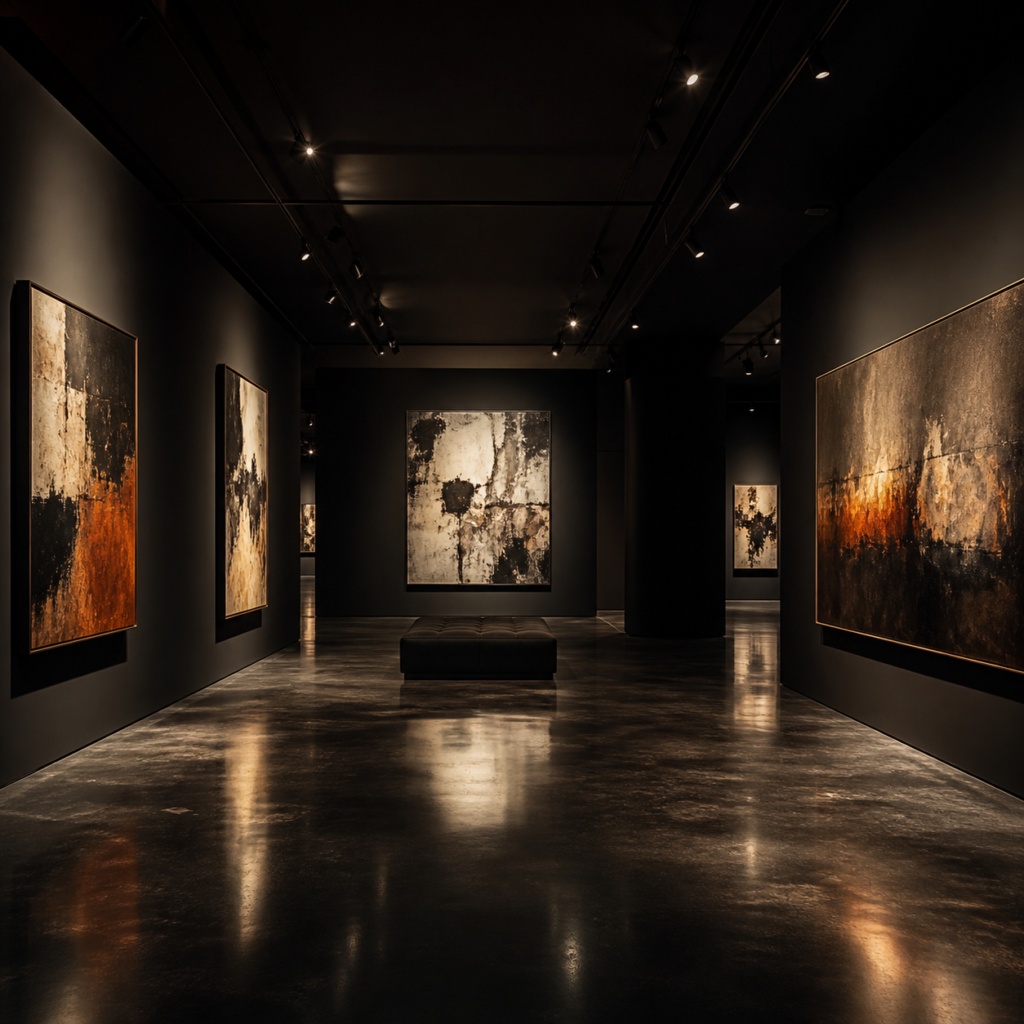
Art gallery lighting is the difference between a painting that glows and a painting that fades — and most galleries get it only half right. The wrong beam angle creates glare on the glass. The wrong color temperature turns a warm oil portrait cold and clinical. And the wrong light source slowly, invisibly destroys the artwork itself.
Track lighting has been the gallery standard for decades because it does one thing no other system does well: it lets you aim precise, controllable light at each piece individually — and re-aim it whenever the collection changes. This guide covers exactly how to light paintings and sculptures correctly: aiming angles, beam angles, color temperature, CRI, UV/IR protection, and the layout rules professional museum designers use.
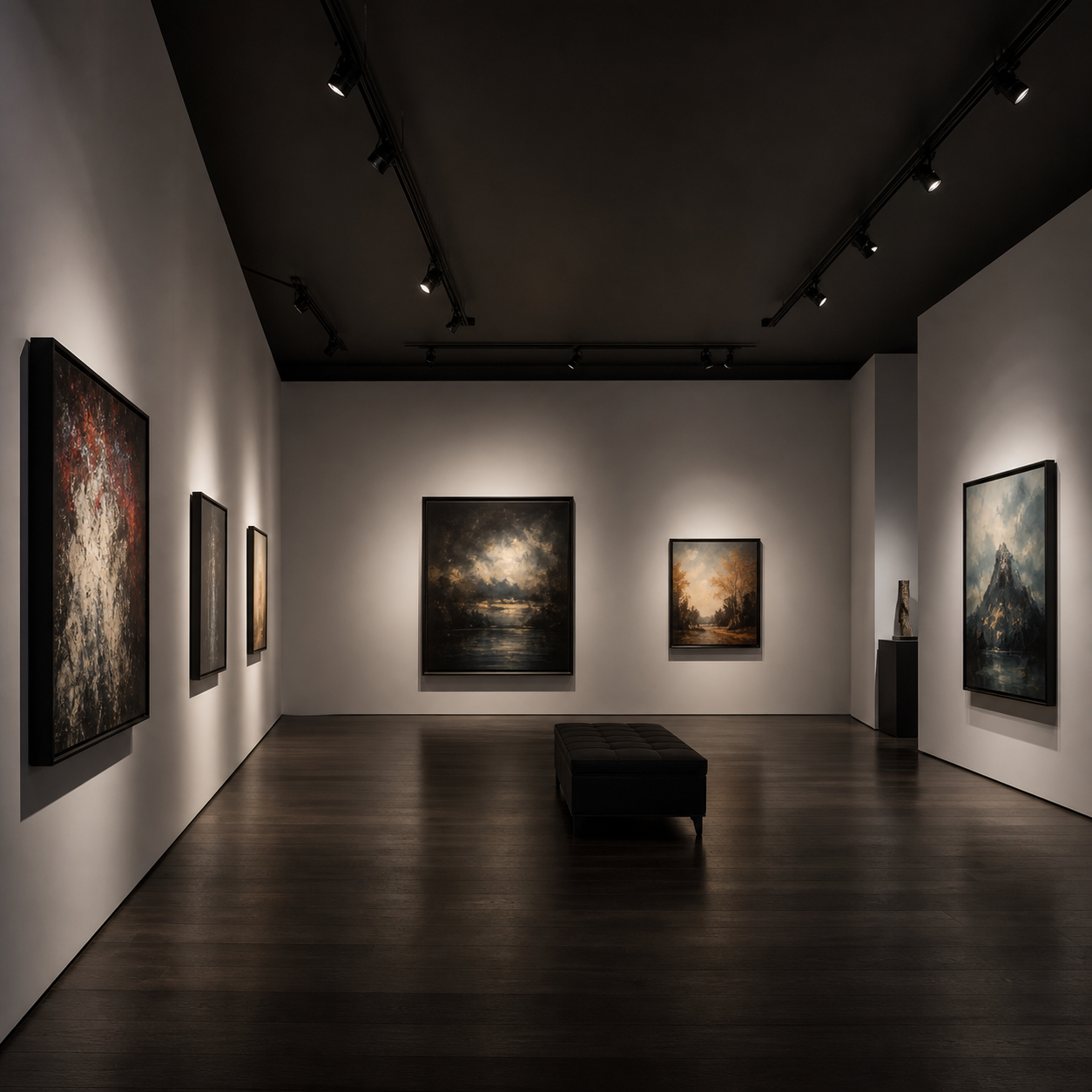

Why Track Lighting Is the Gold Standard for Art Galleries
Walk into any serious museum or commercial gallery and you will see the same answer: track lighting. It is not a stylistic preference — it is the only lighting system that satisfies the four demands of art display simultaneously:
- Individual aiming: every track head points at its own artwork, with no light spilling onto the frame or the wall beside it
- Reconfigurability: when the collection changes, heads are re-aimed or moved along the rail in minutes — no electrician, no re-wiring, no new ceiling penetrations
- Glare control: a properly aimed head keeps direct light out of the viewer’s eyes while bathing the artwork in light
- Museum-grade optics: quality gallery track heads use precision lenses and baffles that shape the beam and cut stray light
Fixed downlights cannot re-aim, picture lights cannot re-position, and pendants cannot cover both a 3-meter canvas and a freestanding sculpture from the same rail. Track lighting does all three.
First, the Damage Risk: UV, IR and Lux Limits
Before aesthetics comes preservation. Light is energy, and every photon that hits a painting carries the potential to fade pigments, yellow varnishes, and embrittle canvas. Gallery lighting must balance visibility against damage.
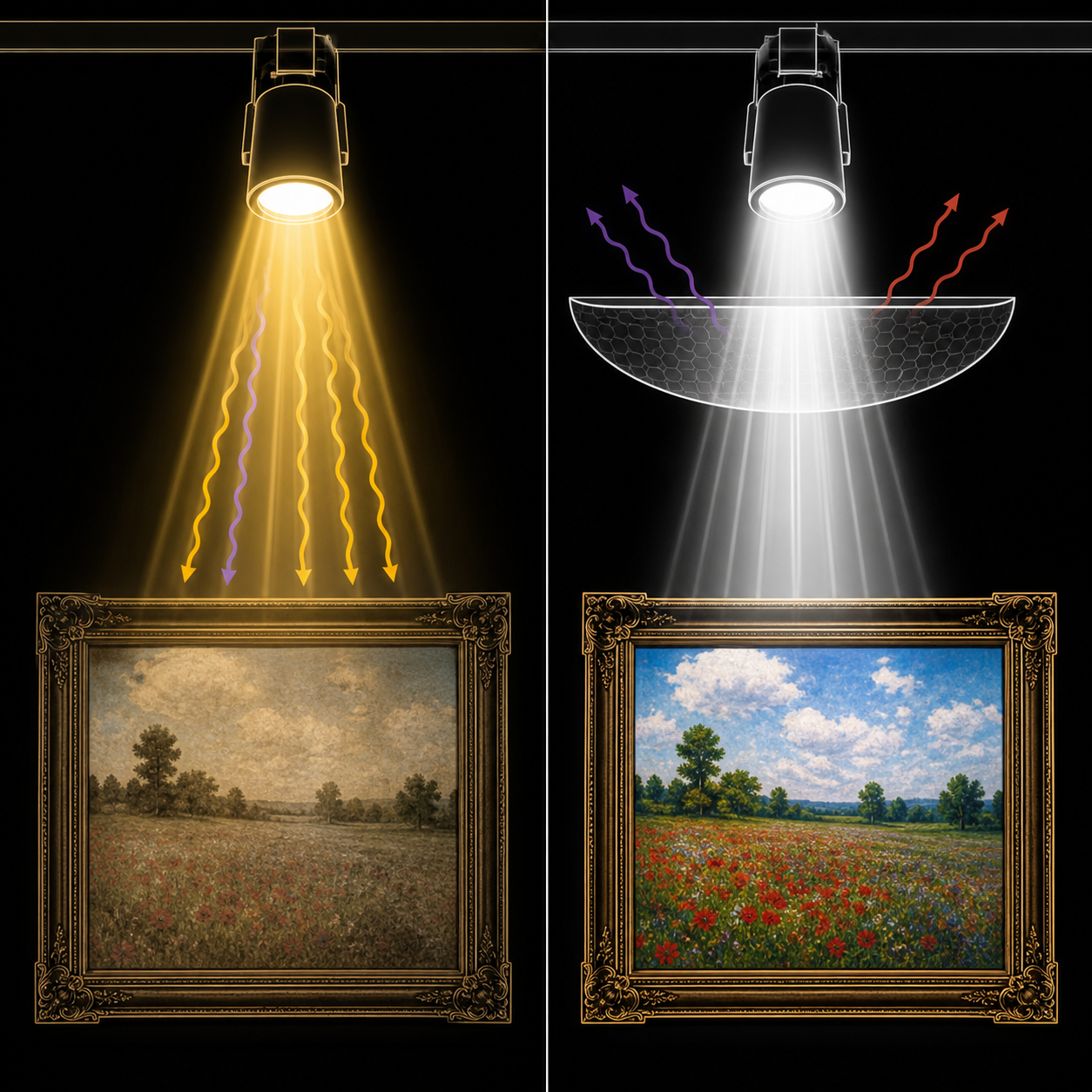
Three factors determine light damage:
- UV (ultraviolet): the most damaging band — it breaks chemical bonds in pigments and papers. Any gallery-grade light source must filter UV to near zero. ENCORE IMAX track heads use UV-filtered optics as standard, so the 385–400nm edge of the spectrum never reaches the artwork.
- IR (infrared): invisible heat that dries and cracks surfaces. LED track lighting produces almost no IR compared with halogen — one more reason museums converted decades ago. IMAX optics add IR control for temperature-sensitive works.
- Total lux-hours: damage is cumulative. The standard guidance for sensitive works is a maximum of 50 lux for paper and watercolors, 150 lux for oil and tempera, and 300 lux for sturdy objects like metal and stone — with annual exposure limits tracked in lux-hours.
This is where high-end gallery fixtures earn their price: precision optics deliver the same visual brightness at lower lux, because more of the light lands on the artwork instead of scattering onto walls and floors. A well-aimed IMAX head at 150 lux can look brighter than a poorly aimed 400 lux flood — while doing a fraction of the damage.
Lighting Paintings: Angle, Beam and Color
Paintings are 2D, but they are not flat to light. Varnish, impasto texture, and glass all react to the angle of incidence.
The 30° Aiming Rule
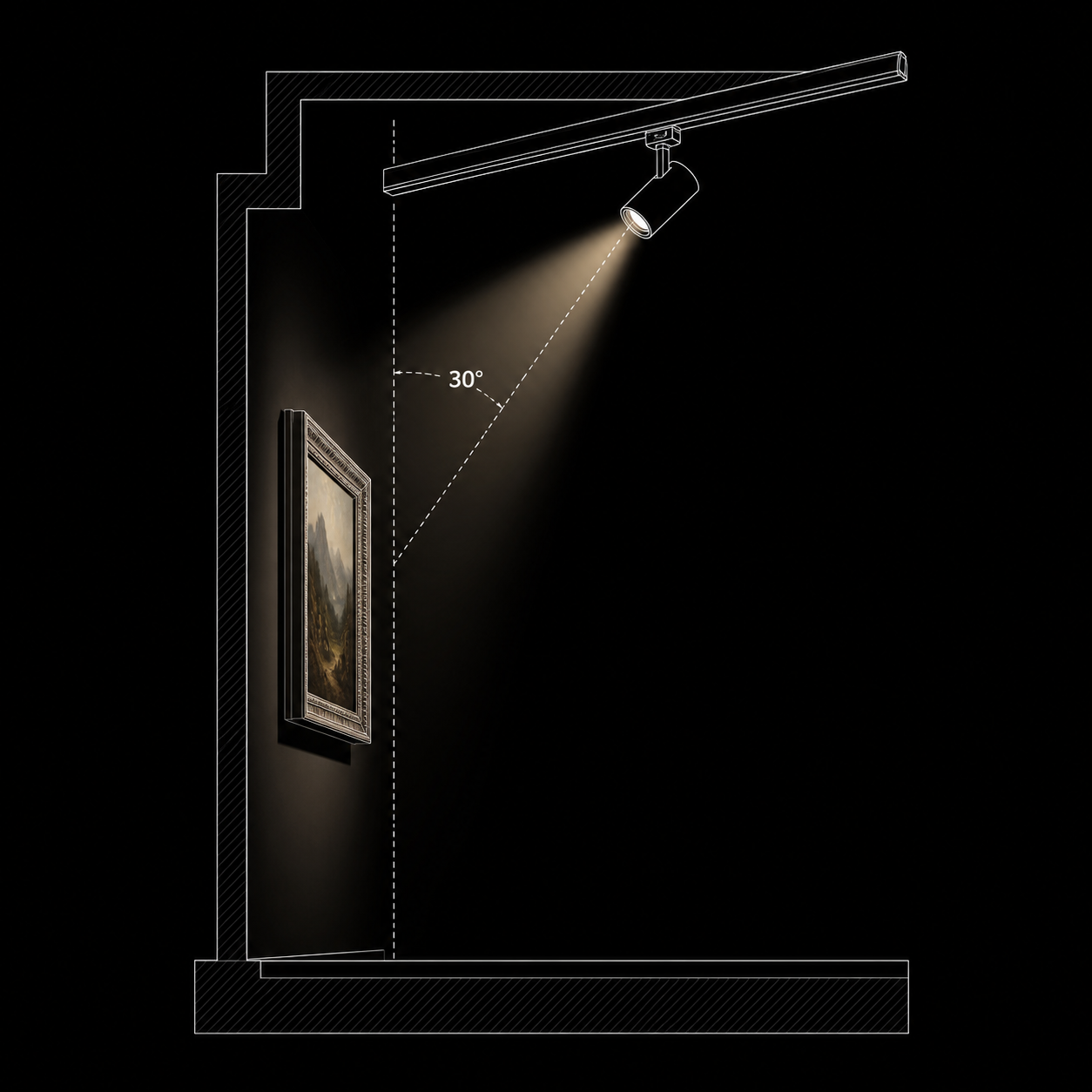
The professional standard is to aim track heads at a 30° angle from the vertical toward the center of the painting. This does three things:
- Keeps direct light out of the viewer’s eyes — the reflected beam bounces away from standing viewing positions
- Reveals brushwork and texture — grazing light catches impasto ridges that flat-on light flattens
- Minimizes veiling glare on framed and glass-covered works
For very large works, use two heads aimed from opposite sides at 30° each, meeting at the center. For works with heavy varnish or glass, increase the angle slightly to 35–40° to push specular reflections off-axis.
Beam Angle: 24–36° for Paintings
A 24–36° beam is the gallery workhorse for wall art. The beam should slightly overcover the artwork — roughly 1.5 to 2 times the canvas width at the wall — so edges and frames are lit evenly without hot spots. Narrow 15° beams suit small works at distance; wide 60° beams are for wall washes, not individual pieces.
Color Temperature: 3000K Is the Gallery Default
Almost every major gallery specifies 3000K as its base color temperature. It renders warm and neutral palettes faithfully without the yellow cast of 2700K or the clinical feel of 4000K. 4000K appears occasionally in contemporary spaces showing cool-toned works, but it must be a deliberate curatorial choice — never a default.
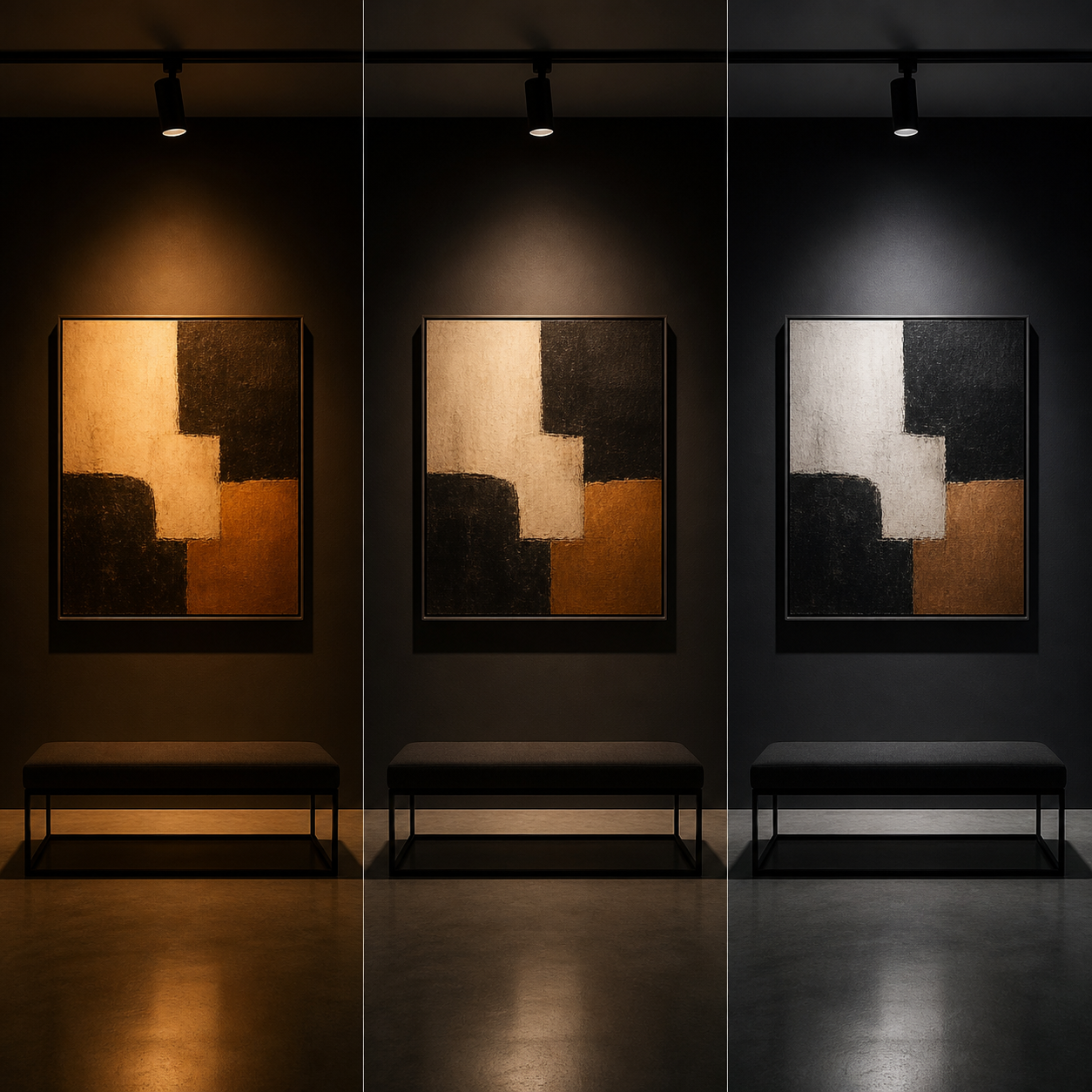
Never mix color temperatures in one gallery space. Adjacent works lit at different CCTs make the whole room feel wrong, and visitors will perceive the difference even if they cannot name it.
Lighting Sculptures: A 3D Approach
Sculptures are the opposite problem from paintings: instead of lighting a flat surface evenly, you are modeling a three-dimensional form. One head is never enough.
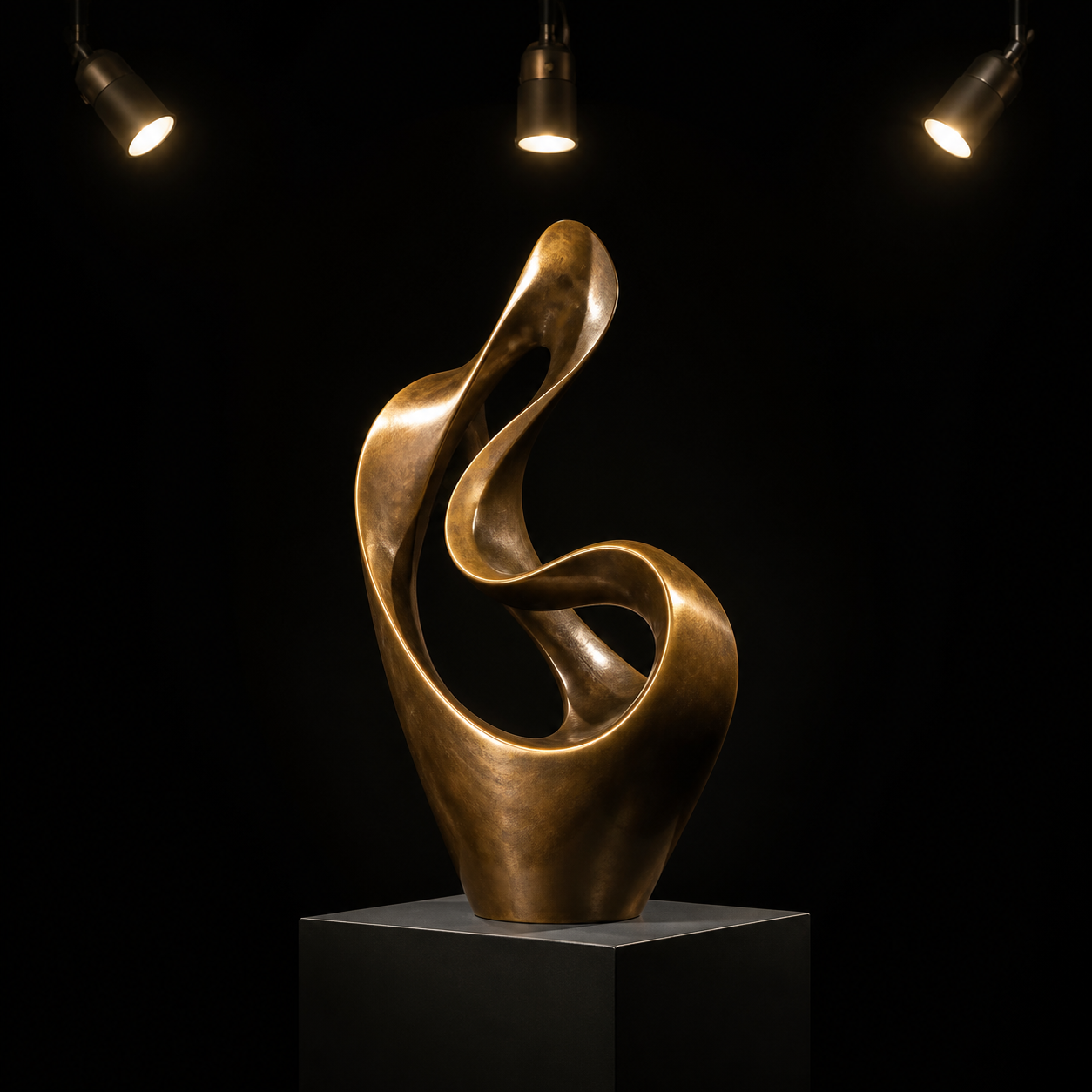
The professional technique is key light + fill light, adapted from photography:
- Key light: a 24–36° head aimed at 45° from the primary viewing direction, establishing the main form and shadow pattern
- Fill light: a wider 36–60° head at lower intensity from the opposite side, softening shadows and revealing detail in the recesses
- Optional rim/accent: a narrow head from behind or above to separate the sculpture from the wall and add drama — common for bronze and stone
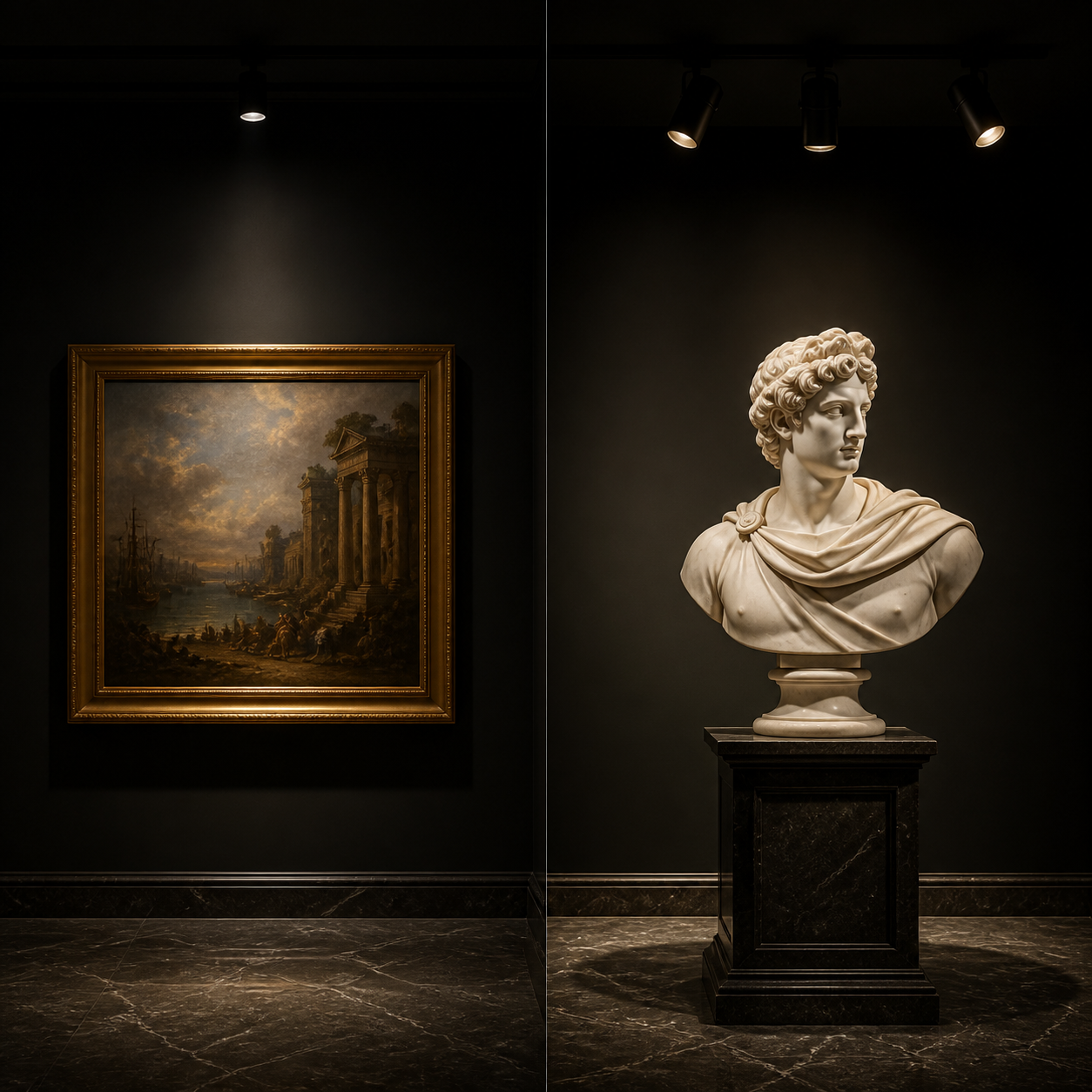
For freestanding sculptures, add a fourth consideration: the viewer walks around the piece. Every side needs at least base-level modeling, so the lighting design must work from multiple viewing angles — another reason track heads’ re-aimability is invaluable. Avoid lighting sculptures from directly above only; it flattens facial features and casts harsh downward shadows.
CRI 95+: Color Rendering Is Non-Negotiable for Art
Color rendering index (CRI) measures how faithfully a light source reveals true colors. For art, this is not a marketing number — it is the entire point of the installation.
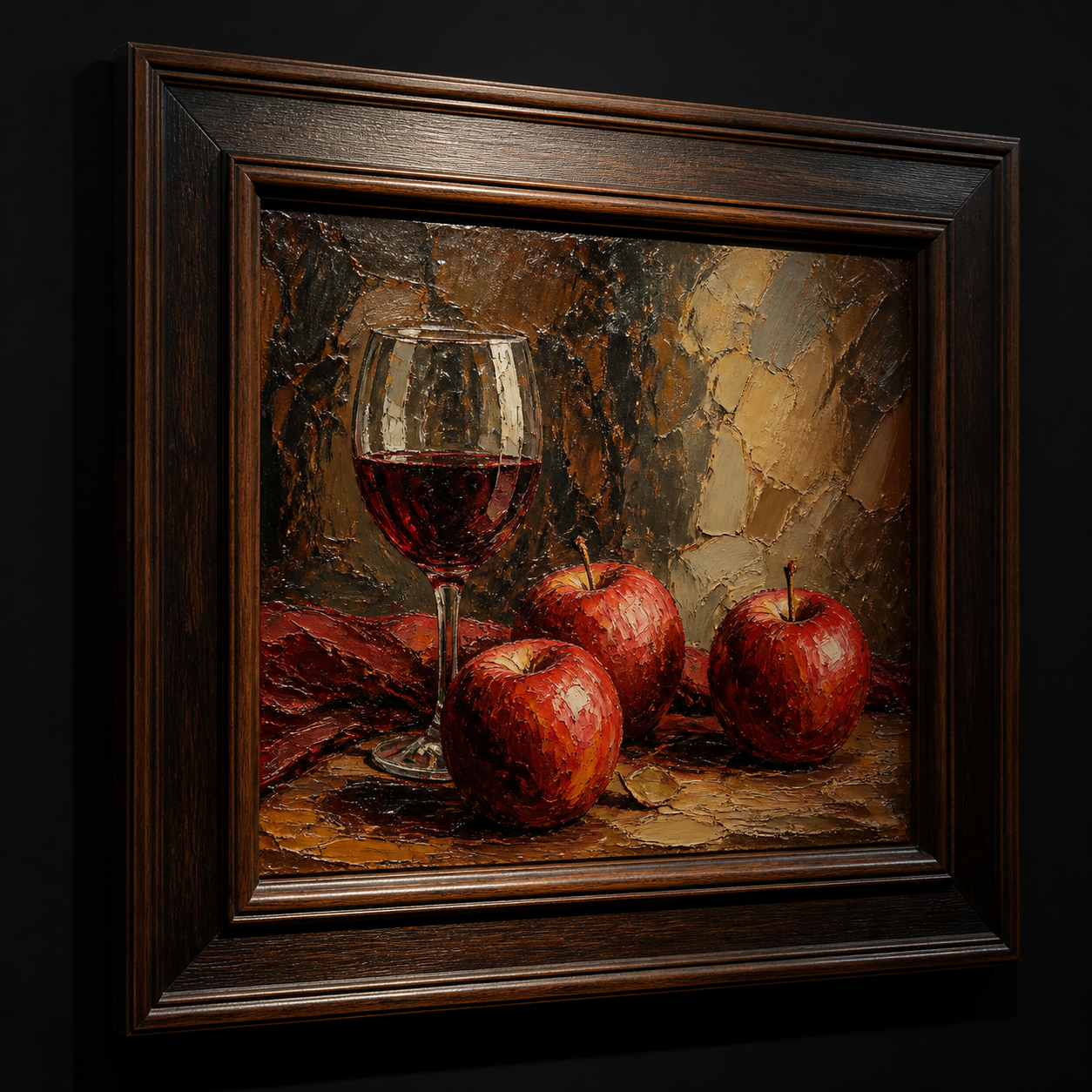
CRI 80 is acceptable for corridors and utility spaces. CRI 90 works for most retail. CRI 95+ is the gallery and museum standard, and here is why: paintings contain the full pigment spectrum, and low-CRI light sources typically fail most dramatically on deep reds and skin tones — exactly the colors that dominate classical portraiture and still lifes.
Check two numbers on any gallery fixture spec sheet:
- CRI (Ra): the average fidelity across eight standard colors — IMAX series delivers Ra ≥ 95
- R9: the deep-red rendering value — most fixtures drop hardest here. Look for R9 > 90; IMAX series specifies R9 > 90 as standard
A CRI 95 track head and a CRI 80 head at the same color temperature will make the same painting look like two different paintings. If your gallery budget allows only one upgrade, upgrade the CRI.
Gallery Layout: Track Positioning and Spacing
Good gallery lighting is 80% layout and 20% fixture quality. The rules that museum lighting designers follow:
- Track distance from wall: mount the track 60–120cm (2–4 ft) from the wall, adjusted for ceiling height — the 30° aiming angle determines the exact position
- Ceiling height: on a 3m (10 ft) ceiling, the track sits roughly 1.2–1.5m from the wall; higher ceilings push the track farther out
- One head per artwork: never light two adjacent paintings with one head unless they are a deliberate diptych — spill light degrades both
- Aim at the center: each head targets the vertical center of its painting, not the top or bottom
- Leave the wall between works dark: dark wall space between lit pieces increases perceived contrast and makes each work feel more important
For circulation and floor light, add a separate ambient layer — wide-beam heads or wall washers on a different circuit — so the space never relies on accent heads alone. Ambient and accent should be on independent dimming channels: 100% accent / 30% ambient for evening, reversed for cleaning and installation days.
Frequently Asked Questions
What angle should track lighting be aimed at artwork?
Aim track heads at 30 degrees from vertical toward the center of the painting. This keeps direct light out of viewers’ eyes, reveals texture and brushwork, and minimizes glare on glass. Increase to 35-40 degrees for heavily varnished or glass-covered works.
What beam angle is best for lighting paintings?
Use 24-36 degree beams for most wall art, sized so the beam slightly overcovers the canvas. Narrow 15-degree beams work for small works at distance, and 60-degree wide beams are for wall washing rather than individual pieces.
What color temperature do art galleries use?
3000K is the gallery and museum default because it renders warm and neutral palettes faithfully. Use 4000K only as a deliberate curatorial choice for cool-toned contemporary works, and never mix color temperatures within one gallery space.
Is CRI 90 or CRI 95 better for art lighting?
CRI 95 is the professional standard for art. Paintings contain the full pigment spectrum, and low-CRI sources fail most on deep reds and skin tones. Also check R9 (deep red rendering) – it should be above 90 for gallery-grade fixtures.
How many lux are safe for artwork?
Guidance varies by material sensitivity: 50 lux for paper and watercolors, 150 lux for oil and tempera, up to 300 lux for sturdy objects. UV and IR must be filtered to near zero, and annual exposure should be tracked in lux-hours.
Final Recommendation
Correct art gallery lighting comes down to five decisions: track system for aiming flexibility, 30° aiming for paintings, key-plus-fill modeling for sculptures, 3000K with CRI 95+ and R9 > 90 for faithful color, and UV/IR-filtered optics for preservation. Get those right and the artwork does the rest.
ENCORE’s IMAX series track lighting was engineered for exactly this brief: Ra ≥ 95 with R9 > 90, UV/IR-filtered optics, 15°–60° interchangeable beam optics, 3000K/4000K CCT options, 0-10V/DALI dimming, and precision baffles for glare control. It is the fixture family our gallery, museum and auction-house clients specify — and the one we recommend for yours.
Planning a gallery lighting project? Talk to our specification team for a free layout with photometric calculations, or explore the IMAX track light range. You can also read how track lighting performs in other exacting environments in our museum track lighting guide and our restaurant lighting design guide.