
custom oem lighting factory — most US importers start with a catalogue and a price, and end up rebuilding a container of fixtures that do not pass inspection. The fixtures are rarely the problem. The questions you did not ask before the PO are. This guide is the list we wish every US buyer brought to the first meeting: what to verify on the floor, what to demand in writing, which listing covers which market, and how to spot a trading company wearing a factory badge.
It is written for the buyer who is sourcing track lighting oem factory capacity — private label, custom wattage, custom beam angles, US-market listings — and who needs the factory to be the source of truth, not a middleman with a warehouse. Everything below is what we would answer, and what we would expect to be asked, on a factory visit in Shenzhen or Zhongshan.

What “OEM Factory” Actually Means — And How to Tell You’re Not Talking to One
The phrase gets used loosely. In practice you are dealing with one of three businesses, and only one of them can carry your brand all the way to a customs-cleared import.
- A trading company. Takes your order, places it with a factory you will never see. Good for commodity catalogues, fatal for anything you call “custom”.
- An ODM house with your logo. Owns the tooling but builds from a fixed design library. Fast and cheap; your differentiation is limited to finish, wattage and packaging.
- A manufacturer with in-house tooling, SMT, photometry and certification. This is what a custom track lighting manufacturer: OEM & ODM factory genuinely does — it can cut a new mould for a housing profile, change the driver to hit a US listing, and re-run photometry on the new build.
Four checks separate the third from the first two, and none of them require a flight.
1. Ask for the mould, not the catalogue
Request a photograph of the mould for the housing you are being quoted, plus the tooling ownership clause in writing. A trading company cannot produce this because it does not own the asset. A real factory will send a mould-room photo with the asset number visible within a day.
2. Ask who writes the driver firmware
Dimming compatibility is where most OEM track projects fail. If the answer is “the driver supplier handles it”, you have no control over the 0–10V or DALI curve, and no way to fix a flicker complaint in the field. The factory should be able to show a firmware repository, a version number, and a change log for the driver board.
3. Ask for the sphere report, not the lumen number
“120 lm/W” on a datasheet is a claim. An integrating-sphere report with the test lab’s name, the report number and the measurement date is evidence. Ask for the file, then verify it — we cover exactly how in the certificate section below.
4. Ask how many SKUs they shipped last year to your market
Not total revenue. SKU count to your destination market, and the name of one reference customer you may contact. A factory that has never cleared US customs will underestimate the label, the packaging warnings, and the DLC filing — and you will pay for that education.
The Factory Audit: Eight Stops, About Two Hours
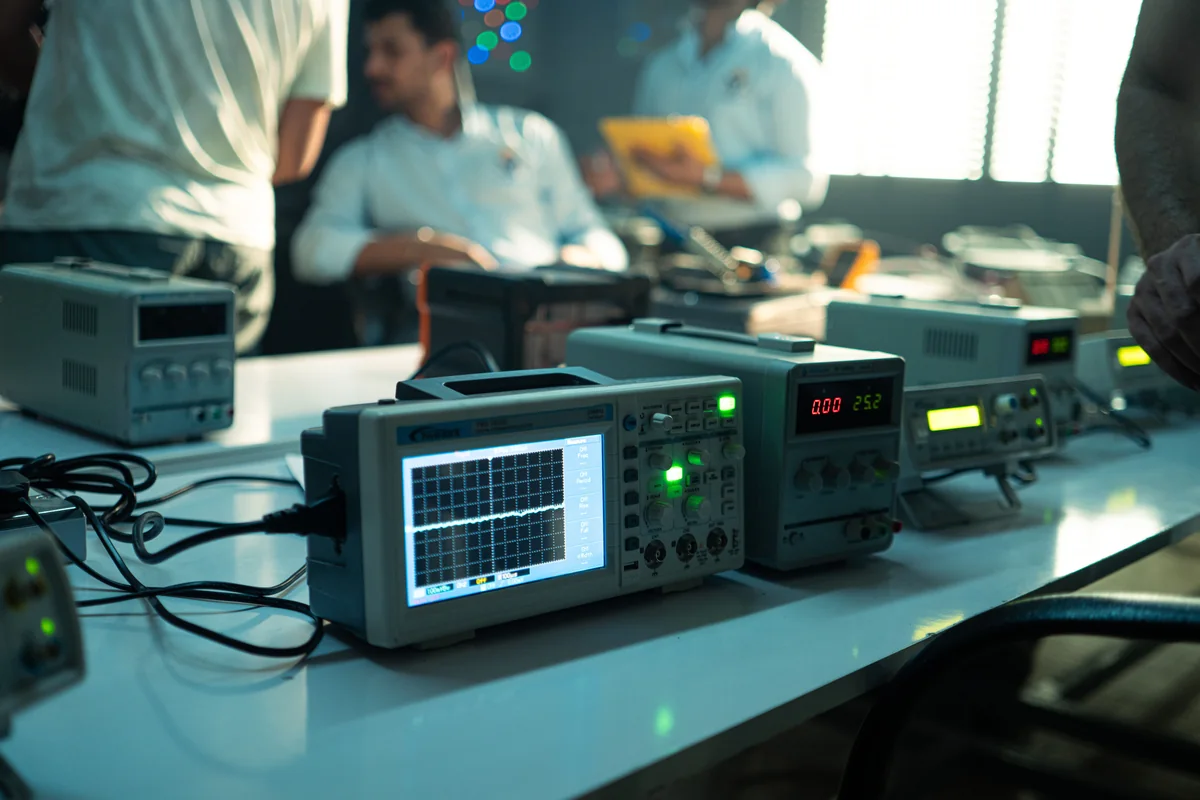
A serious plant tour takes roughly two hours if you actually stop and ask for records. Ours runs about 120 minutes across eight stations — and the value is not in seeing machines, it is in seeing the log behind the machine. Any supplier can show you a soldering iron. Only a real factory can show you calibration stickers and AQL reports.
Tooling and mould room
Who owns the die? Where are the Foton and 3D files stored? Who is allowed to modify them? Ask for the maintenance log. A mould that has run 200,000 shots without maintenance will produce out-of-tolerance housings, and housings that do not seal are the number one cause of field failures in damp retail ceilings.
SMT and driver assembly
In-house or subcontracted? If subcontracted, which line, and can you see a lot code that ties a finished fixture back to a PCB batch? Traceability is what lets the factory answer “which units are affected” instead of replacing an entire shipment.
Integrating sphere and goniophotometer
Own lab or third party? What is the calibration interval on the sphere — 12 months is standard. If the factory has no sphere, every optical claim it makes is a copy of someone else’s data, and any custom optic you request is unverified.
Aging and burn-in racks
Ask the burn-in duration and whether it is 100% or sampled. A 4-hour sample burn-in will not surface the infant-mortality failures that annoy a retailer in month two. Our own racks hold 100% of production for 8 hours before packing.
Hi-pot and earth continuity
Every unit or AQL sampled? Is the log kept with a timestamp and operator ID? This is the station that decides whether your shipment clears a US inspector’s attention.
Powder coat and finishing
Salt-spray test hours, and the colour-delta tolerance the factory will hold against your approved sample. Without a stated ΔE tolerance, “matte black” on the tenth container will not match the first.
QC gates and AQL records
What AQL level, and who signs the inspection report? Ask to see a completed report from last month, not a blank template. A factory that cannot show a signed report has no QC system, only a QC person.
Packing and drop test
Drop height, cycles, and carton burst strength. Track heads show up at retail with dented bezels and snapped yokes because the inner pack was designed for a shorter drop. This is also where private-label cartons get their structure — see the branding section of our track lighting OEM RFQ guide for the packing spec to put in writing.
Certification: What a US Importer Must Demand in Writing
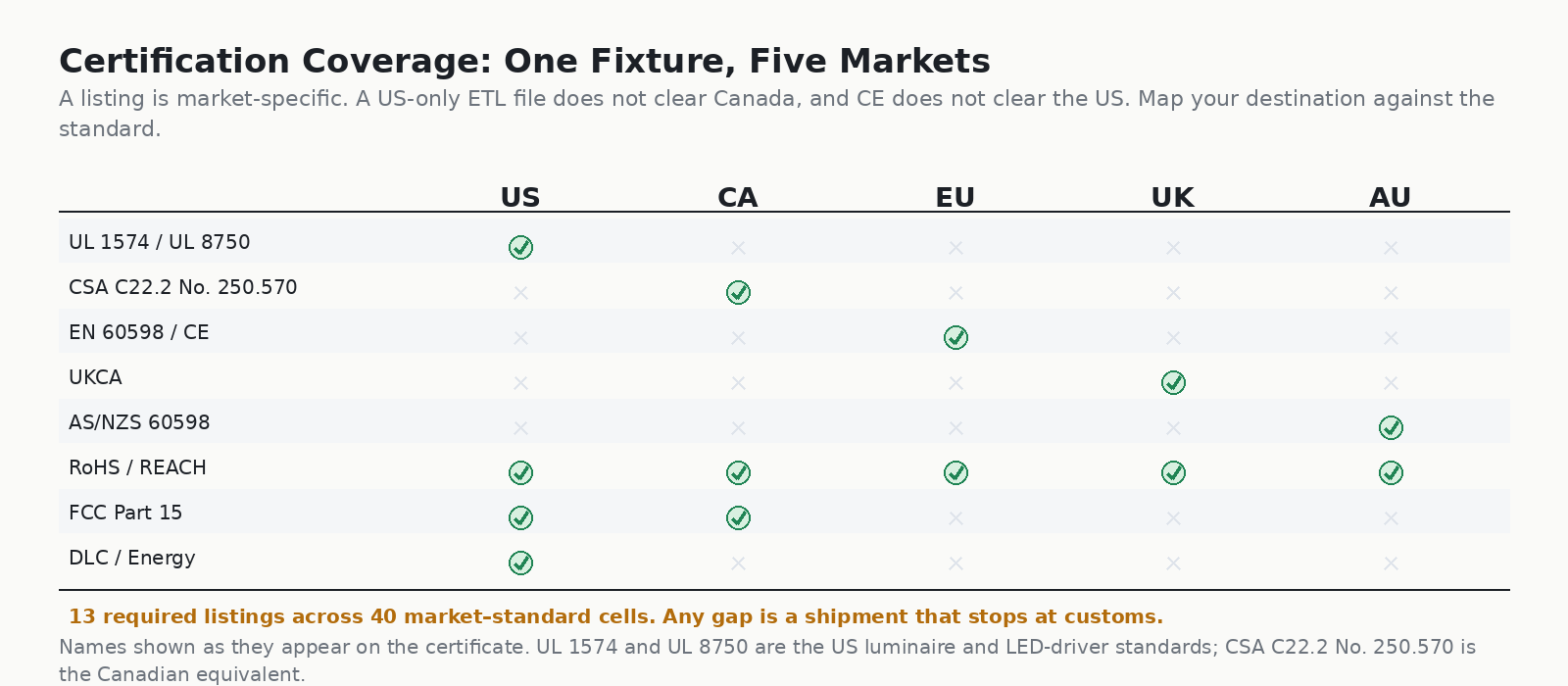
Electrical listings are market-specific, and this is where the most expensive misunderstandings happen. A US-only ETL file does not clear Canada. A CE declaration does not clear the US. If your fixture ships to a three-market distribution, it needs three-market coverage, and the factory should be able to name the standard behind each one.
| What to ask for | Why it matters | Red flag |
|---|---|---|
| The file / control number, not just the logo | It is the only way to look the listing up independently | Only a watermark or a cropped logo image |
| The exact standard cited | UL 8750 covers the LED driver; UL 1574 covers the luminaire — you need both | “UL approved” with no standard number |
| Model number matching your PO | Suffixes (−D, −2, /W) are separate filings | The certificate covers a “family” that never lists your model |
| Listing status field | Revoked and expired files stay published for years | No status, or “pending” for the market you ship to |
| Factory audit report from the listing body | An NRTL listing includes periodic factory surveillance | Factory cannot name its last surveillance date |
If your project also touches Canada, read the mark carefully — the difference between the US and Canadian marks is worth its own article, and we wrote one: ETL vs cETL certification: what’s the difference. For the combined US/Canada mark, the cETLus certification guide covers what the cETLus mark actually covers and how to verify it before you order.
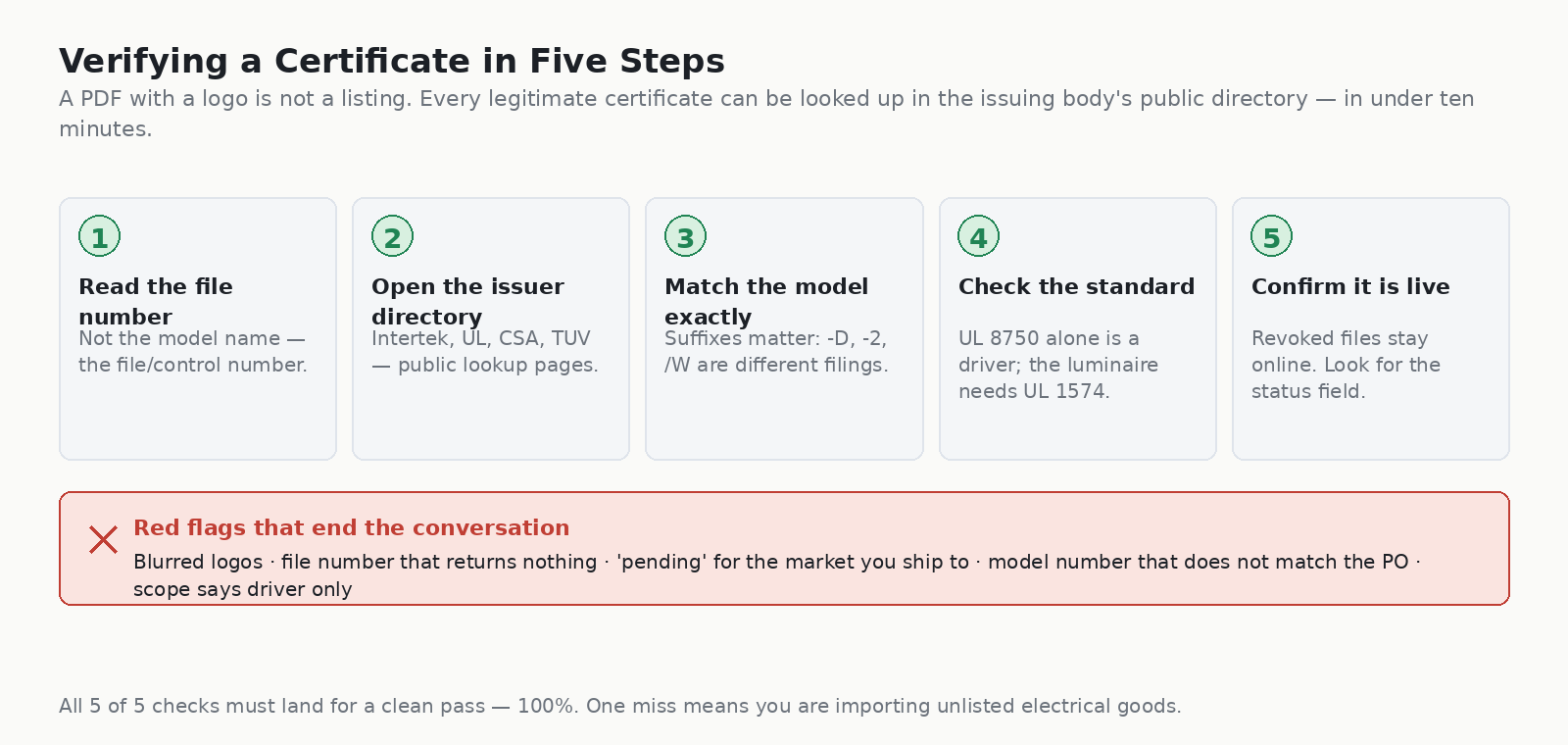
Verify a certificate in five steps
A PDF with a logo is not a listing. Every legitimate certificate can be looked up in the issuing body’s public directory, and the whole check takes under ten minutes. Run all five before you release a deposit.
It is also worth knowing where the testing actually happens. Intertek, UL, CSA Group and TÜV all operate accredited laboratories in mainland China, which is why a well-managed Chinese factory can hold US and Canadian listings without shipping samples abroad. The trade-off is that the certificate is issued to a specific factory at a specific address — if your supplier moves production to a different site, the listing does not travel with it.
See the factory, and see the paperwork
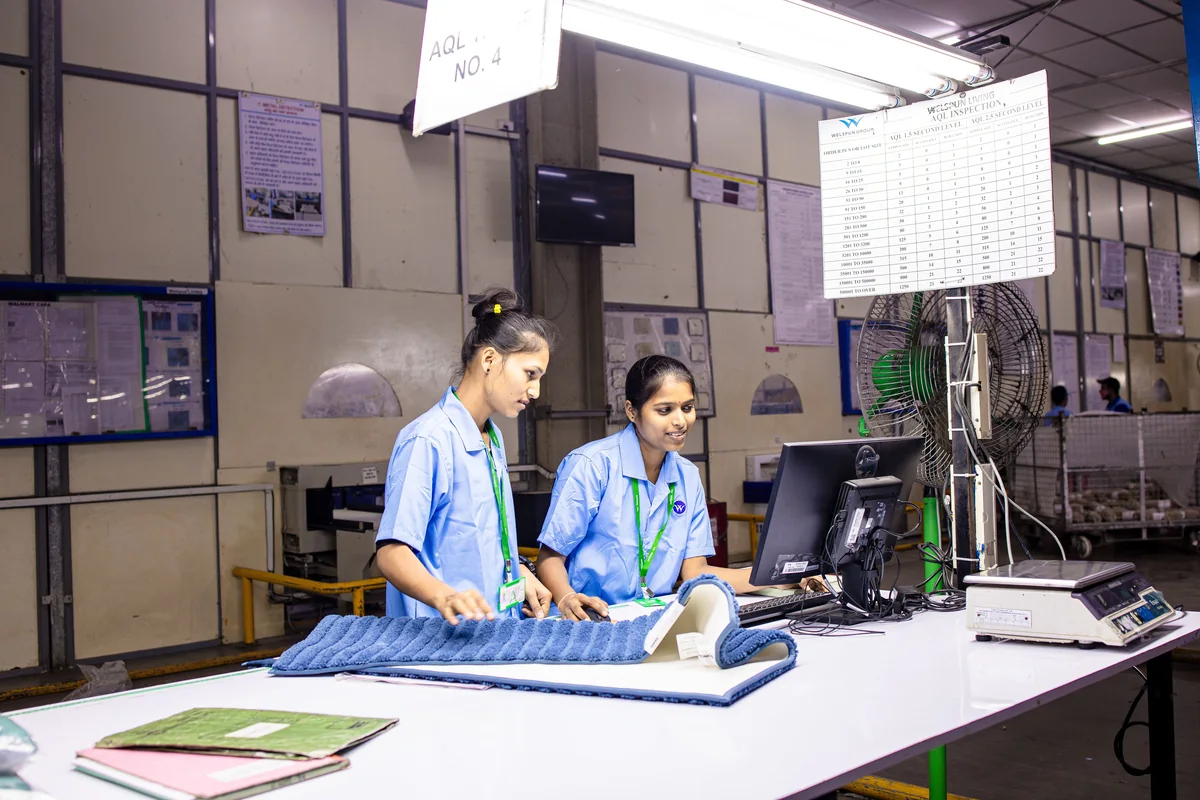
Ask to photograph three things on the wall: the AQL chart, the calibration certificate of the light meter, and the QC organisation chart. Those three documents tell you more about the plant’s real process discipline than any showroom.
The Sample Loop: 42 Days, Three Rounds, Measured Every Time
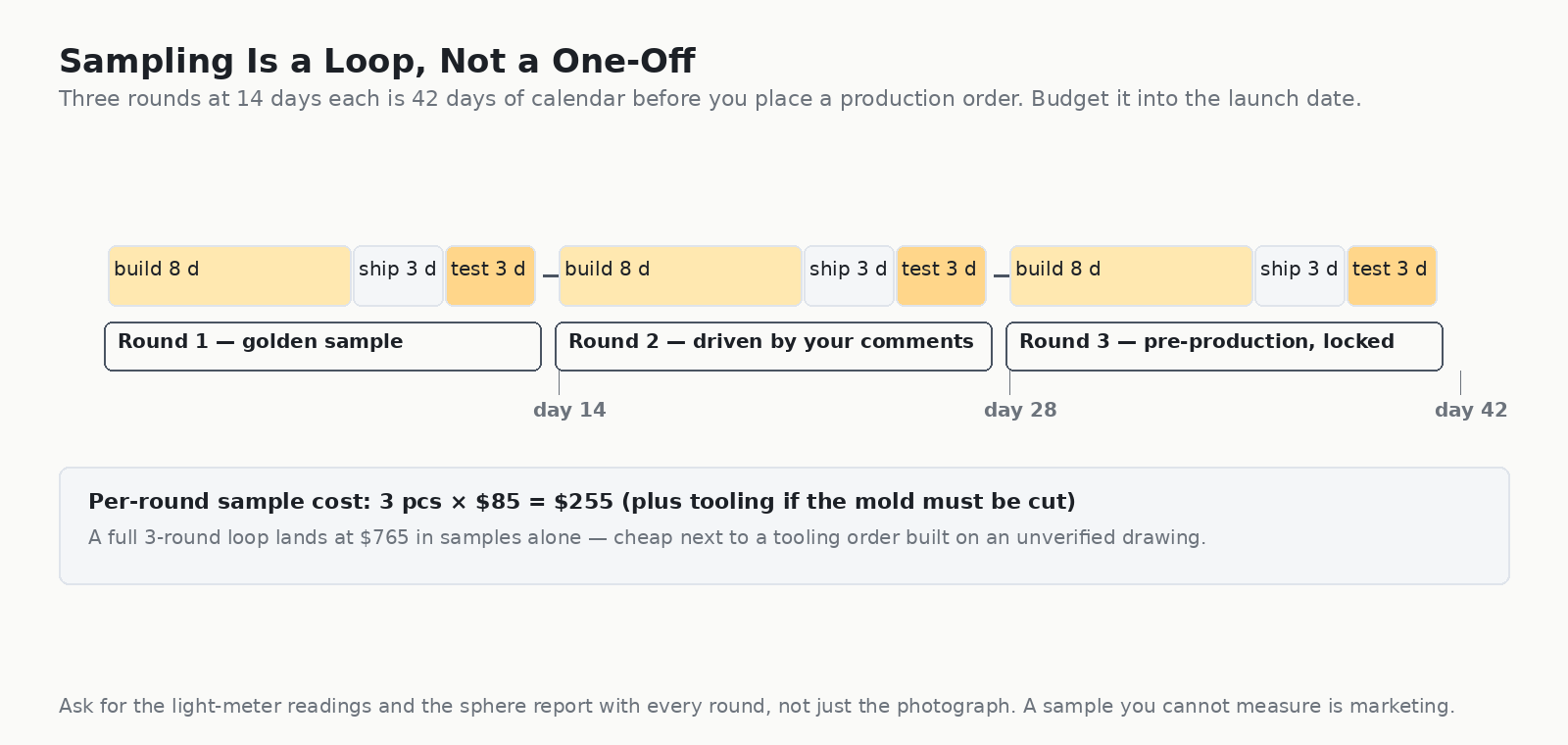
Sampling is not a one-off. It is a loop, and each turn exists to kill a specific class of risk. Budget roughly six weeks of calendar before a production order, and insist on measurement data with every round — a photograph of a glowing fixture tells you nothing about beam angle, CCT drift or flicker.
| Round | What it proves | What you must receive |
|---|---|---|
| Round 1 — golden sample | That the factory can build to your specification at all | Sphere report, lux readings at your specified throw distance, CCT and CRI measurement, driver photo |
| Round 2 — comment-driven | That the factory can change the design without losing optical performance | Revised datasheet with the new values, not the old one re-dated |
| Round 3 — pre-production | That the tooling, the driver and the label are all frozen | Signed golden-sample approval, packing artwork proof, label copy in your market’s language |
Sample cost is not the number to optimise
At a typical $85 per unit and three pieces per round, a full loop costs a few hundred dollars. That is noise next to the cost of cutting a mould based on an unverified drawing. Pay for the samples, pay for the freight, and pay for your own third-party re-test if the optical numbers are load-bearing for your project — the whole point of the loop is to spend small money early to avoid spending large money later.
What to measure yourself
At minimum, measure illuminance at the throw distances your project actually uses, the CCT at 100% and at 10% dim, and flicker depth at the dimming levels a phone camera will capture. Dim-to-off behaviour is the single most common complaint in OEM track projects because it is specified as a range and never verified at the bottom of that range. Our lux vs lumens explainer covers why the lumen figure on the box is not the number your client will perceive.
Terms, Compliance Risk and the Paperwork That Outlives the Order
Commercial terms decide what happens when something goes wrong, which is precisely when the relationship is tested. Four clauses are worth arguing over before you sign.
Tooling ownership and the exit clause
State explicitly that the mould is your property, that it will be marked with your asset ID, that it is stored at a named address, and that it will be handed over — or destroyed with photographic proof — if the relationship ends. A factory that refuses an exit clause is telling you the mould is its leverage over you.
Standard sample and AQL
Attach the approved sample as a contractual standard and name the AQL level per defect class. “Reasonable quality” is not enforceable language; “critical 0, major 0.65, minor 1.5” is.
Labelling for your market
The country of origin, the importer’s name and address, the electrical rating, and the applicable safety mark all have to be on the product or the packaging in the form your regulator expects. This is also where private labelling becomes a compliance question, not just a branding one — your logo on the housing makes you the responsible party in the eyes of a customs officer.
Warranty, and who pays for the field failure
Ask what the warranty covers: the fixture, the driver, the labour, or the freight. A five-year housing warranty paired with a two-year driver warranty is a two-year product. Also ask for the failure-rate history of the exact model you are buying — a factory that tracks field returns will have this number; one that does not will answer with adjectives.
Shipping terms and the documents you will need
Confirm Incoterms, then confirm who prepares the commercial invoice, the packing list, and the declaration that the goods meet the listing they claim. For US importers, get the US Customs and Border Protection import requirements in front of you before the first shipment rather than after, and treat the safety listing as a precondition — not a shipping detail.
Five Questions That Expose a Weak Factory in One Call
- “Send me the file number on the US listing for this model.” A real factory answers in minutes. A trading company asks why you need it.
- “Which station takes the lux measurement, and can I watch it run?” Watch for a factory that describes a process it does not have.
- “What is your AQL level, and who signs the report?” Listen for a number and a job title, not a promise.
- “Can you change the driver firmware, and who owns that code?” The answer determines whether your dimming spec is yours or your supplier’s.
- “Give me one reference customer in my market.” Then actually call them and ask about the third shipment, not the first.

For the full specification checklist to attach to your first enquiry, our track lighting OEM RFQ guide walks through every field a factory needs to quote accurately — including the optical, driver and packaging sections that get skipped.
Frequently Asked Questions
What should I ask a Chinese track lighting OEM factory before placing an order?
Ask for four things: the tooling ownership clause, the file number on the certification listing for your exact model, an integrating-sphere report for the model being quoted, and one reference customer in your destination market. If a supplier can produce all four within a day, you are dealing with a manufacturer. If any of them is deferred or replaced with a photograph, you are probably dealing with a trading company.
How do I verify a Chinese factory’s UL or ETL certification is real?
Take the file or control number from the certificate, open the issuing body’s public directory — Intertek, UL, CSA Group or TÜV all publish lookup tools — and confirm that the model number matches your PO exactly, that the standard cited covers the luminaire and not only the driver, and that the listing status is current. Blurred logos, missing file numbers and “pending” status for your market are all disqualifying. Never accept a certificate image as the only evidence.
Which certifications does a track light need to be imported into the US?
For a line-voltage track luminaire, a US safety listing under the UL 1574 luminaire standard, plus UL 8750 for the LED driver equipment, is the baseline that inspectors, insurers and electrical contractors expect. Magnetic low-voltage systems need the corresponding low-voltage listing. If your catalogue also claims energy savings, DLC listing is a separate filing, and if you ship to Canada you need Canadian coverage as well — the marks are not interchangeable.
How long does custom track lighting OEM sampling take?
Budget about 42 days for a three-round loop: roughly 14 days per round split into build, freight and in-house measurement. A modification to an existing ODM platform is faster; a fully custom housing with new tooling is longer, and adding a new market listing on top of that can add several more weeks because the test sample is the production sample. Plan the listing into the schedule, not after it.
Can I get my own brand on a Chinese factory’s track lighting?
Yes, and private labelling is routine — logo on the housing, driver label, carton, spec sheet and instruction manual. Two cautions. First, get the exit clause on tooling in writing. Second, remember that putting your brand on the product makes you the responsible party for the listing and the labelling in your market, so demand the certification evidence under your brand and model number, not the factory’s own.
Include the Lamp in the Room, Not Just the Fixture in the Carton
Everything above is about de-risking the supply chain. The last question is the one most OEM buyers skip: what does the fixture do in the room you are lighting? A track head that meets every electrical requirement but throws a 12° beam at a 3 m ceiling will still fail your client’s space.
That is why our spec sheets lead with the numbers we actually specify on site — beam angle, CCT, CRI and throw distance — rather than a single lumen figure. If you are sourcing for retail, gallery, hospitality or office projects, start from the track light range and then work backwards into the OEM conversation with a beam angle already in mind. When you are ready to talk tooling, volumes and listings, send us your RFQ — we will answer with a file number, not a brochure.
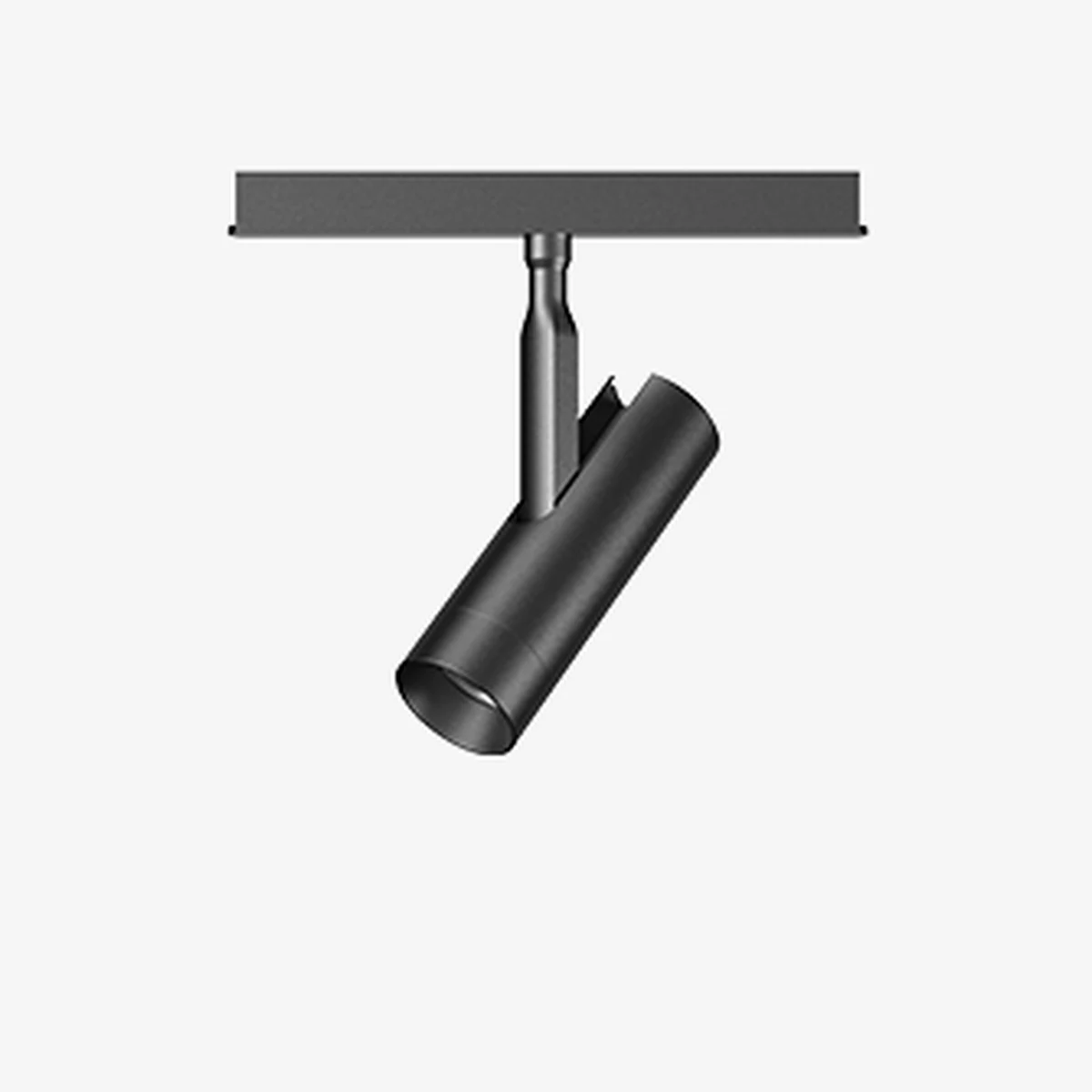
| Encore track range | Where it fits an OEM programme |
|---|---|
| VEGA-01 magnetic track heads | 24/48 V DC flexibility for gallery and retail reconfigurations |
| Zoomable VEGA spots | One SKU covering 15°–50°, cutting your inventory while keeping one optic |
| CADIO track lights | Line-voltage retail and commercial permanence with interchangeable optics |
| Cylinder and linear pendants | Vertical accents and architectural lines in hospitality and office work |
| Motorised and remote-controlled heads | High-end retail and showroom aiming without a lift |
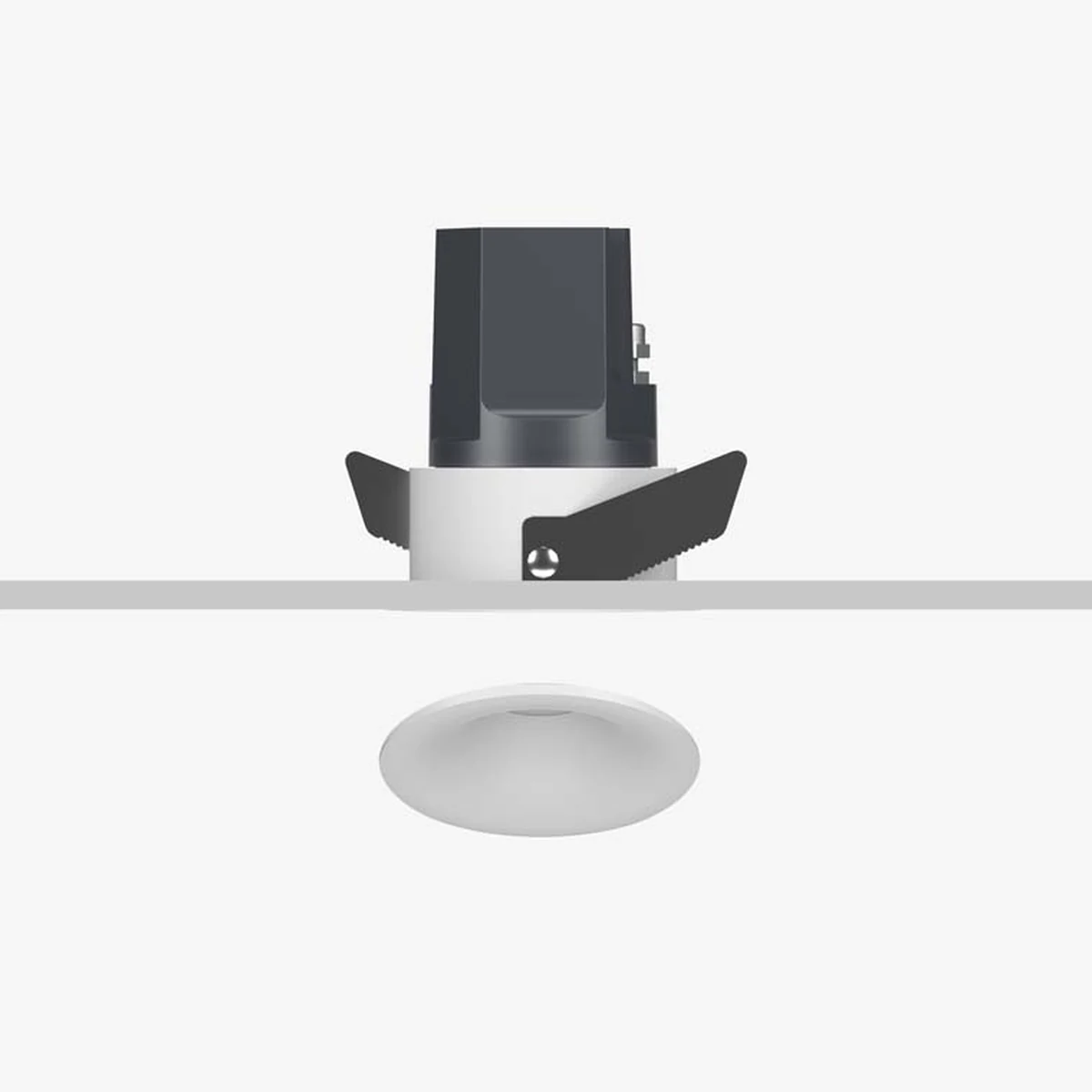
If your programme spans multiple fixture families, the magnetic track systems and line-voltage track range are tooled on shared driver and optic platforms, which means one certification file can cover a family instead of one SKU. That single fact is usually worth more to an importer than any discount on the unit price.